What you'll learn
- What “writing to inform” means in GCSE English Language.
- How to choose clear, relevant detail for your reader.
- How to organise information using paragraphs, headings and logical order.
- How to keep a neutral or semi-formal tone while still sounding confident.
Where this fits in AQA English Language
AQA GCSE English Language has two papers. Each paper is 1 hour 45 minutes, worth 80 marks and 50% of the GCSE. Reading questions are in Section A; writing questions are in Section B. Every question is compulsory.
In Paper 2 Section B, you complete one 40-mark writing task. The marks are split into 24 marks for content and organisation, assessed through AO5, and 16 marks for technical accuracy, assessed through AO6.
Writing to inform
Writing to inform means giving the reader useful information in a clear, organised and appropriate way. Your main aim is not to entertain, shock or aggressively persuade; it is to help the reader understand something.
The main goal
A strong informative response feels useful. The reader should finish knowing more than they did at the start, without having to work hard to follow your ideas.
Use this six-part checklist whenever a task asks you to inform.
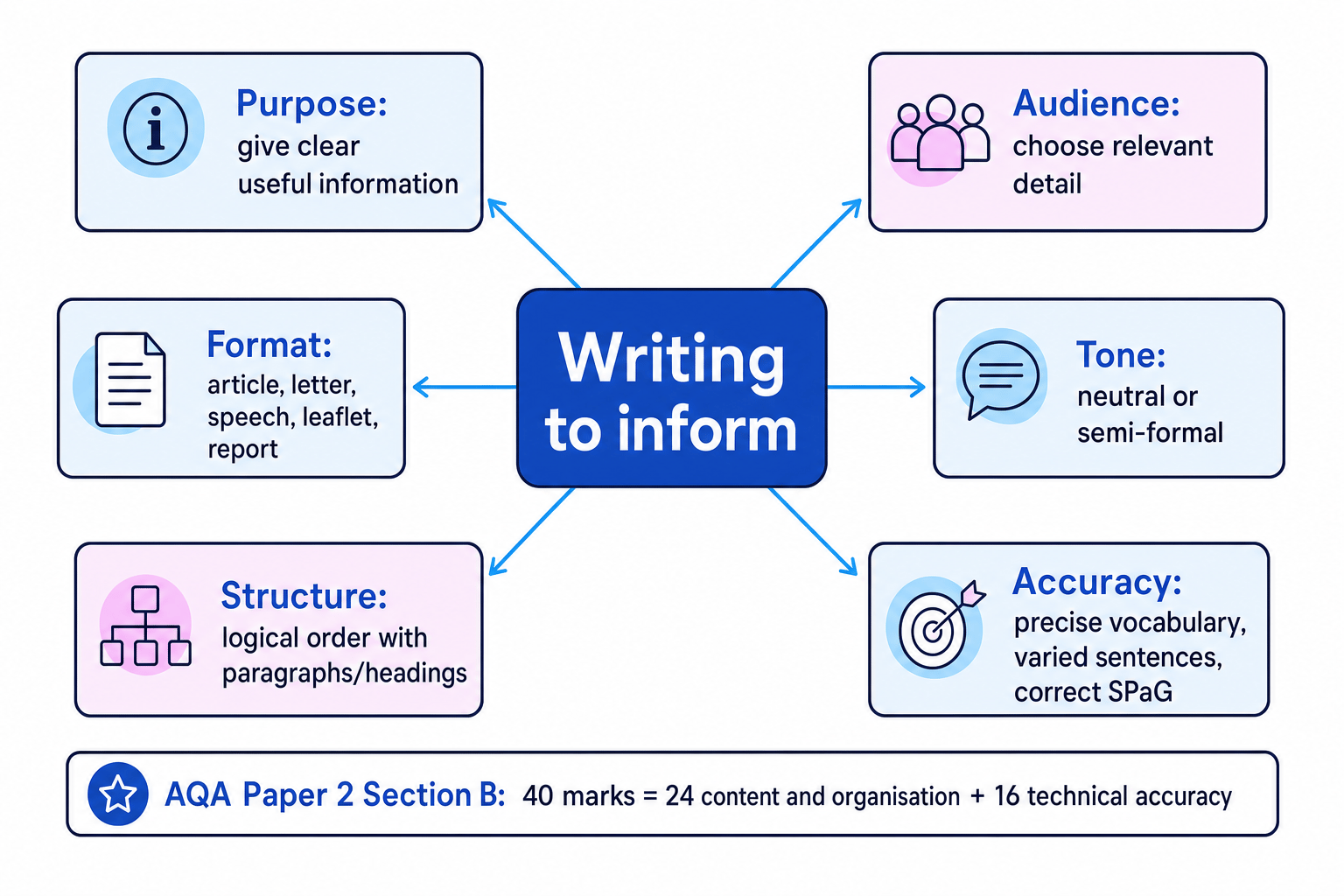
1. Start with purpose, audience and form
Before you write, you need to understand what the task is asking you to produce.
Purpose, audience and form
- Purpose means why you are writing: for example, to inform, explain, argue or persuade.
- Audience means who the writing is aimed at: for example, students, parents, local residents or newspaper readers.
- Form means the type of text you are writing: for example, an article, letter, speech, leaflet, report or website post.
These three choices control everything else: your vocabulary, tone, level of detail and structure.
Turning a task into writing decisions
Suppose the task is: Write a leaflet for new Year 7 students informing them about how to use the school library.
-
Use the audience to decide what they need. New Year 7 students may feel unsure, so they need practical, reassuring information: where the library is, when it opens, how to borrow books and who can help.
-
Use the purpose to control the content. Because the purpose is to inform, the leaflet should focus on useful facts and instructions, not long personal opinions about reading.
-
Use the form to choose layout features. A leaflet can use a clear title, short sections and headings such as “Opening times”, “Borrowing books” and “Getting help”.
-
Use the tone to sound suitable. The response should be friendly and semi-formal: clear enough for younger students, but not slangy or patronising.
2. Choose relevant detail
Relevant detail
Relevant detail is information that directly helps the reader understand the topic or take the next step. It is not just any fact you can think of.
A good way to plan informative writing is to ask the six basic information questions:
- Who is involved?
- What is happening or being explained?
- Where does it happen?
- When does it happen?
- Why does it matter?
- How can the reader act, join in or understand it?
You do not always need all six, but they help you avoid vague writing.
Fact dumping
Do not throw in random facts just to sound detailed. Information should be selected and grouped so the reader can actually use it.
Selecting useful information
Suppose you are writing an article informing parents about after-school revision sessions.
-
Identify the reader’s likely questions. Parents may want to know when sessions run, which subjects are covered, whether students need to sign up and how the sessions help.
-
Keep information that answers those questions. Useful details might include days of the week, the location, the subjects available and the type of support offered.
-
Reject information that distracts from the purpose. A long history of the school building or a dramatic complaint about exams would not help parents understand the revision sessions.
-
Group the details logically. You could use sections such as “When and where”, “What students can expect” and “How parents can support attendance”.
3. Structure: guide the reader through the information
Structure and cohesion
Structure means the order and shape of your whole response. Cohesion means how clearly your ideas connect from sentence to sentence and paragraph to paragraph.
For informative writing, structure should feel easy to follow. You are not trying to hide the point or create a mystery. You are guiding the reader.
Useful structures include:
- Most important first: good for notices, leaflets and urgent information.
- Chronological order: useful when explaining a process or event in time order.
- Question-and-answer order: useful for leaflets, websites and advice pieces.
- Problem-solution order: useful when explaining an issue and what can be done.
A basic structure might look like this:
- Opening: introduce the topic and why it matters.
- Middle paragraphs: give grouped information, one main idea per paragraph.
- Ending: summarise the key message or give the reader a clear next step.
Paragraph rule
Begin each paragraph with a clear topic sentence: a sentence that tells the reader what that paragraph is mainly about.
Headings and subheadings
A heading is a short title for a whole text or section. A subheading is a smaller heading used to divide a text into sections.
Headings are helpful in leaflets, reports, webpages and some articles. They are less suitable in a speech, where spoken signposting works better: for example, “The first thing to know is…” or “Another important point is…”
Using headings instead of development
Headings can organise information, but they do not earn marks by themselves. You still need developed paragraphs with clear, relevant detail.
Building a clear order
Suppose you are informing local residents about a new community garden.
-
Choose the most useful opening information. Residents first need to know what the garden is and where it will be, so the opening should make that clear immediately.
-
Group the body paragraphs by reader need. One paragraph could explain the purpose of the garden, another could explain how residents can use it, and another could explain volunteering or opening times.
-
Place practical action near the end. If readers need to sign up, attend a launch event or contact someone, that information works well in the final paragraph because it leaves them with a next step.
-
Add linking phrases to create cohesion. Phrases such as “In addition”, “For younger visitors” and “To get involved” show how the sections connect.
4. Tone: neutral or semi-formal
Tone and register
Tone means the attitude or voice of your writing. Register means the level of formality. A semi-formal register is polite and clear, but not stiff or old-fashioned.
Writing to inform usually needs a neutral or semi-formal tone. Neutral does not mean boring. It means you avoid exaggeration, insults and dramatic pressure. You can still sound warm, confident and helpful.
Compare these two sentences:
- Too pushy: “You’d be crazy not to join because this club is absolutely life-changing!”
- Informative: “Students can join the club at any point during the term, and weekly sessions provide practical support from staff and older pupils.”
The second sentence gives clearer information and sounds more trustworthy.
Adapting tone for an audience
Original sentence: Loads of people mess up revision because they leave everything way too late.
-
Remove slang or over-casual phrasing. “Loads of people” and “mess up” may sound too informal for parents or a school article.
-
Keep the useful idea. The main information is that revision is more effective when it starts early.
-
Choose precise, calm vocabulary. A better phrase would be “Many students find revision more manageable when they begin early.”
-
Shape it into an informative sentence. Final version: “Many students find revision more manageable when they begin early, as shorter regular sessions can reduce pressure before exams.”
5. Factual style and clarity
Factual style
A factual style presents information as clear, believable and specific. It uses precise details, sensible examples and controlled vocabulary rather than wild claims.
In the exam, you may invent details for your writing task, but they should sound plausible. Avoid fake statistics that seem too exact or unbelievable, such as “97.83% of students agree”, unless the task gives you that information.
Clear informative writing often uses:
- Precise nouns: “revision timetable” instead of “thing”.
- Active verbs: “students collect a pass” instead of “a pass is collected by students”.
- Specific examples: “maths, science and English sessions” instead of “lots of subjects”.
- Discourse markers: words and phrases such as “firstly”, “as a result”, “however” and “for example” that show how ideas connect.
Making vague writing informative
Vague sentence: There are lots of things at the centre and it is good for people.
-
Replace vague nouns with precise ones. “Things” could become “study rooms, sports clubs and advice sessions”.
-
Explain who benefits. “People” could become “students who need a quiet place to work or support with homework”.
-
Add a clear reason. Instead of saying “it is good”, explain the benefit: it helps students work independently and ask for help when needed.
-
Write the improved version. “The centre offers study rooms, sports clubs and advice sessions, giving students a quiet place to work independently and ask for help with homework.”
6. Technical accuracy: AO6 supports the message
Technical accuracy means accurate spelling, punctuation, grammar and sentence control. In AQA Section B, this is worth 16 of the 40 marks, so it matters a lot.
For writing to inform, punctuation should make the information easier to follow. For example:
- Use full stops to avoid overlong sentences.
- Use commas to separate extra information clearly.
- Use a colon to introduce a list or explanation.
- Use brackets sparingly for brief extra detail.
Varied sentence structures also help. A short sentence can highlight an important fact. A longer complex sentence can explain how or why something happens. The key is control: do not make sentences long just to sound impressive.
Clarity before cleverness
If a sentence becomes confusing, split it. Examiners reward controlled communication more than overcomplicated writing.
A mini model of informative style
Here is a short example of the kind of writing you might aim for:
Revision support is available every Tuesday and Thursday in the library from 3.15pm to 4.15pm. Students can attend for help with English, maths and science, or they can use the space for quiet independent study. No booking is needed, but students should bring the work they want to focus on so that staff can give targeted advice.
Notice how it gives practical information, uses a calm tone and keeps the reader’s needs in mind.
In the exam
- Read the task carefully and identify the form, audience and purpose before you start writing.
- Spend a few minutes planning four or five clear sections using the questions who, what, where, when, why and how.
- Put the most useful information early, then group related details into clear paragraphs.
- Use headings only when they suit the form; use spoken signposting instead if writing a speech.
- Leave time to check spelling, punctuation, sentence boundaries and whether your tone stays neutral or semi-formal.
Check yourself
- Can you explain the difference between informing and persuading?
- Can you choose details that are relevant to a specific audience?
- Can you organise an informative response using clear paragraphs, topic sentences and suitable headings?
