What you'll learn
- What “writing to advise” means in GCSE English Language.
- How to sound supportive, practical and encouraging without becoming bossy.
- How to use direct address, balanced warnings and clear suggestions.
- How this skill links to Paper 2 Section B marks for AO5 and AO6.
Where this fits in AQA GCSE English Language
In AQA GCSE English Language 8700, writing tasks appear in Section B of each paper. Paper 2 Section B is viewpoint writing: you are asked to communicate a point of view for a specific audience, purpose and form.
Paper 2 is 1 hour 45 minutes, worth 80 marks and 50% of the GCSE. The writing task is compulsory and worth 40 marks: 24 marks for AO5 — clear, effective communication and organisation — and 16 marks for AO6 — vocabulary, sentence structures, spelling and punctuation.
Writing to advise
Writing to advise means guiding the reader towards sensible choices. You give practical suggestions, explain why they help, warn about risks in a balanced way, and encourage the reader to act.
Advice guides, not orders
The best advice sounds like a calm, knowledgeable guide beside the reader — not like someone shouting instructions from above.
Start with purpose, audience and form
Before you write, identify three basics.
Purpose means why you are writing. In this topic, your purpose is to advise.
Audience means who you are writing for. Advice for Year 7 students will sound different from advice for parents, teachers or local residents.
Form means the type of writing, such as a letter, article, speech, leaflet or essay. The form affects your layout, greeting, ending and level of formality.
Planning from purpose, audience and form
Imagine the task is: Write an article for your school website advising new Year 7 students on how to settle in.
-
Purpose: The key verb is advising, so your writing should offer guidance rather than simply argue, entertain or describe.
-
Audience: The readers are new Year 7 students, so the tone should be reassuring, clear and not patronising. They may feel nervous, so you should acknowledge that.
-
Form: It is an article, so you could use a heading, an engaging opening, clear paragraphs and a final encouraging comment.
-
Content choices: Useful advice might include asking for help, organising equipment, joining clubs and being patient with yourself.
-
Overall approach: A strong response would move from reassurance, to practical steps, to a gentle warning, to encouragement.
The advising voice: supportive and calm
Tone means the attitude your writing creates. In advice writing, your tone should usually be supportive, measured and respectful.
A supportive tone avoids making the reader feel stupid. Instead of saying, “You are making a mistake if you panic,” you could write, “It is completely normal to feel uncertain at first, but small routines can make the change feel much easier.”
Notice the difference: the second version still gives advice, but it does not blame the reader.
A simple tone test
After writing a sentence, ask: Would this make the reader feel helped or judged? If it sounds judgemental, soften it with phrases such as “try”, “you might”, “one useful step is” or “it can help to”.
Direct address: speaking to the reader
Direct address means speaking directly to the reader using words such as you and your. It is useful in advice because it makes the writing feel personal.
For example:
- “You may feel overwhelmed at first.”
- “Your first week does not have to be perfect.”
- “If you are unsure, ask someone before the problem grows.”
You can also use inclusive pronouns, such as we and us, to create a sense of shared experience: “We all need time to adjust to new situations.”
Be careful, though. Too much “you must” can sound aggressive. Advice usually works better with modal verbs.
Modal verbs
Modal verbs are verbs such as could, should, might, can and must. They show possibility, advice, ability or necessity.
In advice writing, could, might and should often sound more helpful than constant must.
Sounding too bossy
A common mistake is writing advice as a list of commands: “Do this. Don’t do that. You must…” This can become harsh. Mix gentle modal verbs with clear explanations so the reader understands the reason behind the advice.
Practical suggestions: make the advice useful
Advice needs to be more than vague encouragement. A practical suggestion is an action the reader could realistically take.
Weak advice: “Be more organised.”
Stronger advice: “Pack your bag the night before, check your timetable, and keep a spare pen in your blazer or pencil case.”
The stronger version works because it gives specific, manageable actions.
Turning vague advice into practical advice
Suppose you want to advise students not to leave homework until the last minute.
-
Identify the vague idea: “Manage your time better” is sensible, but it is too general to be very useful.
-
Choose one realistic action: A student could write homework deadlines into a planner or phone calendar on the day they are set.
-
Add a reason: This helps because the task is less likely to be forgotten and can be broken into smaller stages.
-
Shape it into advice: “When homework is set, write the deadline down straight away and decide which evening you will start it. That small habit prevents a stressful rush the night before it is due.”
Balanced warnings: be honest, not dramatic
A warning tells the reader about a possible problem. A balanced warning does this without exaggerating or frightening the reader unnecessarily.
For example, in advice about social media:
- Too dramatic: “If you use your phone too much, your life will be ruined.”
- Balanced: “If your phone is beside you while you work, it can easily break your concentration, so try leaving it in another room for short revision sessions.”
Balanced warnings often use conditional sentences — sentences built around “if” and a result.
Example: “If you ignore small problems, they can become harder to solve later.”
Adding a balanced warning
Imagine you are advising someone who is nervous about joining a new club.
-
Name the risk without exaggeration: The reader might avoid going because the first session feels awkward.
-
Explain the consequence realistically: If they give up immediately, they may miss the chance to make friends or develop confidence.
-
Add reassurance: Feeling awkward at first is normal and usually improves after a few sessions.
-
Write the advice: “If the first session feels uncomfortable, do not decide immediately that the club is not for you. New groups often feel strange at the beginning, so give yourself two or three visits before making a final decision.”
Encouraging language: help the reader feel capable
Encouraging language reassures the reader that improvement is possible. It does not pretend everything is easy; it makes the next step feel achievable.
Useful phrases include:
- “Start with one small change…”
- “You do not need to solve everything at once…”
- “It is normal to feel…”
- “A sensible first step would be…”
- “Over time, this can help you…”
You can also use rhetorical questions. A rhetorical question is a question asked for effect, not because you expect an answer. In advice writing, rhetorical questions can show that you understand the reader’s worries: “Worried that you will not fit in straight away?”
Use them sparingly. One thoughtful rhetorical question is better than a whole paragraph of questions.
Organising an advice response
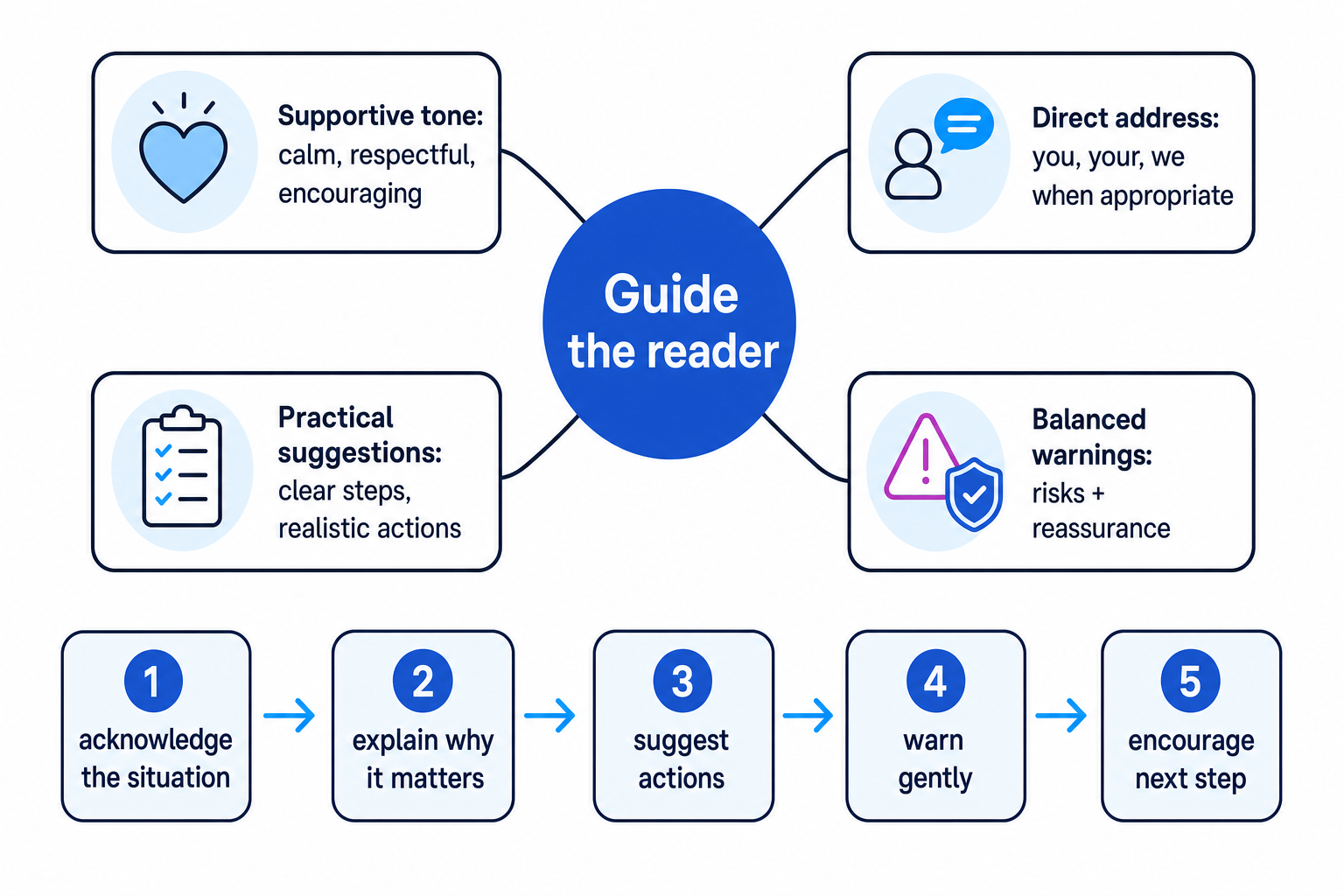
A strong advice response usually follows a helpful journey:
- Acknowledge the reader’s situation.
- Explain why the issue matters.
- Offer practical suggestions.
- Include a balanced warning.
- End with encouragement.
This structure helps you meet AO5 because your writing is clearly shaped for the reader.
One useful paragraph pattern is CARE:
- Concern: show you understand the reader’s situation.
- Advice: give a specific suggestion.
- Reason: explain why it helps.
- Encouragement: leave the reader feeling able to act.
Building an advice paragraph
Topic: advising students on managing screen time while revising.
-
Choose the concern: The reader may intend to revise but keep getting distracted by notifications.
-
Select a practical action: Put the phone in another room for a short, timed revision session.
-
Explain the reason: Removing the phone reduces temptation and makes concentration easier.
-
Add a balanced warning and reassurance: Warn that “just checking” can become a long distraction, but reassure the reader that short breaks are still allowed.
-
Combine the parts: “If your phone keeps interrupting your revision, try leaving it in another room for twenty minutes at a time. This does not mean cutting yourself off completely; it simply gives your mind a fair chance to focus. Be careful with ‘just checking’ one message, because it can quickly become ten minutes of scrolling. After a focused session, reward yourself with a short break.”
Language choices that suit advice
For AO6, your vocabulary and sentence structures matter. Aim for control and variety.
Try using:
- Clear topic sentences to introduce each paragraph’s advice.
- Discourse markers such as “firstly”, “more importantly”, “however”, “as a result” and “finally” to link ideas.
- Varied sentence openings, such as “If you feel…”, “When this happens…”, “One useful approach is…” and “Instead of…”
- Precise verbs, such as “prepare”, “prioritise”, “reduce”, “avoid”, “discuss” and “reflect”.
Punctuation should support clarity. Commas can separate opening phrases: “When you feel under pressure, take a moment to decide what matters most.” A colon can introduce advice: “Try this simple routine: plan, act, review.”
Balance warmth with authority
The examiner should feel that you know what you are talking about, but the reader should feel that you are on their side.
Mini toolkit for advising phrases
You can adapt these to many tasks:
- “It is understandable if…”
- “One realistic first step is…”
- “You might find it helpful to…”
- “Try to avoid… because…”
- “If this happens, do not panic; instead…”
- “The important thing is not perfection, but progress.”
- “By taking this step, you give yourself a better chance to…”
These phrases help you move beyond simple commands and into thoughtful guidance.
In the exam
-
Spend a few minutes identifying the purpose, audience and form before you write; this keeps your advice focused.
-
Aim for a clear structure: acknowledge the issue, give practical suggestions, include balanced warnings, and end encouragingly.
-
Check that you are earning both sets of marks: AO5 for clear, organised communication and AO6 for accurate spelling, punctuation, vocabulary and sentence variety.
Check yourself
- Does your advice sound supportive rather than bossy?
- Have you included specific, realistic actions the reader could take?
- Have you balanced warnings with reassurance and encouragement?
