What you'll learn
- What audience means in GCSE English Language viewpoint writing.
- How to change your tone, vocabulary, examples and structure for different readers.
- How to handle common audiences such as teenagers, parents, teachers, local residents and the general public.
- How audience awareness helps you gain marks for AO5 in Paper 2 Section B.
Why audience matters in Paper 2 Section B
In AQA GCSE English Language 8700, Paper 2 is 1 hour 45 minutes and worth 80 marks, which is 50% of the GCSE. Section B is the writing task: 40 marks split into 24 marks for content and organisation and 16 marks for technical accuracy.
The writing task is compulsory. You may be asked to write a letter, article, speech, leaflet or another form of viewpoint writing.
Audience mainly affects AO5, because AO5 rewards clear, effective communication that is shaped for the purpose and reader. AO6 still matters too: accurate spelling, punctuation, sentence control and ambitious vocabulary help your writing sound confident and credible.
Audience
Audience means the intended reader or listener for your writing. In Paper 2 Section B, the audience is often named directly in the task, such as “students”, “parents”, “local residents” or “readers of a newspaper”.
The main idea
Strong viewpoint writing does not sound the same for every reader. The same opinion can be made more formal, more personal, more reassuring, more urgent or more challenging depending on the audience.
Start with the task wording
Before you write, identify four things:
- Form: what type of writing you are producing, such as a speech, letter or article.
- Purpose: what your writing is trying to do, such as persuade, argue, explain or advise.
- Audience: who will read or hear it.
- Viewpoint: the opinion or perspective you are putting forward.
Register
Register means the level of formality in your language. A formal register might use “I strongly believe this proposal is necessary”, while an informal register might use “Let’s be honest — this needs to change.”
Spotting audience clues
Sometimes the audience is obvious: “Write a speech to your classmates.” Sometimes it is broader: “Write an article for a newspaper.” If it is broad, think about what a mixed audience would need: clear explanations, accessible vocabulary and examples most people can understand.
Reading the task for audience
Imagine the task says: “Write a letter to your local council arguing that more should be done to improve public transport in your area.”
- Identify the audience: the reader is the local council, so they are decision-makers, not close friends or classmates.
- Choose the register: because the council is a public authority, your writing should be mostly formal and respectful.
- Select relevant content: focus on issues the council can act on, such as bus routes, cost, safety, pollution and access for elderly residents.
- Shape the tone: sound firm and persuasive, but not rude. “This matter deserves urgent attention” is stronger than “You lot need to sort this out.”
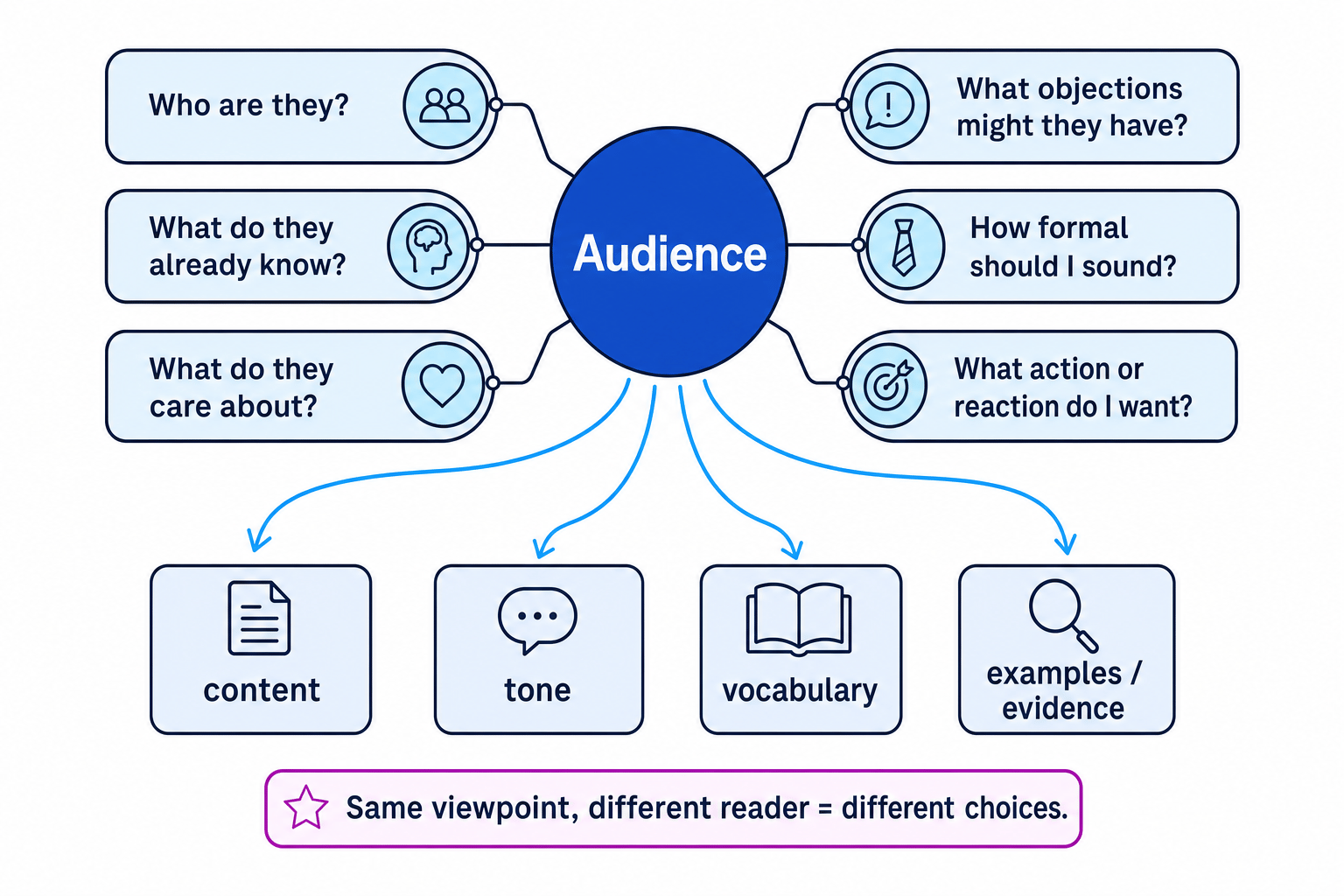
Build an audience profile
An audience profile is a quick mental picture of the reader. You do not need to write this in your answer, but it helps you make better choices.
Ask yourself:
- Who are they?
- What do they already know?
- What do they care about?
- What might they disagree with?
- How formal should I sound?
- What action or reaction do I want from them?
Quick planning shortcut
Write A + P + T in your plan: Audience, Purpose, Tone. Even ten seconds spent on this can stop your answer sounding generic.
How audience changes your writing
Audience affects four main choices: content, tone, vocabulary and examples.
1. Content: what you include
Content means the ideas, points and details you choose. Different audiences care about different things.
For example, if you are writing about school lunches:
- Teenagers may care about taste, choice, cost and fairness.
- Parents may care about health, value for money and their child’s wellbeing.
- Teachers may care about concentration, behaviour and the school day.
- Governors may care about budgets, policy and long-term outcomes.
2. Tone: how you sound
Tone means the attitude or mood your writing creates. You might sound passionate, serious, humorous, concerned, respectful, challenging or reassuring.
A speech to teenagers can be energetic and direct. A letter to governors should usually be more formal and measured.
3. Vocabulary: the words you choose
Vocabulary means your word choice. Strong vocabulary is not about using the longest word possible. It is about choosing words that fit the audience and purpose.
For example:
- To parents: “nutritious”, “wellbeing”, “safeguarding”, “affordable”.
- To teenagers: “choice”, “stress”, “freedom”, “realistic”.
- To local residents: “community”, “neighbourhood”, “safety”, “shared responsibility”.
- To governors: “investment”, “outcomes”, “evidence”, “long-term impact”.
4. Examples and evidence: what makes your point believable
Evidence in writing can include facts, statistics, examples, anecdotes or logical reasoning. You do not need to invent precise fake statistics. If you use numbers, keep them plausible and general unless the task gives you exact information.
Using fake precision
Avoid made-up statistics such as “97.3% of students hate school dinners” unless the exam task gives you that figure. It often sounds unreliable. A safer phrase is: “Many students feel…” or “In schools across the country…”
Adapting one viewpoint for different readers
Viewpoint: schools should reduce homework.
- For teenagers, focus on lived experience: “After six hours in lessons, many students need time to rest, exercise and see their families — not begin a second school day at the kitchen table.”
- For parents, focus on wellbeing and family life: “Reasonable homework can support learning, but excessive homework can create stress at home and reduce time for sleep, conversation and healthy routines.”
- For teachers, focus on learning quality: “A smaller amount of purposeful homework may be marked more carefully, completed more thoughtfully and used more effectively in the next lesson.”
- For governors, focus on outcomes and policy: “A clear homework policy could improve consistency across departments while supporting student wellbeing and academic progress.”
Common GCSE audiences and how to write for them
Teenagers or students
If your audience is teenagers, you can be direct, lively and relatable. You may use contractions such as “don’t” or “we’re” if the form allows it. However, do not become sloppy or childish.
Good choices:
- direct address: “You know what it feels like…”
- shared experience: school, pressure, friendships, social media, future plans
- energetic openings
- clear, punchy sentences
Do not patronise young readers
Writing for teenagers does not mean using slang every sentence. Forced slang can sound fake and may weaken your control. Aim for intelligent, direct and relevant.
Parents
For parents, think about responsibility, safety, cost, wellbeing and future opportunities. A persuasive tone can be serious and reassuring.
Useful phrases include:
- “No parent wants to see…”
- “Families need…”
- “This is not about blame; it is about support.”
- “The long-term effects matter.”
Teachers
For teachers, be respectful and practical. Teachers are professionals, so show that you understand pressure, workload and learning.
Useful angles:
- classroom behaviour
- concentration
- fairness
- student progress
- realistic solutions
Avoid sounding as if teachers are the enemy. A balanced argument often sounds more mature.
Local residents
Local residents care about the area they live in. Focus on community, safety, pride, noise, traffic, public spaces and shared responsibility.
Useful language:
- “our community”
- “the streets we share”
- “local families”
- “a neighbourhood we can be proud of”
Newspaper readers
A newspaper audience is usually broad. You need an engaging opening, clear paragraphs and accessible language. The tone depends on the topic, but it should usually be confident and readable.
An article can use:
- a striking opening statement
- rhetorical questions
- varied paragraph lengths
- a clear viewpoint
- examples that ordinary readers can recognise
School governors
School governors are decision-makers. They care about school policy, budgets, reputation, student outcomes and long-term planning. Use a formal, reasoned tone.
Good choices:
- “I urge the governing body to consider…”
- “This proposal would benefit students by…”
- “A practical first step would be…”
- “The evidence from daily school life suggests…”
The general public
For the general public, avoid assuming specialist knowledge. Explain the issue clearly and use examples that many people can understand.
You can appeal to shared values such as fairness, safety, opportunity, health and responsibility.
Addressing the reader directly
Direct address means speaking straight to the reader using words like “you” or “your”. It can make writing feel immediate and personal.
Inclusive language means using words like “we”, “us” and “our” to create a shared identity with the audience.
Examples:
- “We all want safer streets.”
- “You should not have to choose between heating your home and feeding your family.”
- “Our school can do better than this.”
These methods are useful, but they must fit the audience. “We” works well for students, local residents or the general public. For a council or governors, you might use “we” carefully to suggest cooperation rather than blame.
Using pronouns to shape the relationship
Topic: improving a local park
- To local residents, use inclusive pronouns to build community: “We deserve a park that feels safe, clean and welcoming for every family in our neighbourhood.”
- To the council, use respectful direct address: “You have the power to make practical changes that would improve safety and restore public confidence.”
- To teenagers, use a more direct challenge: “If you want somewhere decent to meet your friends, then this park should matter to you too.”
Handling objections
An objection is a reason your audience might disagree with you. Strong writers predict objections and respond to them.
This is especially useful for adult or decision-making audiences, such as parents, teachers, councils or governors.
For example:
-
Objection: “It will cost too much.”
-
Response: “However, small changes now may prevent more expensive problems later.”
-
Objection: “Students will take advantage.”
-
Response: “Clear rules and consistent expectations would prevent misuse.”
Mature persuasion
The best viewpoint writing does not ignore disagreement. It shows the reader that you understand their concerns, then gives them a reason to think again.
Answering a likely objection
Viewpoint: the school should introduce a later start time. Audience: teachers.
- Predict the concern: teachers may worry that a later start will shorten lesson time or disrupt routines.
- Acknowledge it fairly: “Understandably, staff may be concerned about losing valuable teaching time.”
- Respond with a practical solution: “However, a carefully adjusted timetable could protect lesson length while helping students arrive more alert and ready to learn.”
- Link back to the audience’s values: “If the aim is better concentration and stronger progress, then student readiness should be part of the conversation.”
Mini model: same idea, different audience
Viewpoint: people should reduce plastic waste.
For the general public:
Every bottle we throw away has a life far longer than the few minutes we use it for. If each of us made one small change — carrying a reusable bottle, refusing unnecessary packaging, recycling properly — our collective impact would be enormous.
For school governors:
Reducing plastic waste across the school would support environmental responsibility while setting a clear example for students. A practical policy on reusable bottles, recycling points and canteen packaging could make sustainability part of everyday school life.
Notice how the first version appeals to shared public responsibility, while the second sounds more formal and policy-focused.
Writing the same answer for everyone
A generic answer may still make sense, but it will not feel carefully controlled. Examiners reward writing that suits the task, so keep asking: “Would this reader care about this point?”
Planning a response around audience
A simple plan could look like this:
- Opening: grab attention in a way that suits the audience.
- Main point 1: choose the issue your audience will care about most.
- Main point 2: develop a different angle or consequence.
- Objection and response: show maturity by addressing a concern.
- Ending: finish with a clear call to action or final judgement.
A call to action is a direct statement telling the audience what should happen next, such as “It is time for the council to act” or “We must change this policy before more students are affected.”
Audience-first openings
Before writing your first sentence, ask: “What would make this reader keep listening?” Teenagers may respond to a relatable scenario; governors may respond to a serious problem and a practical proposal.
In the exam
- Read the task and label the audience, purpose, form and tone before you start writing.
- Choose points, vocabulary and examples that your named audience would genuinely care about.
- Use direct address, inclusive language and rhetorical questions only when they suit the reader and form.
- Predict one possible objection from the audience and answer it calmly.
- Keep technical accuracy strong: varied sentences, secure punctuation and accurate spelling help your argument sound trustworthy.
Check yourself
- If you were writing to school governors, how would your tone differ from a speech to classmates?
- What might local residents care about that newspaper readers across the country might not?
- How could you adapt one opinion for both parents and teenagers?
