What you'll learn
- How to turn a viewpoint into a clear argument, not a list of opinions.
- How to write a strong thesis statement and develop logical points.
- How to use evidence, examples, counterargument, rebuttal and conclusion.
- How AQA Paper 2 Section B rewards your writing through AO5 and AO6.
Where this skill appears
In AQA GCSE English Language 8700, Paper 2 lasts 1 hour 45 minutes and is worth 80 marks, which is 50% of the GCSE. Section B is the writing task, worth 40 marks: 24 marks for AO5 — clear communication and organisation — and 16 marks for AO6 — vocabulary, sentence structures, spelling and punctuation.
All questions are compulsory. In Paper 2 Section B, you may be asked to write a letter, article, speech, essay or another viewpoint form. The purpose may be to argue, persuade, explain or give a viewpoint. This note focuses on writing to argue.
Argument
An argument is a reasoned case for a clear viewpoint. It uses claims, reasons, evidence or examples to show why your judgement is stronger than other possible views.
The core idea: make a judgement
A judgement is your overall decision about the issue. In argumentative writing, you should not sound as if you are collecting random thoughts. You should sound as if you have considered the issue and reached a clear position.
The six-word test
A strong argument can often be reduced to: “I believe X because Y.” If you cannot add because, you probably have an opinion rather than an argument.
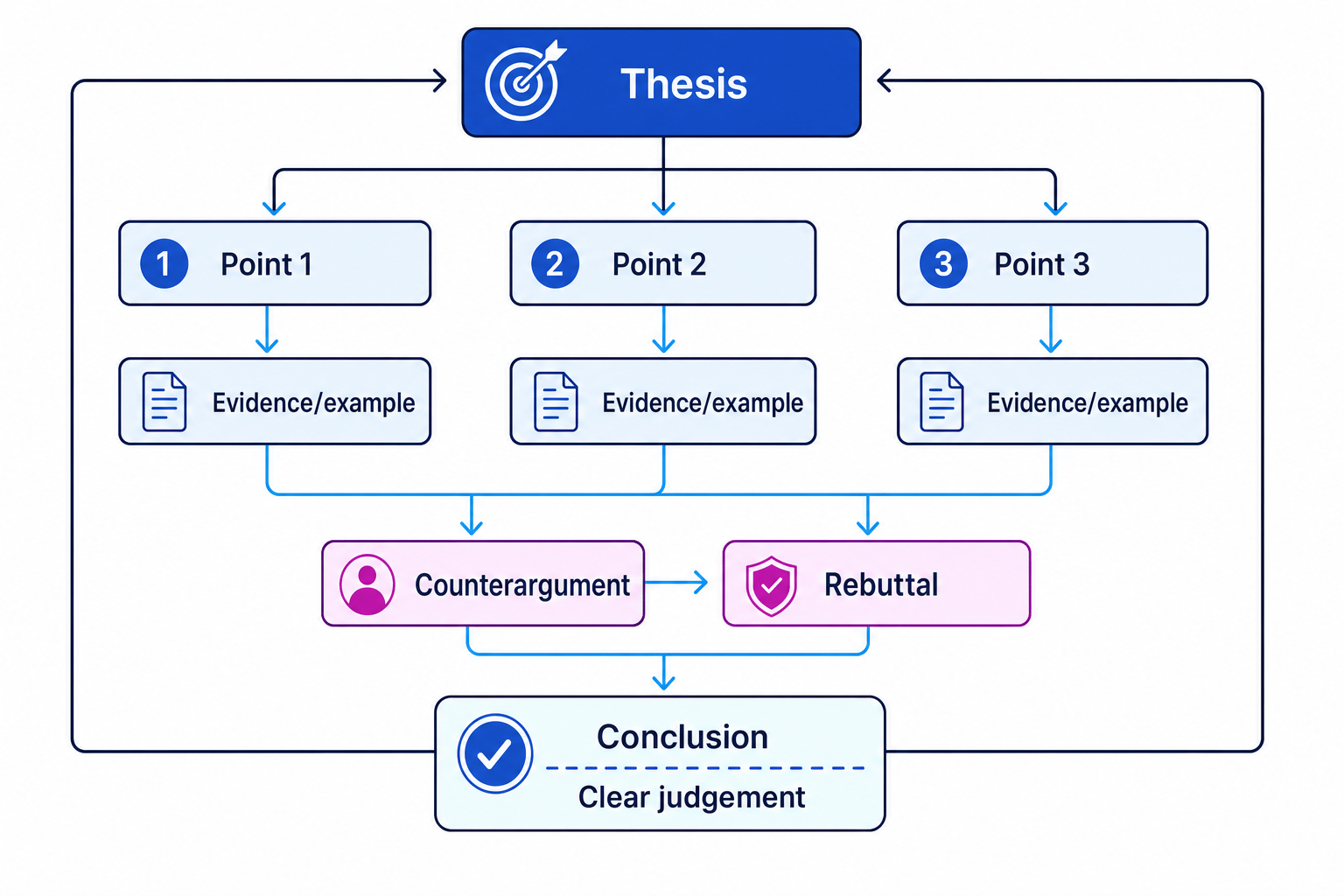
Arguments usually have a shape: start with your position, develop reasons, deal with opposition, then return to your final judgement.
Thesis statements
A thesis statement is the main argument of your whole piece, usually expressed near the beginning. It tells the reader what you think and gives a sense of why.
A weak opening might say: “Phones in school are a big issue.” That is true, but it does not argue anything. A stronger thesis takes a side and creates a route for the paragraphs that follow.
Turning a prompt into a thesis
- Choose a precise judgement: instead of saying “phones are good” or “phones are bad”, decide whether you support unrestricted use, limited use, or a ban except for emergencies.
- Add the main reasons behind that judgement: for example, concentration, wellbeing and equality in the classroom.
- Shape it into a thesis: “Although phones can support learning when teachers control their use, unrestricted phone use in school should be limited because it damages concentration, increases social pressure and makes classrooms less equal.”
Use a balanced but firm opening
Words like although, while and despite help you sound thoughtful, but your thesis must still be clear. Do not balance so much that nobody knows what you actually think.
Logical points
A logical point is a reason that supports your thesis. Good points are not just different ways of saying the same thing. Each paragraph should move the argument forward.
For example, if your thesis is about limiting phones in school, your points might be:
- learning and concentration
- social pressure and mental wellbeing
- fairness for pupils who do not have the latest technology
- the need for school-wide rules, not individual guesswork
Notice how these are separate ideas. That gives your writing structure.
Planning logical points
- Start with your thesis: unrestricted phone use should be limited in school.
- Sort your reasons into different categories: learning, wellbeing and fairness are separate strands, so they can become separate paragraphs.
- Put the points in a deliberate order: begin with the classroom effect, widen to social pressure, then finish with fairness and school community.
Listing random opinions
Avoid writing one paragraph about phones, then uniforms, then homework, then teachers unless the task genuinely asks for all of those. A strong argument stays focused on one clear line of judgement.
Evidence and examples
In Paper 2 Section B, evidence does not usually mean quotations from the reading sources. You are producing your own writing. Evidence can be a realistic example, a brief scenario, a general observation or a reference to shared experience.
An example is a specific case that makes a point concrete. It stops your writing sounding vague.
Weak: “Phones are distracting and bad.”
Stronger: “A pupil who keeps checking notifications during a lesson is not simply missing one message; they are repeatedly breaking their attention, which makes sustained thinking harder.”
Be careful with statistics
Do not invent precise statistics such as “87% of pupils fail because of phones.” If the paper has not given you a figure, use realistic examples or general phrasing instead.
Building an argumentative paragraph
A useful paragraph pattern is:
Point → evidence/example → reasoning → link back to thesis
Reasoning means explaining why your evidence proves your point. This is the part many students rush, but it is what makes your argument feel intelligent.
Building a supported paragraph
- Make a clear point: “Unrestricted phone use damages concentration because it trains pupils to expect constant interruption.”
- Add a realistic example: a pupil checking notifications during independent work keeps restarting the same task instead of thinking deeply.
- Explain the effect: repeated interruption means the pupil may complete the work, but with less focus, less independence and less confidence.
- Link back to the argument: “For that reason, limiting phone use is not about controlling young people for the sake of it; it is about protecting the conditions in which learning can actually happen.”
Counterargument and rebuttal
A counterargument is the opposing view. A rebuttal is your answer to that opposing view. Including both can make your writing more convincing because it shows you have considered the issue rather than ignored it.
A counterargument should be fair. Do not make the other side sound ridiculous just so it is easy to defeat.
Answering the opposing view
- State the opposing view fairly: “Some argue that phones make pupils safer because they can contact parents quickly.”
- Accept the strongest part of it: safety is a real concern, especially during travel to and from school.
- Rebut it by narrowing the issue: “However, that does not mean phones need to be used freely throughout lessons; schools can allow emergency contact while still keeping classrooms focused.”
Attacking a straw man
A straw man is a weak or unfair version of the opposing view. Avoid lines like “Only lazy people want phones in school.” That sounds biased, not logical.
Tone, rhetoric and control
Tone means the attitude your writing creates. An argument can be passionate, but it should not become a rant. A rant often repeats anger; an argument develops reasons.
Rhetoric means language designed to influence an audience. You can use rhetorical questions, repetition, contrast and powerful vocabulary, but they should support your logic.
Useful argumentative sentence starters include:
- The central issue is not… but…
- This matters because…
- Some may argue that… however…
- The stronger judgement is…
- If schools want to…, they must…
A modal verb shows certainty or obligation, such as must, should, could or might. In argument writing, modal verbs help you control force. “Schools must protect learning” sounds stronger than “schools could maybe protect learning.”
Conclusions
A conclusion is the final part of your argument. It should not introduce a brand-new point. Instead, it should return to the thesis, weigh the issue briefly and make the judgement clear.
A strong conclusion might sound like this:
“Ultimately, the question is not whether young people can be trusted with technology; it is whether schools are brave enough to create conditions where every pupil can focus, learn and feel equal. For that reason, phone use should be limited during the school day, with sensible exceptions for learning and safety.”
Notice the conclusion does three things: it reframes the issue, returns to the thesis and gives a final judgement.
In the exam
- Spend about 5 minutes planning your thesis, three logical points and one counterargument.
- Keep checking that every paragraph proves the same overall judgement.
- Use examples and reasoning instead of invented statistics or vague claims.
- Include a fair counterargument followed by a clear rebuttal.
- Leave time to check AO6: sentence boundaries, commas, spelling and ambitious but accurate vocabulary.
Check yourself
- Can you summarise your whole argument in one sentence using because?
- Does each paragraph add a new logical reason rather than repeat the same opinion?
- Have you answered an opposing view fairly and then shown why your judgement is stronger?
