What you'll learn
- How persuasive writing fits into AQA GCSE English Language Paper 2 Section B.
- How to shape your ideas for a specific reader, purpose and form.
- How to use persuasive techniques without sounding forced or fake.
- How to organise a convincing response and improve AO5 and AO6 marks.
Where this fits in AQA English Language
AQA GCSE English Language has two papers. Each paper is 1 hour 45 minutes, worth 80 marks and 50% of the GCSE. Reading questions are in Section A; writing questions are in Section B. Every question is compulsory.
In Paper 2 Section B, you complete a viewpoint writing task. The writing question is worth 40 marks: 24 marks for AO5, which rewards clear, engaging communication and organisation, and 16 marks for AO6, which rewards vocabulary, sentence structures, spelling and punctuation.
You might be asked to write a speech, article, letter, essay, leaflet or text for a website. The topic will be unseen, but the method is transferable.
What persuasive writing is
Persuasion and viewpoint writing
A viewpoint is your attitude or opinion about an issue. Persuasion is writing designed to influence the reader so they think, feel or act in a particular way.
Persuasion is not just “having strong opinions”. It is controlled influence. You make choices about what to say, how to say it and how to guide the reader towards your conclusion.
Start with audience, purpose and form
Before you choose clever language, work out the basics.
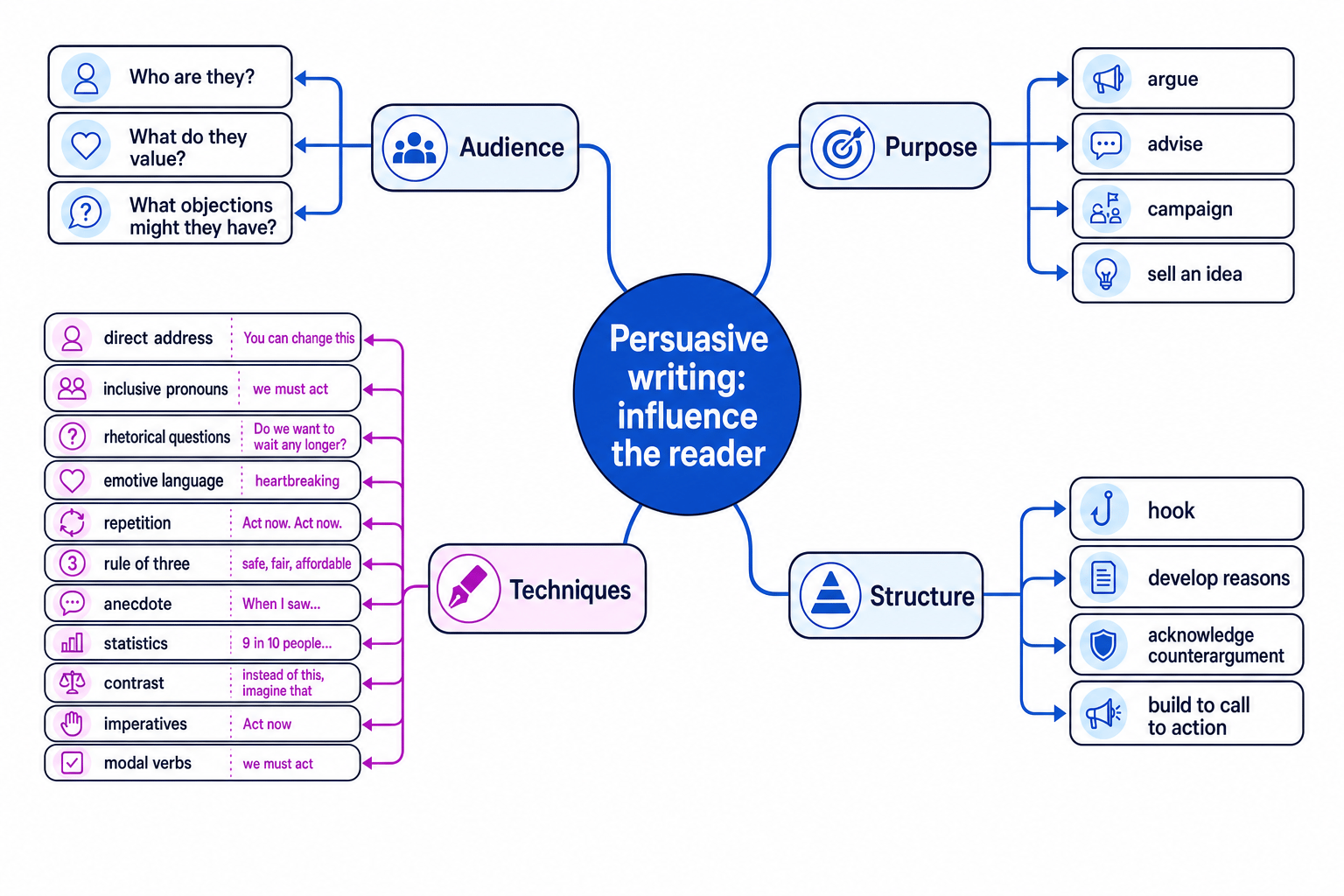
- Audience means the people you are writing for.
- Purpose means what your writing is trying to achieve, such as to persuade, argue, advise or campaign.
- Form means the type of writing, such as a speech, article or letter.
These three choices affect everything else. A speech to younger students will sound different from a formal letter to a headteacher, even if the opinion is the same.
Planning for a persuasive task
Task: Write a speech persuading students to volunteer for a local community project.
- Decide what the audience values. Students may care about friendship, free time, confidence, CVs, fun and not being pressured.
- Shape the purpose around those values. Instead of simply saying “volunteering is good”, make the message: volunteering benefits the community and gives students useful experiences.
- Match the form. Because it is a speech, use direct address, clear signposting and sentences that sound natural when spoken aloud.
- Choose the tone. A friendly, encouraging tone will work better than guilt or blame because the audience may resist being told what to do.
Build the argument first
A persuasive technique is a deliberate method used to influence the reader. However, techniques only work when they support a clear argument.
A strong persuasive response usually includes:
- A hook: an opening designed to catch attention.
- A clear viewpoint: what you believe.
- Developed reasons: why the reader should agree.
- A counterargument: an opposing view you briefly address.
- A call to action: a final push telling the reader what should happen next.
Persuasion is planned influence
The reader should feel your argument moving forwards: problem, reasons, proof-like detail, answer to doubts, then action.
The persuasive technique toolkit
Use techniques because they help your message, not because you want to tick boxes.
| Technique | What it means | What it can do |
|---|---|---|
| Direct address | Speaking directly to the reader, often using “you”. | Makes the reader feel personally involved. |
| Inclusive pronouns | Words such as “we”, “us” and “our” that place writer and reader in the same group. | Creates unity and shared responsibility. |
| Rhetorical question | A question asked for effect rather than because you expect an answer. | Pushes the reader to reflect or agree. |
| Emotive language | Words chosen to create feeling, such as sympathy, anger, hope or urgency. | Makes the issue feel human and important. |
| Repetition | Reusing a word, phrase or sentence pattern. | Emphasises a key idea and creates rhythm. |
| Rule of three | A list or pattern of three words, phrases or ideas. | Makes a point sound complete and memorable. |
| Anecdote | A short personal or realistic story. | Makes an issue feel relatable rather than abstract. |
| Statistics | Numerical evidence, such as percentages or survey results. | Creates a sense of authority and scale. |
| Contrast | Placing opposite ideas close together. | Highlights the difference between what is wrong and what could be better. |
| Imperative | A command form of a verb, such as “act”, “choose” or “remember”. | Gives the reader a clear action. |
| Modal verb | A helping verb showing possibility, certainty or obligation, such as “could”, “should”, “must” or “will”. | Controls how forceful your argument sounds. |
Now put the choices together: audience, purpose, structure and techniques should work as one system, not as separate tricks.
Technique dumping
Do not cram in rhetorical questions, statistics and repetition without developing your point. Examiners reward effective communication, not a checklist of methods.
Making techniques work together
The best persuasive writing often layers two or three methods around one clear idea.
For example, if your point is “The town needs safer cycle lanes”, you could develop it using a concrete image, contrast, direct address and a call to action.
Upgrading a persuasive point
Plain point: The town needs safer cycle lanes.
- Identify the reader’s likely concern. Local residents may care about safety, traffic and cost, so the paragraph should focus on practical benefits rather than vague idealism.
- Replace the abstract issue with a concrete scene. Instead of “cycling is dangerous”, show cars squeezing past children, buses braking suddenly and cyclists being pushed into the gutter.
- Add contrast to create a choice. Present the current situation as chaotic and the alternative as safer, calmer and more sensible.
- Finish with pressure and action. Use a rhetorical question to challenge delay, then an imperative or modal verb to push the reader towards support.
Upgraded version: “Every morning, you see the same dangerous scramble: cars squeezing past children, buses braking hard, cyclists pushed into the gutter. We can either accept this chaos, or we can create safe, sensible, separated cycle lanes. Why wait for an accident before we act? Tell the council that our streets should protect people, not frighten them.”
Using evidence-like detail
In viewpoint writing, you are not expected to research facts in the exam room. Still, your writing becomes more convincing when it feels specific.
An anecdote can make a big issue personal: “Last winter, one elderly neighbour told me she stopped walking to the shops because the pavements felt unsafe.”
A statistic can make an issue feel wider: “A recent student survey suggested that most pupils would join a club if transport home were available.”
Statistics must sound believable
If you invent a statistic for a writing task, keep it plausible and avoid bizarre precision. “Nearly two thirds” sounds more convincing than “63.87% of all teenagers everywhere”.
Tone: passionate, not aggressive
Tone means the attitude or voice of your writing. Persuasive writing should usually sound confident and energetic, but controlled.
Modal verbs help you adjust tone:
- “We could improve this” sounds open and reasonable.
- “We should improve this” sounds firmer.
- “We must improve this” sounds urgent and forceful.
Imperatives can be powerful, but too many commands may sound bossy. Try saving them for key moments, especially the ending: “Choose fairness. Support the change. Act today.”
Structure for a full response
A simple persuasive structure could look like this:
- Opening hook: begin with a striking image, question or statement.
- Your viewpoint: make your position clear early.
- Main reason one: develop the most obvious or relatable argument.
- Main reason two: add a different angle, such as fairness, cost, safety or opportunity.
- Counterargument and response: admit a possible objection, then show why your view still stands.
- Call to action: end by telling the reader what to think, support or do.
A counterargument makes you sound mature because you show awareness of other views. For example: “Some will argue that change is expensive. But the cost of doing nothing is higher: more waste, more delay and more frustration.”
Form features: enough, not too much
You should show the form, but do not waste time decorating it.
For a speech, you might use a greeting, direct address and spoken signposts such as “Let me be clear” or “Think about this”.
For a letter, use a suitable greeting and sign-off, and keep the tone appropriate for the recipient.
For an article, you can use a headline-style opening, engaging paragraphs and a clear viewpoint.
For a leaflet or webpage text, you can use short sections and clear subheadings, but the writing still needs developed ideas.
Match the form quickly
Use two or three form features early, then focus on the quality of your argument, paragraphing and expression.
AO6: sentences and accuracy
Technical accuracy means control of spelling, punctuation, grammar and sentence structure. AO6 is worth 16 marks, so it matters.
Vary your sentences for effect:
- A main clause makes sense on its own: “This must change.”
- A subordinate clause depends on a main clause: “If we care about safety”.
- A complex sentence can combine them: “If we care about safety, we must invest in better lighting.”
Use punctuation to support meaning. A colon can introduce an explanation: “The choice is simple: act now or accept the consequences.” A question mark should only follow a real question, including a rhetorical question.
Mini checklist for persuasive paragraphs
For each main paragraph, ask:
- What is my clear point?
- Why should my audience care?
- Which one or two techniques will strengthen this idea?
- Have I developed the consequence, not just stated the opinion?
- Does the paragraph link back to my overall viewpoint?
In the exam
- Spend about 5 minutes decoding the task: audience, purpose, form and your main viewpoint.
- Plan 4 or 5 paragraphs so your argument builds rather than repeats.
- Use persuasive techniques in purposeful clusters, not as a random checklist.
- Leave time to check AO6: sentence boundaries, commas, apostrophes, spelling and paragraphing.
- End with a clear call to action so the reader remembers your viewpoint.
Check yourself
- Can you explain the difference between direct address and inclusive pronouns?
- Which three techniques would suit a persuasive speech to students, and why?
- How could you include a counterargument without weakening your own viewpoint?
