What you'll learn
- What AQA Paper 2 Question 5 is asking you to do.
- How to decode the topic, audience, purpose and form in the task.
- How AO5 and AO6 marks are awarded.
- How to plan a clear, convincing viewpoint before you write.
Where Question 5 fits
AQA GCSE English Language has two papers. Each paper lasts 1 hour 45 minutes, is worth 80 marks, and counts for 50% of the GCSE. In both papers, Section A is reading and Section B is writing. Every question is compulsory.
Paper 2 Section B is Question 5. It is worth 40 marks, so it is a major part of the paper. AQA says this section asks you to produce a written text giving your own perspective on the theme introduced in Section A.
Viewpoint writing
Viewpoint writing means writing a non-fiction piece that clearly presents what you think about an issue, topic or debate. You are not analysing the sources here; you are creating your own piece of writing.
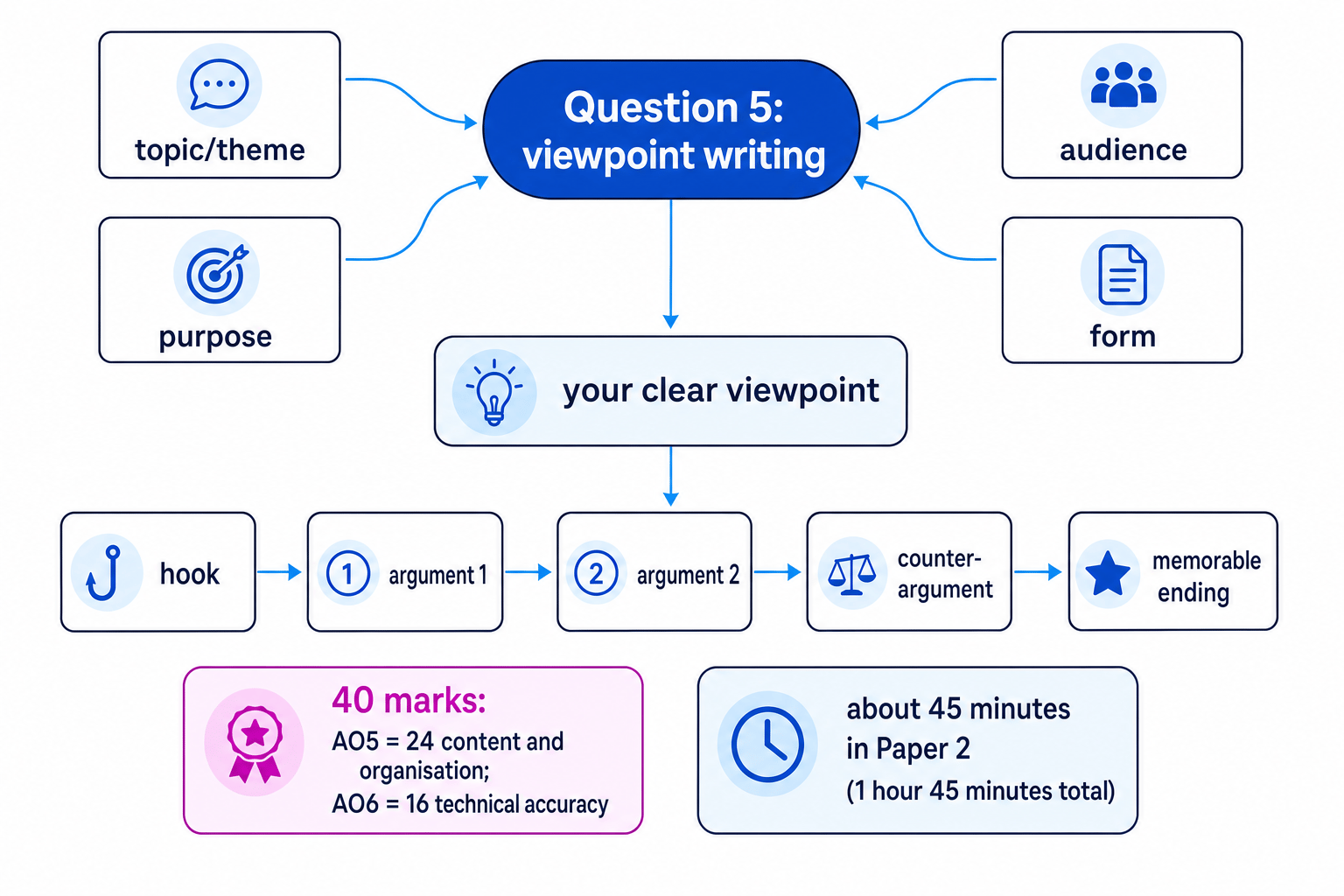
The prompt will give you a topic, an audience, a purpose and a form. These four details tell you what to write about, who you are writing for, why you are writing, and what kind of text to produce.
The basic job: give your own perspective
Your answer should not be a random collection of opinions. It needs a clear line of argument from start to finish.
Perspective
A perspective is a particular way of seeing an issue. In Question 5, your perspective is your overall position: what you believe, feel or want the reader to consider.
For example, if the topic is technology in schools, your perspective might be:
- Technology helps learning when used carefully.
- Schools rely too much on screens.
- The real issue is balance, not banning devices completely.
You do not have to choose the most dramatic opinion. A thoughtful, controlled viewpoint often scores better than an extreme one that runs out of ideas.
Your main aim
Question 5 rewards writing that is clear, shaped and convincing. Your examiner should know what you think, why you think it, and why it matters.
Decoding the task prompt
A Question 5 task usually looks something like this in structure:
“Write a [form] for [audience] in which you [purpose] your views on [topic].”
The exact wording will change, but the four key ingredients stay the same.
Topic
The topic is the issue you are writing about. It may connect to the theme of the reading sources, such as travel, education, technology, the environment, work, family or social change.
Audience
The audience is who your writing is aimed at. This could be readers of a newspaper, students, parents, your local community, a school leadership team or a general public audience.
Purpose
The purpose is what your writing is trying to do. Common purposes include to argue, persuade, explain or inform. Often, viewpoint writing combines these: you explain your ideas while persuading the reader to agree.
Form
The form is the type of text you must write, such as an article, letter, speech, essay or text for a leaflet. Form affects features like greeting, sign-off, headline, direct address and paragraph style.
Decoding a viewpoint task
Imagine the task says: “Write a speech for your classmates in which you argue your views about whether young people spend too much time online.”
- Identify the form: it is a speech, so you could use direct address, rhetorical questions and a clear closing statement aimed at listeners.
- Identify the audience: it is for your classmates, so the tone should sound relevant to young people, not like a government report.
- Identify the purpose: the word argue tells you to take a clear position and support it with reasons, rather than simply describing both sides equally.
- Identify the topic: the issue is whether young people spend too much time online, so your points should stay focused on online time, not technology in general.
- Shape a viewpoint: for example, “The problem is not screen time itself, but the way it replaces sleep, exercise and real conversation.”
Ignoring the form
A strong set of ideas can lose marks if it reads like the wrong kind of text. A speech should sound spoken; a letter should address its recipient; an article usually needs a headline or clear opening that suits a publication.
How the marks work
Question 5 is worth 40 marks. The marks are split into two assessment objectives:
- AO5: 24 marks for content and organisation.
- AO6: 16 marks for vocabulary, sentence structures, spelling and punctuation.
AO5
AO5 assesses how clearly and effectively you communicate, including your ideas, tone, structure, paragraphing and organisation.
AO6
AO6 assesses technical accuracy: your spelling, punctuation, grammar, vocabulary choices and variety of sentence structures.
AO5 is worth more, so your ideas and structure matter hugely. However, AO6 is still 40% of the marks for this question, so accuracy is not optional.
The 24/16 split
Think of AO5 as what you say and how you organise it, and AO6 as how accurately and stylishly you write it.
Planning a clear viewpoint
A quick plan is not wasted time. It prevents you from writing three similar paragraphs and then stopping suddenly.
A useful structure is:
- Opening hook — introduce the issue and your viewpoint.
- First main argument — your strongest or most obvious reason.
- Second main argument — a different angle or consequence.
- Counter-argument — acknowledge another view, then respond to it.
- Ending — leave the reader with a memorable final thought or call to action.
Counter-argument
A counter-argument is an opposing view that you mention in order to challenge, limit or respond to it. It can make your writing sound balanced and mature.
Planning a viewpoint response
Suppose your viewpoint is: “Schools should teach more practical life skills.”
- Choose a clear position: instead of “life skills are good”, make it debatable: “Schools should teach practical life skills alongside academic subjects.”
- Select distinct arguments: one paragraph could focus on money management; another could focus on communication, employment and confidence.
- Add a counter-argument: acknowledge that schools already have crowded timetables, then argue that life skills could be built into existing subjects or tutor time.
- Plan the ending: return to the bigger idea that education should prepare students for real life, not just exams.
Writing with purpose: argue, persuade and explain
In viewpoint writing, your purpose affects your style.
If you are asked to argue, you should build a logical case. Use reasons, examples and links between ideas.
If you are asked to persuade, you should influence the reader’s feelings and beliefs. Use rhetorical questions, direct address, emotive language and contrast — but keep control.
If you are asked to explain, you should make your viewpoint clear and understandable. Use examples and careful development, not just slogans.
Rhetorical question
A rhetorical question is a question asked for effect rather than because you expect an answer, such as “How can we call this progress if it leaves people behind?”
Emotive language
Emotive language is vocabulary chosen to create an emotional response, such as “neglected”, “pressured”, “hopeful” or “unfair”.
Technique spotting in your own writing
Do not throw in rhetorical questions, statistics or repetition just to show you know them. Techniques only help when they support your viewpoint and suit the audience.
Adapting to audience and tone
Tone means the attitude or voice your writing creates. Your tone might be serious, passionate, reflective, urgent, humorous or formal.
The right tone depends on the task. A letter to a headteacher may need controlled politeness. A speech to classmates can be more direct and energetic. An article for a national newspaper may need a confident, public voice.
Adapting tone to audience
Viewpoint: “Public transport should be cheaper for young people.”
- For classmates, you might write: “We are told to be independent, yet many of us cannot even afford the bus into town.”
- For local councillors, you might write: “Affordable transport for young people would support education, employment and safer travel across the community.”
- Compare the choices: the first version uses shared experience and direct identification; the second sounds more formal and focuses on public benefit.
- Keep the core viewpoint: both versions argue the same idea, but the vocabulary and emphasis shift for the audience.
Organisation: make the journey easy to follow
Good organisation means the reader can follow your thinking without getting lost. Use paragraphs to separate stages of your argument.
Useful linking phrases include:
- To begin with…
- More importantly…
- However…
- Some people may argue…
- The real issue is…
- Ultimately…
You can also use structural methods such as a repeated phrase, a contrast between past and present, or a return to an idea from the opening.
Cyclical structure
A cyclical structure is when a piece ends by returning to an idea, image or phrase from the beginning. It can make your response feel complete and deliberate.
Paragraph control
Aim for developed paragraphs rather than lots of tiny ones. Each main paragraph should make one clear point, develop it, and connect back to your overall viewpoint.
Technical accuracy: AO6 matters
AO6 is not just about avoiding mistakes. It also rewards variety and control.
Try to use:
- Varied sentence lengths: short sentences for impact, longer sentences for explanation.
- Accurate punctuation: full stops, commas, apostrophes, colons, semicolons and question marks where appropriate.
- Ambitious but precise vocabulary: choose words because they fit, not because they sound fancy.
- Controlled paragraphing: start a new paragraph when your argument moves on.
Sentence variety
Sentence variety means using a mixture of sentence types and lengths to create rhythm, emphasis and clarity.
For example:
We need change. Not next year, not when the damage is irreversible, but now — while our choices still matter.
This uses a short sentence for impact, repetition for emphasis, and punctuation to control the pace.
Accuracy over showing off
Ambitious punctuation only helps if it is accurate. A secure colon, dash or semicolon is better than a confusing sentence packed with punctuation you cannot control.
What not to do
Question 5 is not asking you to analyse the unseen sources. The theme may link to Section A, but your job is to produce your own non-fiction writing.
You also do not need to invent lots of fake statistics. A believable example, personal observation or logical consequence can be more convincing than a suspicious “97% of people agree” claim.
Forgetting the viewpoint
Some students write generally around the topic without taking a clear position. Keep returning to your central argument so the piece feels purposeful.
A simple success formula
Before you start writing, ask yourself:
- What exactly is my viewpoint?
- Who am I writing for?
- What form am I using?
- What is my strongest argument?
- How will I end strongly?
If you can answer those questions, you are much more likely to produce a focused response.
The big picture
A successful Question 5 answer sounds like it was written by someone with a clear opinion, a clear reader in mind, and control over structure and accuracy.
In the exam
- Spend about 5 minutes planning: decode the topic, audience, purpose and form, then list 3–4 main stages of your argument.
- Write for about 35 minutes, keeping your viewpoint clear and adapting your tone to the audience and form.
- Leave about 5 minutes to check AO6: full stops, commas, apostrophes, paragraphing, spelling and any sentences that have run on too long.
Check yourself
- Can you explain the difference between topic, audience, purpose and form?
- Can you state a clear viewpoint on a debate in one sentence?
- Can you name one thing AO5 rewards and one thing AO6 rewards?
