What you'll learn
- How to choose ambitious but accurate vocabulary for GCSE creative writing.
- How precise nouns, verbs and adjectives create atmosphere and control tone.
- How to use figurative language without sounding forced.
- How to avoid over-complicated words that weaken your writing.
Why vocabulary choices matter
In AQA GCSE English Language Paper 1 Section B, you write creatively. Paper 1 lasts 1 hour 45 minutes and is worth 80 marks, which is 50% of the GCSE. The writing task is worth 40 marks: 24 for content and organisation, and 16 for technical accuracy.
Vocabulary matters for both: it helps you communicate clearly and imaginatively for AO5, and it helps show control of vocabulary, sentence structures, spelling and punctuation for AO6.
The big goal
Strong vocabulary is not about using the longest word. It is about choosing the most precise word for the mood, image, character or action you want the reader to imagine.
Start with the effect you want
Before choosing impressive words, decide what you want the reader to feel. This is your intended effect: the response you are trying to create.
Atmosphere, tone and connotation
Atmosphere is the mood of a place or scene. Tone is the attitude or feeling in the writing, such as calm, bitter, playful or tense. Connotations are the ideas and feelings a word suggests beyond its literal meaning.
For example, the words home, house, shelter and hideout can all refer to a place where someone stays, but they suggest different feelings. “Home” sounds warm and personal; “hideout” suggests danger or secrecy.
Use this workflow when you are deciding whether a word is helping your writing or just decorating it.
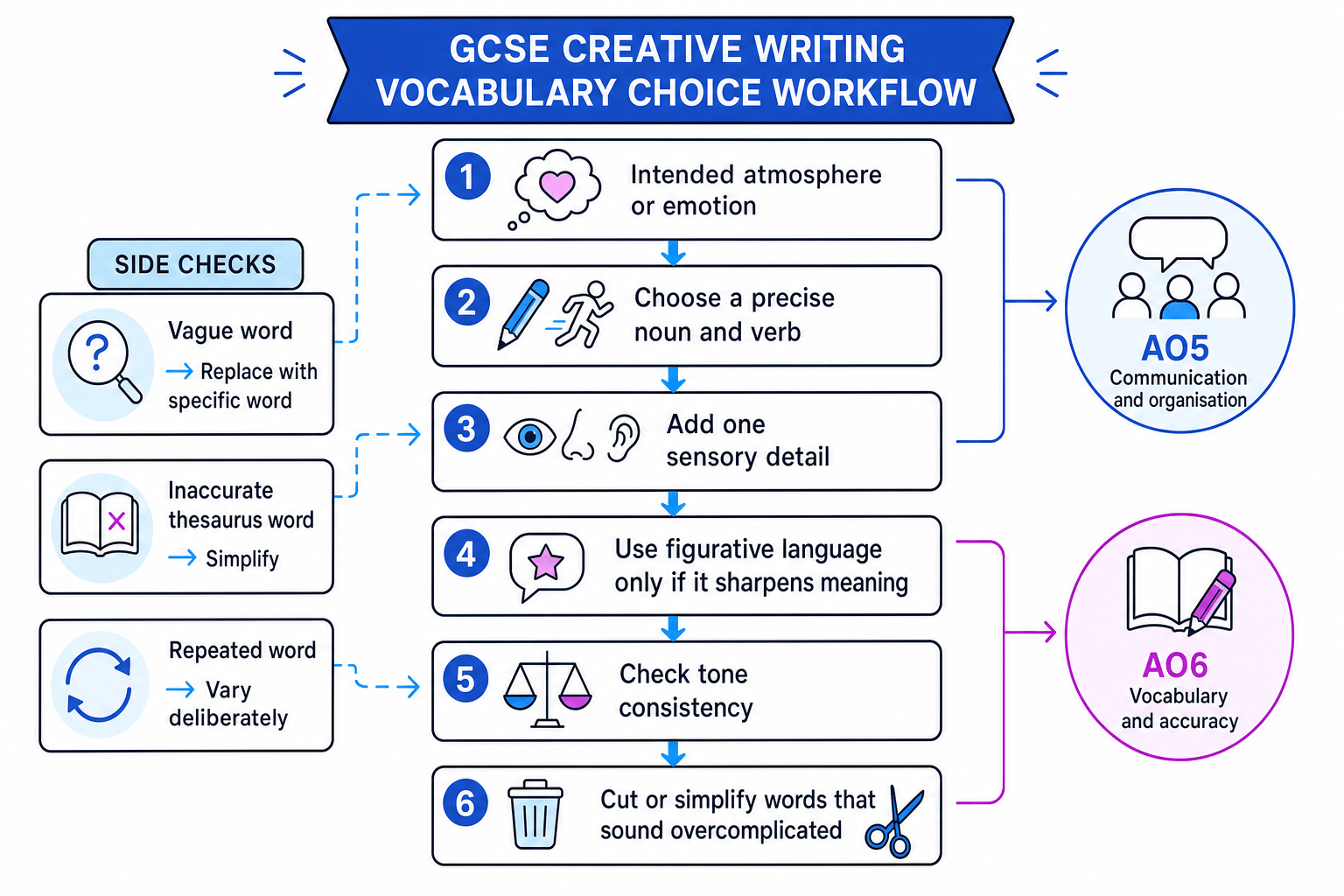
Choosing a word for its connotations
Suppose your basic sentence is: She looked through the window.
- Decide the effect you want. If the character is afraid and trying not to be seen, “looked” is too neutral.
- Compare possible verbs: stared suggests intensity, glanced suggests quickness, glared suggests anger, and peered suggests careful or anxious looking.
- Choose the verb that best matches the moment: peered fits fear and caution.
- Improve the sentence: She peered through the window, barely breathing.
Precision before ambition
A precise word gives the reader a clear mental picture. A vague word leaves too much work for the reader.
Useful word classes
A noun names a person, place, thing or idea. A verb shows an action or state. An adjective describes a noun. An adverb describes a verb, adjective or another adverb.
In creative writing, precise nouns and verbs usually do more work than long strings of adjectives.
Weak: The bad weather made the place scary.
Stronger: Rain lashed the empty platform.
The second version is stronger because “lashed” gives action, force and sound. “Platform” is more specific than “place”. You can picture it quickly.
Nouns and verbs first
If a sentence feels weak, upgrade the noun or verb before adding more adjectives. “The man walked” can become “The stranger limped”, “The guard marched” or “The child wandered” — each version creates a different story.
Upgrading vague vocabulary
Original sentence: The scary place was very bad and the wind went through the trees.
- Identify the vague words: scary, place, very bad and went do not give a clear image.
- Choose a more specific setting noun. Instead of “place”, use lane, platform, corridor or wood. Here, lane creates a narrow, trapped feeling.
- Replace the weak verb phrase “went through” with a verb that suggests sound and threat: scraped, hissed or raked. Choose scraped because it suggests discomfort.
- Keep the sentence controlled rather than adding too many adjectives: The narrow lane seemed to shrink around me as the wind scraped through the trees.
The adjective pile-up
Do not rely on several adjectives to make a sentence impressive: the dark, scary, creepy, terrifying forest sounds less controlled than the forest tightened around us.
Vocabulary banks for atmosphere
Vocabulary banks are not lists to copy mechanically. They are starting points. Pick words that fit your narrator, setting and tone.
| Atmosphere | Nouns | Verbs | Adjectives and adverbs |
|---|---|---|---|
| Fear | shadow, pulse, silence, threat | trembled, flinched, lurked, recoiled | brittle, breathless, uneasy, sudden |
| Calm | stillness, hush, warmth, glow | drifted, rested, softened, settled | gentle, pale, steady, quietly |
| Anger | fist, glare, heat, wound | snapped, spat, clenched, surged | sharp, bitter, raw, furious |
| Mystery | mist, whisper, trace, doorway | flickered, vanished, beckoned, concealed | hidden, strange, faint, uncertain |
| Sadness | ache, absence, dusk, memory | faded, sagged, lingered, mourned | hollow, grey, tired, fragile |
| Joy | laughter, sunlight, spark, rhythm | danced, lifted, burst, shimmered | bright, golden, weightless, alive |
| Isolation | distance, echo, emptiness, horizon | withdrew, drifted, waited, hollowed | remote, silent, bare, abandoned |
| Chaos | crash, crowd, storm, panic | scattered, collided, spilled, roared | frantic, jagged, wild, breathlessly |
Use vocabulary clusters
For a strong atmosphere, use three or four words from the same mood family across a paragraph. This creates consistency without needing to state the feeling directly.
Build a semantic field
Semantic field
A semantic field is a group of words linked by meaning. Writers use semantic fields to build a clear atmosphere or idea across a passage.
For example, a semantic field of decay might include rotting, stained, rusted, cracked, mould, dust and stale. You do not need all of them. A few carefully placed words are enough.
Creating a semantic field of neglect
Basic description: The room was old and dirty.
- Decide the main impression: not just “old”, but neglected — nobody has cared for this room.
- Choose objects that can show neglect: walls, carpet, curtains, window, furniture.
- Select linked vocabulary: stained, sagged, rusted, fraying, dust.
- Write the description through details: Stained curtains sagged beside the window, and dust gathered along the fraying edge of the carpet.
Figurative language: clear before clever
Figurative language
Figurative language is language that is not meant literally. Common types include simile — comparing using “like” or “as”; metaphor — saying one thing is another; and personification — giving human qualities to something non-human.
Figurative language can make your writing vivid, but only if it sharpens meaning. A random simile can distract the reader.
Weak: The rain was like a million tiny soldiers attacking the world.
More controlled: Rain drilled against the roof.
The second version is shorter and stronger. The verb “drilled” suggests force, repetition and sound.
Turning literal detail into controlled imagery
Literal sentence: The clouds were dark above the street.
- Choose the feeling you want: pressure, heaviness and threat.
- Pick a comparison that matches that feeling. A lid suggests something pressing down and trapping what is underneath.
- Avoid overloading the image with extra description. Let the comparison do the work.
- Write the sentence: The sky lowered like a heavy lid over the street.
Random similes
A simile should match the mood. If you are creating sadness, a comic or exaggerated comparison can accidentally ruin the tone.
Control your tone
Tone is created by many choices working together: vocabulary, sentence length, punctuation, imagery and viewpoint. Vocabulary is one of the fastest ways to change tone.
Compare these:
- The old house stood at the end of the lane. Neutral.
- The house crouched at the end of the lane. Threatening.
- The house waited at the end of the lane. Mysterious or ominous.
- The house welcomed us from the end of the lane. Warm or comforting.
The noun has stayed mostly the same, but the verb changes the tone.
Register
Register means the level or style of language, such as formal, informal, conversational, poetic or detached.
In creative writing, register should suit the narrator. A frightened child, a bitter adult and a calm observer would not all describe the same scene in the same way.
Keeping tone consistent
Mixed-tone sentence: The cemetery was totally spooky, and the gravestones seemed melancholy beneath the moon.
- Spot the clash in register. Totally spooky sounds casual and childish, while melancholy sounds more formal and reflective.
- Decide which tone you want. If you want a serious, unsettling tone, keep the more controlled register.
- Replace the casual phrase with vocabulary that fits: restless, uneasy, watchful or cold.
- Revised sentence: The cemetery lay restless beneath the moon, and the gravestones leaned like tired figures in the dark.
Avoid the thesaurus trap
A thesaurus can help, but it can also lead you into inaccurate vocabulary. Some words look similar but have different meanings, grammar patterns or connotations.
Malapropism
A malapropism is the mistaken use of a word that sounds impressive or similar to the intended word but has the wrong meaning.
For example, writing the atmosphere was very condiment instead of tense would be a malapropism. It sounds wrong because “condiment” means something like a sauce or seasoning, not a mood.
Over-complicated wording
Do not write as if every simple word must be replaced. The rain started is often better than the precipitation commenced, especially in a tense scene.
Simplifying over-complicated vocabulary
Overwritten sentence: The gargantuan precipitation commenced its aqueous assault upon the urban walkway.
- Identify the actual meaning: heavy rain started falling on the pavement.
- Keep one ambitious word if it is accurate. Relentless could work because it suggests rain that does not stop.
- Replace inflated nouns with precise everyday nouns: rain and pavement are clearer than “precipitation” and “urban walkway”.
- Revised sentence: Relentless rain hammered the pavement.
Ambition must still sound natural
Ambitious vocabulary is rewarded when it is accurate and controlled. If a word makes the sentence sound unnatural, unclear or unintentionally funny, choose the simpler word.
A simple method for choosing vocabulary
When you are writing under timed conditions, use this quick sequence:
- Effect: What should the reader feel?
- Image: What should the reader picture, hear or sense?
- Word class: Could a stronger noun or verb do the work?
- Tone: Does the word fit the narrator and atmosphere?
- Accuracy: Are you completely sure what the word means?
Ambitious but accurate
A single precise word is usually more powerful than a sentence full of impressive but uncertain vocabulary.
In the exam
- Spend a few minutes planning the atmosphere of your piece before you write, so your vocabulary choices have a clear direction.
- Aim for precise nouns and verbs first; then add adjectives, adverbs or figurative language only where they improve the image.
- Leave time to reread your writing and replace any word that feels vague, repeated accidentally, misspelled or too “thesaurus-like”.
Check yourself
- Can you explain the difference between ambitious vocabulary and over-complicated vocabulary?
- Can you create a semantic field for one atmosphere, such as fear or calm?
- Can you improve a vague sentence by changing the noun and verb before adding adjectives?
