What you'll learn
- How to shape creative writing so it feels deliberate, not random.
- How paragraphing, openings, endings and shifts guide your reader.
- How flashback, contrast, pace and sentence variety can improve AO5.
- How to plan a clear structure quickly in Paper 1 Section B.
Why organisation matters in GCSE Creative Writing
In AQA GCSE English Language Paper 1 Section B, you write creatively. Paper 1 lasts 1 hour 45 minutes, is worth 80 marks, and counts for 50% of the GCSE. The writing task is worth 40 marks: 24 marks for AO5 and 16 marks for AO6.
AO5
AO5 assesses how well you communicate clearly, effectively and imaginatively, and how well you organise your writing. In simple terms: does your writing take the reader on a controlled journey?
AO6 is about vocabulary, sentence structures, spelling and punctuation. This topic focuses mainly on AO5, but sentence variety also supports AO6 because it shows control.
The big idea
Strong creative writing is not just “good description”. It is shaped: the writer chooses what the reader sees first, when the focus changes, how quickly events move, and what feeling the ending leaves behind.
Organisation vs structure
Organisation
Organisation means how you group and connect your ideas on the page: paragraphs, order, links between moments, and the overall route through the writing.
Structure
Structure means the shape of the whole piece: how it begins, develops, shifts, builds towards a key moment, and ends.
A simple way to think about it is this: organisation is the layout and movement, while structure is the journey.
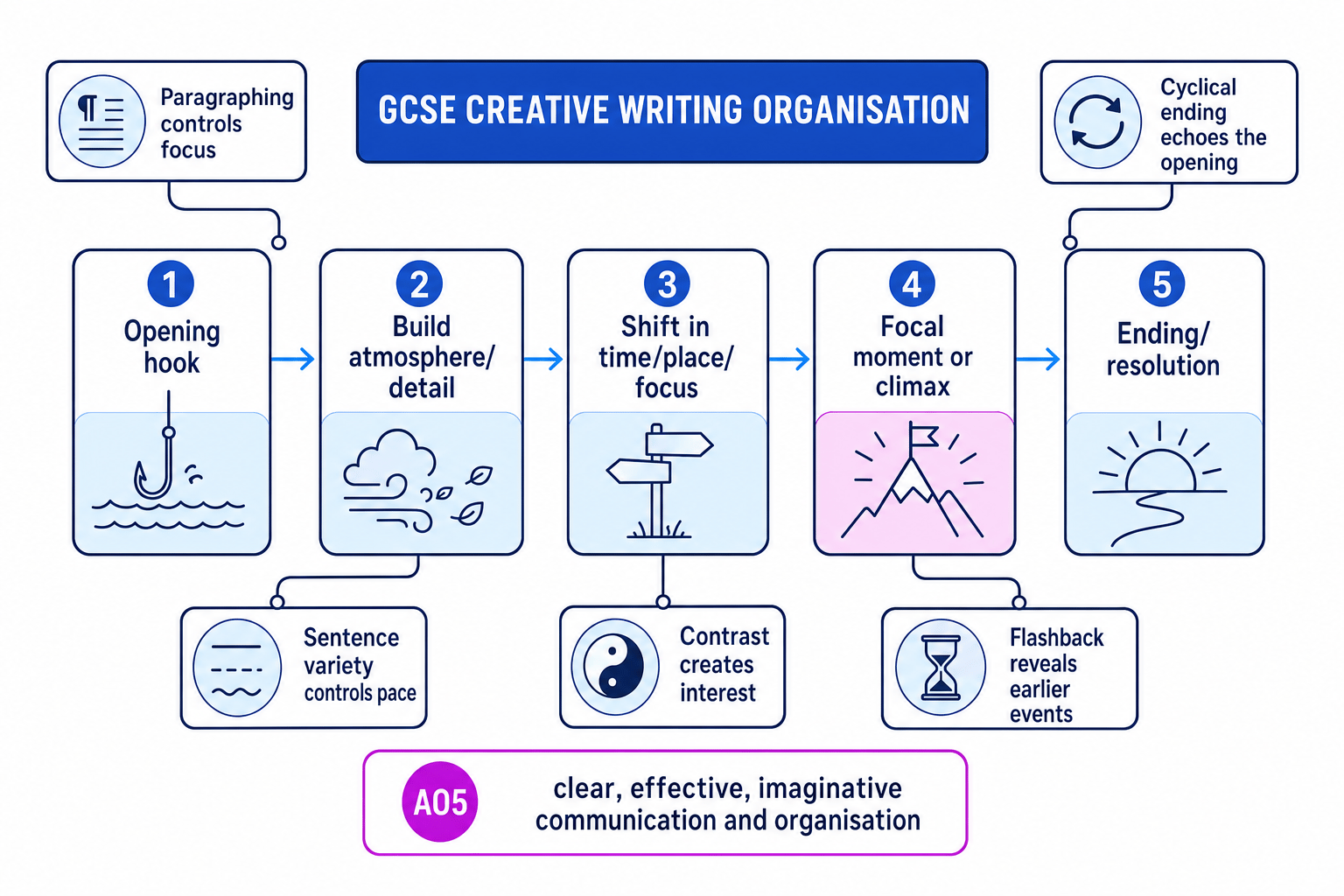
This diagram shows a useful structure for GCSE creative writing: open with control, build detail, shift, focus on a key moment, then end deliberately.
Planning a controlled shape
Suppose the task asks you to write about a frightening place.
-
Choose the main feeling you want to create: fear, isolation, tension, or mystery. If you choose tension, every structural choice should help the reader feel something is about to happen.
-
Decide the order of focus: begin wide with the place, move closer to one unsettling detail, then focus tightly on one sound or movement. This gives the writing a clear zoom-in structure.
-
Add one shift: move from outside to inside, from silence to noise, or from present to memory. The shift stops the piece from becoming a flat list of description.
-
Plan the ending before writing: echo the opening image, but change it slightly. If the piece begins with a closed door, it might end with that door slowly opening.
Paragraphing: controlling the reader’s focus
Paragraphing
Paragraphing means dividing your writing into sections. Each paragraph should usually mark a new focus, moment, place, time, or stage in the mood.
A paragraph is not just “about five lines”. In creative writing, a short paragraph can create drama, while a longer paragraph can slow the pace and build atmosphere.
You might start a new paragraph when:
- the focus changes from the setting to a character;
- the time changes from present to past;
- the place changes from outside to inside;
- the mood shifts from calm to threatening;
- you want a single sentence to stand out.
Using paragraphing to control focus
Imagine you are describing an empty train station at night.
-
Start with a wide focus: describe the whole platform, the darkness, the empty tracks and the distant lights. This establishes setting.
-
Move to a narrower focus in the next paragraph: choose one detail, such as a flickering timetable screen or a discarded glove. This gives the reader something specific to notice.
-
Use a single-sentence paragraph for a sudden change: for example, “Then the announcement system clicked on.” The paragraph break makes the moment feel important.
Random paragraph breaks
Do not begin a new paragraph just because the previous one “looks long”. Paragraphs should show a change in focus, time, place, action, or mood.
Openings: making the reader want to continue
Opening
An opening is the first sentence or paragraph of your piece. Its job is to establish the focus, mood and direction.
A good opening does not need explosions, death, or a complicated backstory. Often, a precise and controlled opening is more impressive.
Useful opening methods include:
- beginning with a striking image;
- starting with a sound, smell, or physical sensation;
- opening in medias res, which means beginning in the middle of action;
- using a calm opening before something changes;
- focusing on one unusual detail.
In medias res
In medias res means starting in the middle of an event rather than explaining everything from the beginning.
Building an opening hook
Suppose you want to open a description of a lonely beach.
-
Choose one specific image: instead of “The beach was empty,” focus on something visible, such as footprints, seaweed, a broken deckchair, or a gull circling.
-
Attach mood to the image: “The deckchair faced the sea as if someone had just stood up and walked away.” This creates absence and mystery.
-
Leave space for development: do not explain everything immediately. The reader should feel invited to keep reading.
Avoid the weather-only opening
Weather can help create mood, but “It was a dark and stormy night” feels predictable. If you use weather, link it to a specific object, person, or action.
Shifts in time, place and focus
Shift
A shift is a deliberate change in time, place, focus, mood, or pace. It helps your writing develop instead of staying the same all the way through.
A shift is one of the clearest ways to show organisation. For example:
- time shift: present moment to earlier memory;
- place shift: outside the house to inside the hallway;
- focus shift: wide landscape to one tiny detail;
- mood shift: peaceful to threatening;
- pace shift: slow description to quick action.
Flashback
Flashback
A flashback is a shift to an earlier time. It briefly interrupts the present timeline to reveal something that happened before.
Flashbacks can make writing more interesting, but they must be clear. The reader should know when the flashback begins and when it ends.
Adding a flashback clearly
Imagine your character is standing outside an old school building.
-
Anchor the present moment first: begin with the character seeing the gates, hearing the bell, or touching the cold metal fence.
-
Use a trigger to move into the past: the sound of the bell could remind the character of a previous day. This makes the flashback feel natural rather than random.
-
Keep the flashback brief and focused: show one memory, not a whole life story. For example, focus on one classroom, one voice, or one mistake.
-
Return to the present using the same trigger: the bell stops, the gate creaks, or the character lets go of the fence. This closes the shift neatly.
Flashback confusion
If your flashback is too long or has no clear return to the present, the reader may lose track of the timeline. Use flashback as a sharp reveal, not a replacement for structure.
Contrast: creating interest through difference
Contrast
Contrast means placing differences next to each other so they stand out. In creative writing, contrast can be between light and dark, silence and noise, safety and danger, past and present, or appearance and reality.
Contrast gives your writing movement. If everything is gloomy, the gloom can become dull. A brief moment of calm can make the later threat feel stronger.
Creating contrast in a description
Suppose you are describing a busy city street.
-
Choose two opposing details: the warm light from a café and the cold rain outside.
-
Place them close together: the reader sees comfort and discomfort at the same time, which makes the setting feel more vivid.
-
Use the contrast to develop mood: if the character stays outside looking in, the contrast can suggest loneliness or exclusion.
Pace and sentence variety
Pace
Pace means the speed at which the writing feels as if it is moving. Fast pace can create excitement or panic; slow pace can build atmosphere or tension.
Sentence variety
Sentence variety means using different sentence lengths, openings and structures to create rhythm and control.
Short sentences often speed up the pace or create shock. Longer sentences can slow the reader down, adding detail and atmosphere. You can also vary sentence openings so every sentence does not begin in the same way.
Useful sentence types include:
- a simple sentence, which has one main idea;
- a compound sentence, which joins two main ideas, often with “and”, “but” or “so”;
- a complex sentence, which includes a main idea and extra information.
Controlling pace with sentence variety
Imagine a character hears footsteps behind them.
-
Use a longer sentence to build tension: “At first, the sound was almost hidden beneath the rain, a soft tapping that seemed to pause whenever she paused.”
-
Switch to shorter sentences as fear rises: “She stopped. It stopped.”
-
Use a final short sentence for impact: “Then it ran.” The sudden brevity makes the moment feel faster and more threatening.
Too many short sentences
Short sentences are powerful when used selectively. If every sentence is short, the writing can sound repetitive rather than dramatic.
Endings: leaving a controlled final impression
Ending
An ending is the final part of your writing. It should leave the reader with a clear feeling, image, question, or sense of completion.
A strong ending does not have to explain everything. It simply needs to feel intentional.
Cyclical ending
A cyclical ending returns to an image, phrase, setting, or idea from the opening. It makes the piece feel carefully shaped.
For example, if you open with a window that will not close, you might end with the window finally shutting — or with it opening wider. The echo shows control, while the change shows development.
Making an ending feel planned
Suppose your opening image is a flickering streetlight.
-
Choose what the image means at the start: the flickering light might suggest danger, uncertainty, or loneliness.
-
Let the middle of the piece change the mood: perhaps the character becomes braver, or the place becomes more threatening.
-
Return to the image at the end with a change: the light might go out completely, or it might steady itself. Either choice gives the ending meaning.
Plan the final image early
Before you start writing, decide on one image you can return to at the end. This makes your structure feel deliberate even if the plot is simple.
The full technique: shape the reader’s journey
When you plan creative writing, think less about “What happens?” and more about “What does the reader experience first, next and last?”
A strong structure might look like this:
- Opening: hook the reader with a precise image, action or mood.
- Development: build the setting, character or atmosphere through organised paragraphs.
- Shift: change time, place, focus, mood or pace.
- Focal moment: zoom in on the most important detail or action.
- Ending: echo, resolve, contrast or leave a haunting final image.
Shape before detail
Beautiful vocabulary cannot rescue a piece that has no direction. In AO5, examiners reward writing that feels controlled from beginning to end.
In the exam
-
Spend a few minutes planning the shape: opening image, paragraph focuses, one shift, and final image.
-
Use paragraphing to guide the reader through changes in focus, time, place or mood.
-
Control pace with sentence variety: slow down for atmosphere, shorten sentences for tension or impact.
-
Make the ending feel planned by echoing, contrasting or developing something from the opening.
-
Remember the mark split: 24 marks reward content and organisation through AO5, while 16 marks reward technical accuracy through AO6.
Check yourself
-
Can you explain the difference between organisation and structure?
-
Where could you include a clear shift in time, place, focus, mood or pace?
-
What image from your opening could you echo or change in your ending?
