What you'll learn
- How to build simple, compound and complex sentences accurately.
- How sentence length affects pace, tension and flow.
- How to vary sentence openings so your writing does not sound repetitive.
- How to use fragments deliberately without damaging technical accuracy.
Why sentence structures matter
In AQA GCSE English Language, sentence structures matter most in Section B writing. Each writing task is worth 40 marks: 24 marks for AO5 — clear, imaginative communication and organisation — and 16 marks for AO6 — vocabulary, sentence structures, spelling and punctuation.
Paper 1 and Paper 2 are each 1 hour 45 minutes, 80 marks and 50% of the GCSE. Every question is compulsory, so sentence control is not an “extra”: it is part of how you show accuracy and craft.
Sentences are choices
A strong writer does not just write “correct” sentences. They choose sentence structures to control clarity, pace, focus and effect.
Here is a quick reference card for the main sentence patterns you will use in creative writing.
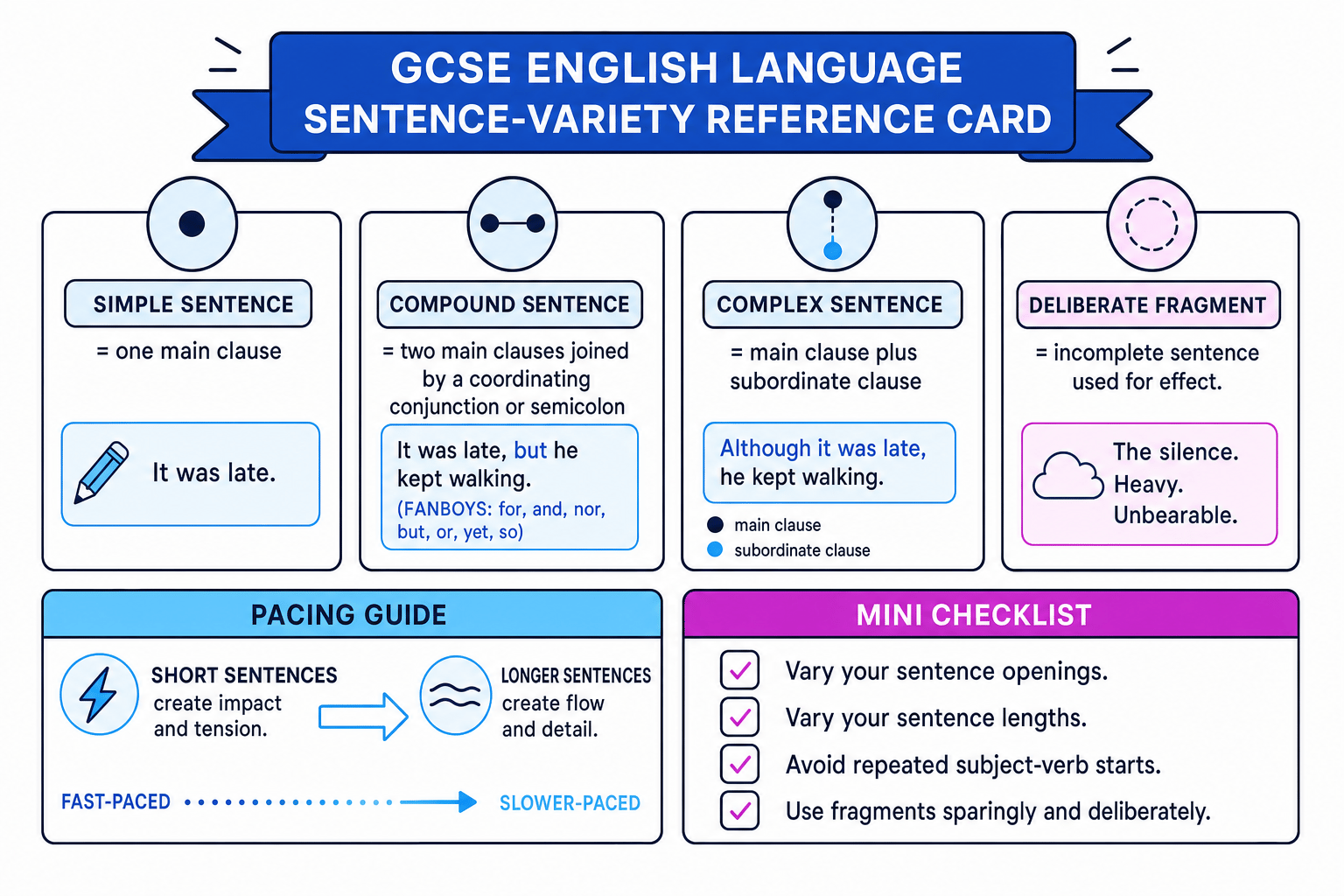
The building blocks: clauses
Before you can control sentence structures, you need to recognise clauses.
Clause
A clause is a group of words containing a verb, and usually a subject. A main clause can make sense by itself. A subordinate clause depends on another clause to complete its meaning.
A subject is the person, place, thing or idea doing or being something. A verb is the action or state of being.
For example:
- The wind screamed = main clause. It makes sense alone.
- because the window was open = subordinate clause. It has a verb, but it feels unfinished.
Finding clauses
-
In the sentence “As the rain thickened, Maya pulled her coat tighter,” identify the verbs: thickened and pulled. Two verbs usually means there may be two clauses.
-
Test each part to see if it can stand alone. “Maya pulled her coat tighter” makes complete sense, so it is the main clause.
-
“As the rain thickened” has a verb, but it leaves you waiting for more information. The word as makes it dependent, so it is a subordinate clause.
Simple sentences
A simple sentence contains one main clause. It does not mean the sentence is childish or tiny; it simply means there is only one complete clause.
Examples:
- The corridor narrowed.
- A single yellow light flickered above the locked door.
The second sentence is longer, but it is still simple because it has one main clause: A single yellow light flickered.
Simple does not mean short
A simple sentence can contain description, adjectives and phrases. What matters is that it has one main clause, not how many words it contains.
Checking a simple sentence
-
Look at: “Beyond the playground, the old caretaker’s hut leaned towards the fence.” The main verb is leaned.
-
Ask whether there is another complete subject-and-verb unit. “Beyond the playground” adds place, but it is not a clause because it has no verb.
-
The sentence has one main clause — “the old caretaker’s hut leaned towards the fence” — so it is a simple sentence, even though it begins with extra detail.
Compound sentences
A compound sentence joins two or more main clauses. Each part could stand alone as a sentence, but the writer links them because the ideas are closely connected.
A coordinating conjunction is a joining word that links equal ideas. The common ones are often remembered as FANBOYS: for, and, nor, but, or, yet, so.
Examples:
- The lights went out, and the room fell silent.
- The gate was locked, but someone had left a key beneath the stone.
You can also join two closely related main clauses with a semicolon:
- The lights went out; the room fell silent.
Comma splice
Do not join two full sentences with only a comma: The lights went out, the room fell silent. That is a comma splice. Use a full stop, a conjunction or a semicolon instead.
Joining main clauses
-
Start with two simple sentences: “The path ended. The forest continued.” Both are main clauses because each could stand alone.
-
Decide the relationship between them. The ideas contrast: the path stops, but the forest goes on.
-
Choose a suitable joining method: “The path ended, but the forest continued.” The conjunction but makes the contrast clear and creates a compound sentence.
Complex sentences
A complex sentence contains at least one main clause and at least one subordinate clause.
A subordinating conjunction is a word that makes one clause depend on another. Common examples include because, although, while, when, if, since, as and before.
Examples:
- Although the street was empty, I felt watched.
- I felt watched because a curtain twitched upstairs.
- When the bell rang, nobody moved.
Complex sentences are useful because they show relationships between ideas: time, cause, contrast, condition or tension.
Building tension with a complex sentence
-
Start with a plain main clause: “The door opened.” It is clear, but it gives limited atmosphere.
-
Add a subordinate clause to control timing: “While the house held its breath, the door opened.” The word while makes the opening feel slow and suspenseful.
-
Place the subordinate clause first to delay the main action. The reader waits through “While the house held its breath” before reaching “the door opened”, so the sentence creates anticipation.
Short sentences for impact
A short sentence often creates speed, shock or emphasis. It works best when it appears after a longer sentence, because the contrast makes it stand out.
Examples:
- Then it stopped.
- Too late.
- Nobody answered.
Short sentences can be powerful in creative writing, especially at moments of fear, realisation or sudden change.
Use contrast
A short sentence has more impact when it interrupts a longer flow. If every sentence is short, none of them feels special.
Longer sentences for flow
A long sentence can create movement, detail or a flowing train of thought. It can slow the reader down, guide them through a setting, or show a character noticing several things at once.
For example:
The mist crept over the playground, slipped between the rusting swings, gathered beneath the climbing frame and curled around the abandoned football like something alive.
This sentence uses a series of verbs — crept, slipped, gathered, curled — to create smooth, continuous movement.
Changing pace with sentence length
-
Decide the effect you want. Suppose you want a slow build-up followed by sudden fear.
-
Use a longer sentence to create flow and detail: “The corridor stretched ahead, narrowing with every step, its walls sweating in the dark.” This slows the moment down.
-
Follow it with a short sentence for impact: “Something moved.” The sudden brevity makes the threat feel sharper.
Varied sentence openings
A sentence opening is the way a sentence begins. If every sentence starts with the same pattern, your writing can sound flat.
A repetitive pattern might look like this:
I walked to the gate. I looked through the bars. I heard a noise. I ran.
There is nothing technically wrong with each sentence, but the repeated I + verb pattern becomes predictable.
You can vary openings by using:
- A place phrase: Beyond the gate, the garden had disappeared into weeds.
- A time phrase: At midnight, the windows began to glow.
- A subordinate clause: Although I wanted to leave, I stepped closer.
- An -ing phrase: Shivering, I reached for the handle.
- A single-word opener: Suddenly, the lock clicked.
A phrase is a group of words that does not contain a full subject-and-verb clause. For example, “Beyond the gate” is a phrase because it gives place, but it has no verb.
Watch unclear -ing openings
Make sure an -ing opening clearly belongs to the subject that follows. “Running down the road, the house vanished” accidentally suggests the house is running. Better: “Running down the road, I watched the house vanish.”
Deliberate fragments
A fragment is an incomplete sentence. In creative writing, a fragment can be used deliberately for voice, drama or tension. It is sometimes called a minor sentence.
Examples:
- No sound.
- A mistake.
- Gone.
Fragments can be effective because they feel abrupt. They can mimic panic, shock or broken thought.
Accidental fragments
Fragments only help if they look controlled. If your whole paragraph is full of unfinished sentences, the examiner may read it as weak accuracy rather than deliberate craft.
Using a fragment deliberately
-
Start with a complete version: “There was no way out.” This is clear and grammatically complete.
-
Decide whether the moment needs speed or shock. If the character has just realised they are trapped, a fragment may capture panic more sharply.
-
Rewrite as a controlled fragment after a complete sentence: “The handle snapped in my hand. No way out.” The fragment works because the surrounding sentence proves you can write accurately.
Avoiding repetitive sentence patterns
Sentence variety is not about showing off every structure you know. It is about matching structure to meaning.
Compare these two versions:
Repetitive:
The street was empty. The windows were dark. The road was wet. The house was silent.
Improved:
Along the empty street, dark windows stared from either side. Rain shone on the road, and at the end of it the house waited in silence.
The improved version varies the opening, combines related details, and saves focus for the house.
Editing repetitive openings
-
Identify the repeated pattern. In “The street was… The windows were… The road was… The house was…”, each sentence starts with a noun followed by was/were.
-
Decide what should be emphasised. The most important image is the house, so save it for the end of the description.
-
Combine and vary the details: “Along the empty street, dark windows stared from either side. Rain shone on the road, and at the end of it the house waited in silence.” The opening phrase, compound structure and final focus make the writing more controlled.
A practical sentence-variety checklist
When you proofread your creative writing, ask:
- Have I used a mix of simple, compound and complex sentences?
- Have I used short sentences only where they create impact?
- Do some longer sentences create flow, atmosphere or detail?
- Do too many sentences begin in the same way?
- Are any fragments clearly deliberate?
- Have I avoided comma splices?
You do not need to force every technique into one paragraph. A controlled paragraph with three well-chosen sentence structures is better than a chaotic paragraph trying to do everything.
In the exam
-
Plan the pace of your writing before you start: slower description, faster action, or a mixture of both.
-
Use sentence variety to support meaning: short for shock, complex for tension or explanation, compound for linked actions.
-
Leave two minutes to proofread for AO6: check comma splices, accidental fragments, repeated openings and missing full stops.
-
Do not overcomplicate every sentence. Clear control earns more credit than awkward “fancy” structures.
Check yourself
-
Can you explain the difference between a main clause and a subordinate clause?
-
Can you turn two simple sentences into a compound sentence without creating a comma splice?
-
Can you rewrite a repetitive paragraph so the sentence openings and lengths are more varied?
