What you'll learn
- How to use a picture as a springboard for creative writing.
- How to choose a clear focus instead of describing everything you can see.
- How to turn an image into a setting, character, moment, atmosphere, or narrative situation.
- How to plan a focused Paper 1 Section B response for AO5 and AO6.
Where this fits in the exam
In AQA GCSE English Language Paper 1, Section B is the creative writing task, often known as Question 5. Paper 1 lasts 1 hour 45 minutes, is worth 80 marks, and counts for 50% of the GCSE. Section B is worth 40 marks: 24 marks for Assessment Objective 5 (AO5), meaning clear, imaginative communication and organisation, and 16 marks for Assessment Objective 6 (AO6), meaning vocabulary, sentence structures, spelling and punctuation.
A sensible target is to spend about 45 minutes on the writing task, including planning and checking.
Picture prompt
A picture prompt is an image given with a writing task to inspire your response. It is not a checklist of things you must describe; it is a starting point for your own creative writing.
The picture is a springboard, not a checklist
The most important idea is this: you do not need to describe every part of the image. You can use one part of it to inspire a place, a person, a tense moment, a mood, or the beginning of a story.
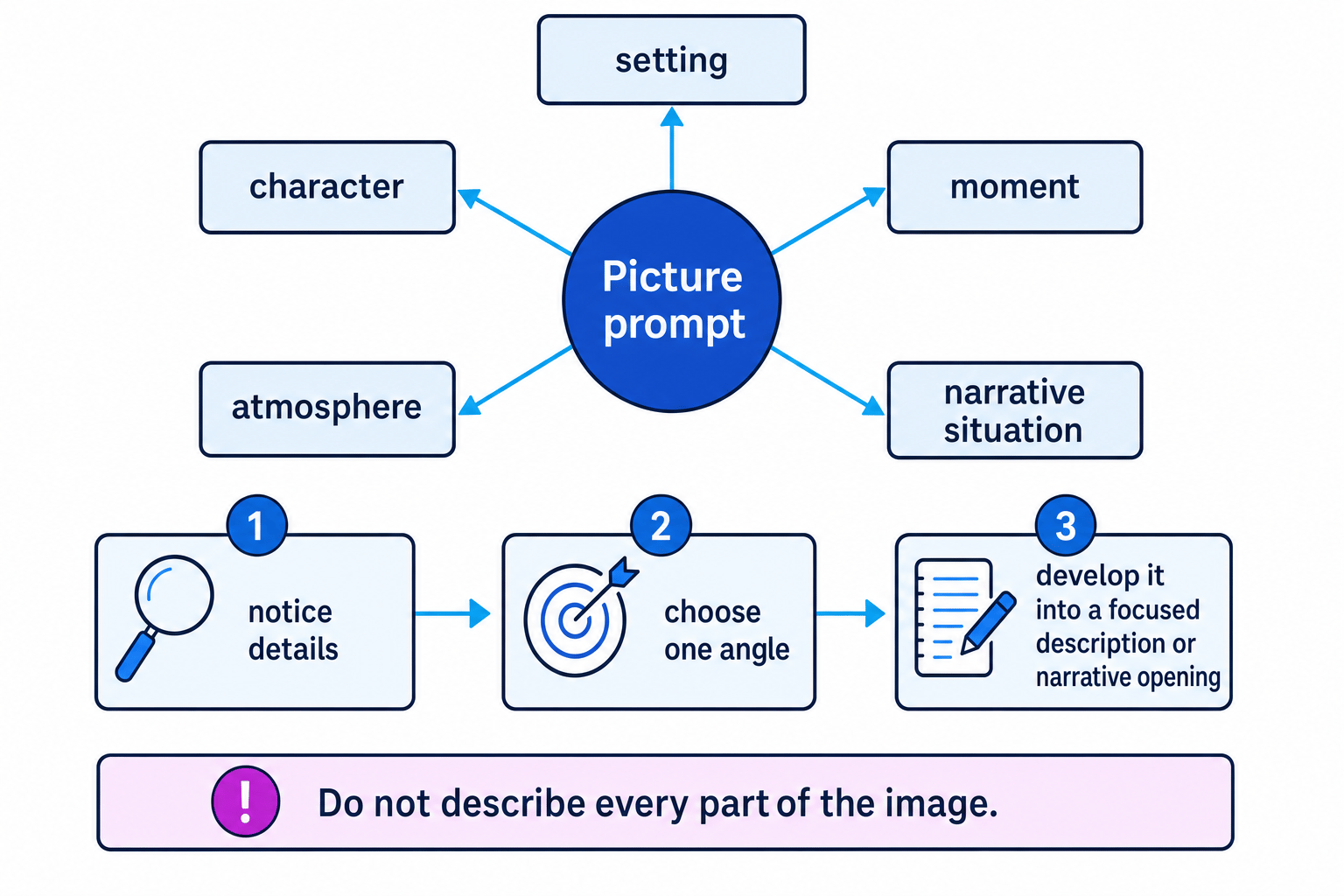
Use the image as inspiration
A strong response usually chooses one clear angle and develops it deeply. It is better to write a vivid, controlled piece based on one detail than a rushed list of everything in the picture.
Start by choosing your focus
Your focus is the main thing your writing is really about. It might be a lonely street, a nervous character, a stormy atmosphere, or the split second before something happens.
When you first look at the image, ask yourself:
- What mood does it suggest?
- What detail draws my attention first?
- Who might be here?
- What might have just happened?
- What might be about to happen?
You are allowed to move beyond the literal image, as long as your writing is still clearly suggested by it.
Choosing a focus from an image
Imagine the picture shows a station platform at night, with rain, empty benches, bright lights, and one person standing near the edge.
- Group the details into possible ideas: the rain and darkness suggest atmosphere; the lone person suggests character; the platform edge suggests a possible moment of tension.
- Decide which idea gives you the most to develop. A full description of the station might become a list, but the lone person waiting in the rain gives you mood, setting, and possible story.
- Turn the focus into a writing intention: “I will describe a deserted station at night through the viewpoint of someone waiting for news.”
- Choose what to leave out. You do not need to mention every sign, bench, light, or building; only use details that support the feeling of waiting and isolation.
Five useful ways to use the image
1. Setting
A setting is the place and time where writing happens. The image might inspire a beach at dawn, a busy street, a silent classroom, or a ruined house.
Good setting writing is not just “what is there”. It creates a feeling.
2. Character
A character is a person in your writing. The image might show someone directly, or it might make you imagine someone who belongs there.
You could focus on what the character notices, fears, remembers, or wants.
3. Moment
A moment is a small slice of time. Instead of trying to tell a whole life story, you might zoom in on one powerful instant: a door opening, a train arriving, a phone ringing, a wave breaking.
4. Atmosphere
Atmosphere means the overall mood or feeling created by your writing. It might be tense, peaceful, eerie, joyful, lonely, or chaotic.
This is often the easiest way to use a picture prompt because you can build atmosphere through word choice, sensory detail, and sentence structure.
5. Narrative situation
A narrative situation is the basic setup for a story: someone is somewhere, and something is happening or about to happen. It is not the whole plot.
For example: a person waits outside a locked house; a child loses sight of their parent in a crowd; a visitor arrives at a place they hoped never to see again.
Keep it simple
For a story opening, try this formula: one person, one place, one change. This gives your writing direction without forcing you to invent a complicated plot.
Description or narrative: read the wording carefully
A description creates a vivid impression of a place, person, object, or moment. It can include movement and time passing, but it does not need a full plot.
A narrative is writing that tells events. In Paper 1 Section B, you are usually rewarded for control and craft, not for cramming in lots of action. A strong opening often sets up tension rather than solving everything.
If the task asks you to write a description, keep the focus on the image, mood, and details. If it asks for a story or opening, use the picture to create a situation and let the image influence the world of the story.
The tour-guide response
A weak picture response often moves around the image mechanically: “On the left there is… In the middle there is… At the back there is…” This sounds like labelling, not creative writing. Instead, choose a viewpoint and shape the details into a mood or moment.
Plan a path through the image
A good plan stops your writing becoming random. You can move from a wide view to a close detail, then shift into sound, movement, memory, or tension.
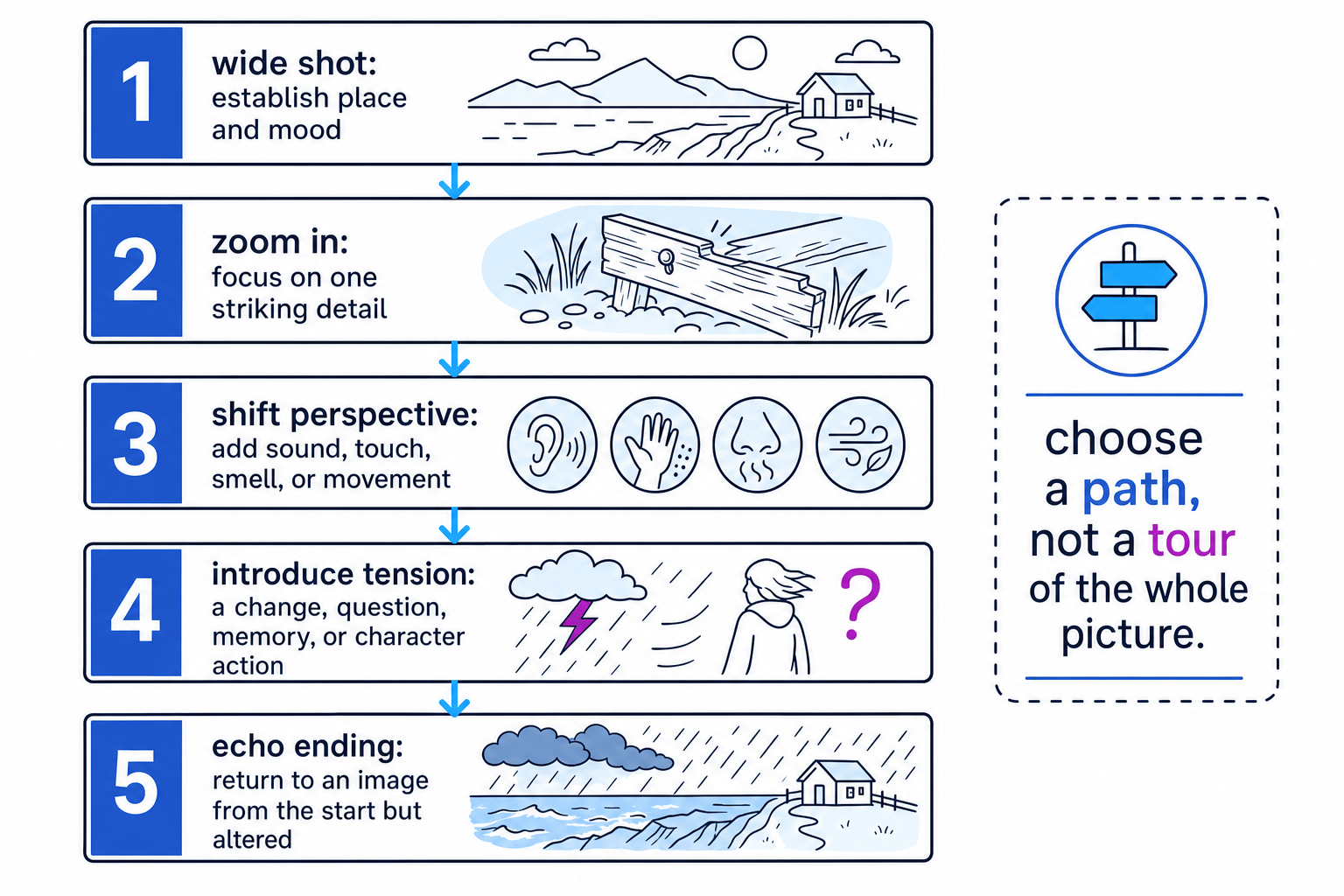
This structure works for both description and narrative openings because it gives your writing shape.
A simple five-part plan
- Wide shot: establish the place and mood.
- Zoom in: focus on one striking detail.
- Shift perspective: add sound, touch, smell, movement, or viewpoint.
- Introduce tension: add a change, question, memory, or character action.
- Echo ending: return to an image from the start, but with a changed feeling.
Structural choice
A structural choice is a decision about the order and shape of your writing, such as where you begin, when you zoom in, how you shift focus, and how you end.
Build detail instead of adding more things
Strong creative writing often comes from developing one image carefully. You can use precise nouns and precise verbs to make the writing sharper. A noun names a thing; a verb shows an action or state.
For example, “the bird moved” is vague. “The gull staggered” is more precise because “gull” gives a clearer image and “staggered” suggests unstable movement.
You can also use figurative language, which means language that describes something by comparing it to, or presenting it as, something else. A simile compares using “like” or “as”; personification gives human qualities to something non-human.
Developing one detail into a paragraph
Suppose your focus is a rainy platform at night.
- Choose one concrete detail that can carry the mood: a puddle under the station light is better than trying to describe the whole platform at once.
- Select precise vocabulary to control the feeling: “puddle”, “trembled”, “strip of light”, and “black water” create a colder mood than “water”, “moved”, and “light”.
- Add sensory detail that fits the focus: sound from the speaker or rain on metal supports the lonely atmosphere without changing the subject.
- Vary the sentence structure for effect: a longer sentence can build the scene, while a short sentence can create a pause or jolt.
Result: Under the station light, a puddle trembled in its thin strip of brightness. Rain ticked against the metal roof. Somewhere above me, the speaker crackled, swallowed its own words, and fell silent again.
Use sentence variety deliberately
Sentence variety means using different sentence lengths and structures to control pace and emphasis.
A simple sentence has one main idea: “The platform was empty.” This can feel blunt or dramatic.
A compound sentence links two main ideas: “The platform was empty, and the rain kept falling.” This can show connection or continuation.
A complex sentence includes a main idea plus extra information: “Although the train was due, the platform remained empty.” This can create tension, contrast, or explanation.
Do not use variety just to show off. Use it to guide the reader’s experience.
Short sentences need a reason
A short sentence works best when it lands on an important moment: a realisation, a sound, a movement, or a change. Too many short sentences in a row can feel choppy.
Keep the link to the picture visible
Even though you can be imaginative, the examiner should still be able to see how the image inspired you. You can keep that link through:
- repeated details from the image, such as rain, light, trees, buildings, water, crowds, or shadows
- a consistent atmosphere suggested by the image
- a setting clearly based on the image
- a character who seems to belong in that scene
- an ending that echoes an earlier visual detail
You do not need to keep saying “in the picture”. In fact, you usually should not. Write as if the scene is real.
Forcing in techniques
Do not add metaphors, similes, semicolons, or ambitious words just because you think they sound impressive. AO6 rewards control and accuracy. AO5 rewards clear, imaginative communication. A simple, accurate sentence is better than a confused one packed with techniques.
A quick planning routine
Before you write, spend a few minutes making decisions:
- What is my main focus: setting, character, moment, atmosphere, or narrative situation?
- What mood do I want to create?
- Which three details from the image will I reuse or develop?
- How will my writing begin and end?
- Where will I include a shift, such as a sound, movement, memory, or change?
This planning does not need to be long. It just needs to stop your response becoming a list.
In the exam
- Spend a few minutes choosing one clear angle from the image before you start writing.
- Use the picture as inspiration, but follow the exact wording of the task.
- Aim for controlled paragraphs: begin with a clear mood or situation, zoom into details, then end with an echo or shift.
- Leave time to check AO6: sentence boundaries, commas, spelling, paragraphing, and tense consistency.
- If you feel stuck, return to one visual detail and develop what it suggests, rather than trying to describe the whole image.
Check yourself
- Can you explain why you do not need to describe every part of a picture prompt?
- Can you turn one image detail into a setting, character, moment, atmosphere, or narrative situation?
- Can you plan a five-part response that has a clear beginning, shift, and ending?
