What you'll learn
- How to write an engaging opening rather than a rushed full story.
- How to use hooks, setting, character, tension, mystery and immediate conflict.
- How to plan a controlled opening for AQA Paper 1 Section B.
- How to shape your writing for AO5 and AO6 marks.
Why story openings matter
In AQA GCSE English Language Paper 1, Section B asks you to write creatively. Paper 1 lasts 1 hour 45 minutes and is worth 80 marks, which is 50% of the GCSE. The writing task is worth 40 marks: 24 marks for AO5, which rewards clear, imaginative communication and organisation, and 16 marks for AO6, which rewards vocabulary, sentence structures, spelling and punctuation.
A strong story opening is often more successful than trying to write a whole novel in miniature. You do not need a complete plot with ten events, a dramatic death and a neat ending. You need a controlled piece of writing that makes the reader want to continue.
Opening, not whole novel
A story opening should begin a situation, not finish everything. Aim to create curiosity, mood and direction.
A strong opening usually has five parts: a hook, an anchor, a character, tension or mystery, and a sense of direction.
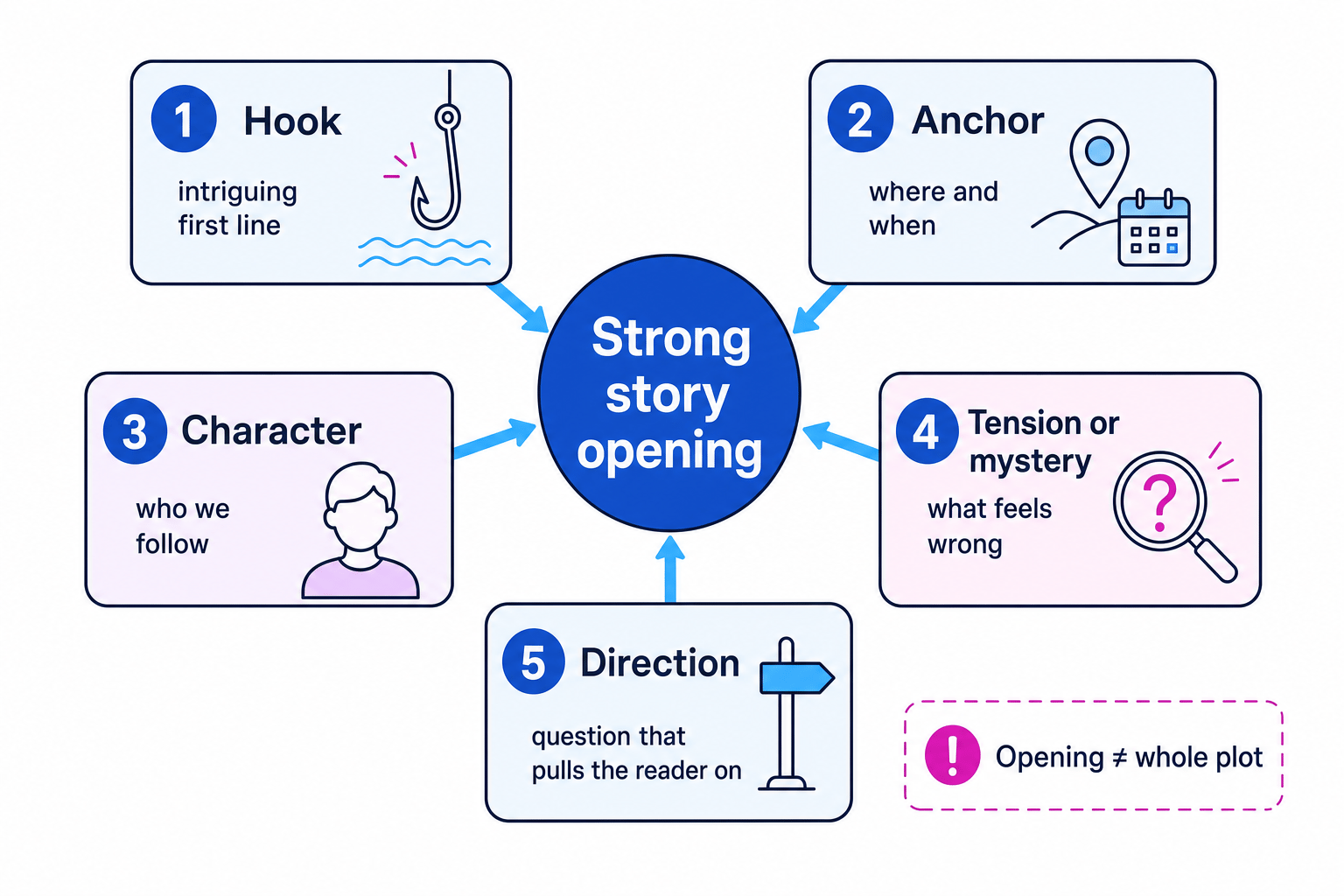
The basic job of a story opening
Story opening
A story opening is the beginning of a narrative. Its job is to introduce the reader to a situation, create interest, and suggest that something is about to change.
A good opening answers some questions quickly:
- Where are we?
- When is this happening?
- Who are we following?
- What feels unusual, tense or important?
- Why should the reader keep going?
It should also leave some questions unanswered. That is what creates curiosity.
Start with a hook
Hook
A hook is a first detail, sentence or moment that grabs the reader’s attention and makes them want to read on.
A hook does not have to be loud or violent. It can be strange, specific, emotional or unsettling. Often, the best hooks make the reader ask a question.
For example, these openings all create curiosity in different ways:
- Specific detail: “At 2.17 a.m., the phone inside the boarded-up shop began to ring.”
- Contradiction: “Everyone said the house was empty, but someone had lit the upstairs lamp.”
- Voice: “I should probably mention now that I was not meant to be there.”
- Immediate problem: “The train doors closed with my bag still inside.”
Notice that none of these explains the whole story. They simply create a reason to continue.
Improving a flat first line
Starting sentence: “It was a scary night and I walked down the road.”
- Replace the vague adjective “scary” with a specific image, because readers feel fear more strongly through detail than through labels.
- Choose one unusual detail that creates a question, such as a sound where there should be silence.
- Put the character into the moment with a precise verb, so the sentence feels active rather than general.
Improved version: “The streetlights flickered out one by one, and I slowed beneath the last pool of yellow light.”
Overloading the first sentence
Do not try to explain the character’s full backstory, the setting, the problem and the ending in your first line. A hook should open a door, not empty the whole room.
Anchor the reader
Anchor
An anchor is the information that helps the reader feel located in the story: usually the place, time and basic situation.
If your opening is only mysterious, the reader may become confused rather than intrigued. After the hook, give enough context for the reader to understand the scene.
This does not mean writing a boring weather report. Setting should do more than decorate the story. It can create mood, pressure and tension.
Setting
The setting is where and when a story takes place. It can include location, time of day, weather, atmosphere and social context.
Compare these:
- “The town was quiet.”
- “Every shop on the high street had its shutters down, though it was only four in the afternoon.”
The second version anchors the reader while creating mystery. The detail “only four in the afternoon” suggests something is wrong.
Use setting as pressure
Ask: How can the place make the situation harder? A locked room, empty station, crowded corridor or stormy beach can all increase tension.
Introduce character through action
A story opening needs a person for the reader to follow. You do not need a full biography. In fact, long character description can slow the opening down.
Characterisation
Characterisation is the way a writer presents a character’s personality, feelings and role in the story.
One of the quickest ways to characterise someone is to show what they do under pressure. Their actions, thoughts and speech can reveal more than a list of traits.
Instead of writing:
“Amir was nervous, kind and responsible.”
You could write:
“Amir checked his little sister’s coat zip for the third time, then looked over his shoulder at the empty road.”
This shows care, anxiety and responsibility without directly listing them.
Introducing character through action
Goal: introduce a character who is anxious but trying to stay calm.
- Give the character a small repeated action that reveals nerves, such as checking a phone, smoothing a sleeve or counting coins.
- Add one responsibility or relationship, because this gives the reader a reason to care about the character’s choices.
- Contrast the character’s outward behaviour with an inward worry, so the reader senses tension beneath the surface.
Model sentence: “Leah smiled at her brother as if everything was fine, but her thumb kept tapping the cracked screen of her phone.”
Build tension, mystery and conflict
Tension
Tension is the feeling of uncertainty, pressure or worry that makes the reader anticipate what might happen next.
Mystery
Mystery is created when the reader knows that something important is hidden, unexplained or incomplete.
Conflict
Conflict is a struggle between opposing forces. It can be external, such as a character against another person or situation, or internal, such as a character fighting fear, guilt or doubt.
Immediate conflict does not have to mean a car chase. It could be:
- a character wants to leave, but the door is locked;
- a character wants to tell the truth, but someone else is listening;
- a character wants to appear calm, but panic is rising;
- a character wants to find someone, but the place is empty.
The key is this: someone wants something, and something blocks them.
Building immediate conflict from a simple situation
Basic situation: a student waits outside a school gate.
- Decide what the character wants: they need to meet someone who promised to bring an important envelope.
- Add an obstacle: the gate is locked, the playground is empty, and the person is late.
- Add a consequence: if the envelope does not arrive, the character will have to go home and face a difficult conversation.
- Create one unanswered question: why was the meeting arranged in secret?
Possible opening direction: “By the time the caretaker locked the main gate, Jonas had already checked his phone nineteen times. The message still said the same thing: Wait there. Don’t let anyone see you.”
Control the pace
Pace
Pace is the speed at which a story feels as if it is moving. Writers control pace through sentence length, paragraphing, detail and action.
Many weak stories start too far back:
- waking up;
- getting dressed;
- eating breakfast;
- travelling to the main event.
Usually, this wastes time. Start close to the moment when something changes.
A useful method is to begin just before the problem becomes unavoidable. This gives you room to build tension without rushing straight to chaos.
Start near the change
Begin your opening at the point where normal life is about to be disturbed: the knock at the door, the missing object, the strange message, the arrival of someone unexpected.
You can also control pace with sentence length. Longer sentences can slow the reader down and build atmosphere. Short sentences can create shock, fear or emphasis.
For example:
“The corridor stretched ahead, narrow and airless, its lockers shining faintly beneath the emergency lights. Then something moved.”
The short second sentence changes the pace and signals danger.
Choose a reliable opening shape
You do not need to invent a completely new structure in the exam. You can use a simple opening shape and make it original through your details and voice.
1. The zoom-in setting opening
Start wide, then focus on one important detail.
Example shape: town → street → house → window → hand behind the curtain.
This works well when you want atmosphere and mystery.
2. The immediate action opening
Begin with a character already doing something urgent.
Example shape: running, hiding, searching, waiting, carrying, escaping.
This works well when you want pace and tension.
3. The mysterious object opening
Focus on an object that should not be there.
Example shape: a key, letter, photograph, suitcase, phone, ticket or broken watch.
This works well when you want curiosity without explaining too much.
4. The voice-led opening
Use a strong narrative voice, which means the personality or perspective of the narrator.
Example shape: a confession, warning, memory or unusual opinion.
This works well when your character’s attitude is interesting.
5. The conflict dialogue opening
Begin with a line of speech that suggests disagreement or danger.
Example: “Put it back before they notice.”
This can work well, but be careful: if you start with dialogue, anchor the reader quickly afterwards so they know who is speaking and where they are.
Dialogue needs context
A first line of dialogue can be effective, but too many unnamed speakers at the start can confuse the reader. Give the reader a person, place or action quickly.
Plan a controlled opening
For Paper 1 Section B, you should normally spend about 45 minutes on the writing task, including planning and checking. A short plan helps you avoid the biggest problem: writing a rushed full plot with an undeveloped ending.
Plan one scene. Give it a beginning, a shift and a final unanswered question.
Turning a prompt into an opening plan
Prompt idea: write a story opening suggested by an empty railway platform.
- Choose the central question: why is one person waiting on an empty platform after the last train should have gone?
- Anchor the scene: late evening, rural station, rain, broken announcement speaker.
- Introduce the character through action: the character keeps checking an old paper ticket rather than using a phone.
- Create immediate conflict: the ticket is for a train that no longer appears on the timetable.
- Decide the final direction: a train arrives silently, but its windows are dark and no driver is visible.
This plan gives you enough to write a focused opening without needing to explain the whole story.
Use language precisely
For AO5, your ideas and organisation matter. For AO6, your technical accuracy and sentence control matter. The best openings usually use precise vocabulary rather than lots of dramatic adjectives.
Instead of:
“The very scary, creepy, terrifying forest was really dark.”
Try:
“The trees pressed together, blackening the path ahead.”
The second version uses a precise verb, “pressed”, to make the setting feel threatening.
Nouns and verbs first
Before adding adjectives, improve your nouns and verbs. “The dog moved” becomes “The hound limped.” That is instantly more specific.
Paragraphing also matters. Start a new paragraph when:
- the focus shifts;
- a new action happens;
- a new character speaks;
- you want to emphasise a moment.
A one-sentence paragraph can be powerful, but only if used sparingly.
End the opening with direction
A story opening should not solve the whole problem. It should end with the reader wanting to know what happens next.
Cliffhanger
A cliffhanger is an ending that breaks off at a moment of suspense, discovery or danger.
However, avoid melodramatic cliffhangers that feel random, such as sudden explosions or “and then I died.” A better ending often reveals a new question.
Good ways to end an opening include:
- a character notices something impossible;
- someone arrives unexpectedly;
- a hidden object is found;
- a decision is made;
- a warning is understood too late.
The ending should feel connected to the opening, not bolted on.
Rushing to the ending
Do not spend three paragraphs building atmosphere and then suddenly summarise five major events in the final two lines. Keep the opening controlled and focused.
In the exam
- Spend a few minutes planning your hook, anchor, character, conflict and final unanswered question.
- Write one controlled scene rather than a full novel-style plot with too many events.
- Start close to the moment of change, not with a long morning routine or backstory.
- Use precise nouns, verbs, varied sentence lengths and clear paragraphing to support AO5 and AO6.
- Leave time to check spelling, punctuation, tense consistency and sentence boundaries.
Check yourself
- Does your first line make the reader curious without explaining everything?
- Can the reader quickly understand where the scene is, when it is happening and who they are following?
- Is there a clear source of tension, mystery or conflict by the end of the opening?
