What you'll learn
- How to plan before you write in AQA GCSE English Language Paper 1 Section B.
- Five quick planning methods: story arc, zoom-in description, mood shift, circular structure and vocabulary bank.
- How planning helps you gain marks for AO5 and AO6.
- How to use 5 minutes wisely before writing your answer.
Why planning matters
In AQA GCSE English Language Paper 1, Section B is the creative writing task. The whole paper lasts 1 hour 45 minutes and is worth 80 marks. The writing task is worth 40 marks: 24 marks for content and organisation, assessed through AO5, and 16 marks for technical accuracy, assessed through AO6.
AO5 rewards clear, imaginative communication and organisation. AO6 rewards vocabulary, sentence structures, spelling and punctuation.
So planning is not “wasted time”. It is how you create a controlled piece of writing that actually has shape.
Planning
Planning means deciding the main content, structure, mood and language choices of your writing before you begin drafting it.
The main point
A short plan helps you avoid the biggest creative writing problem: starting confidently, then running out of direction halfway through.
A good plan does not need full sentences. It can be a quick set of bullet points, arrows, key words and paragraph ideas.
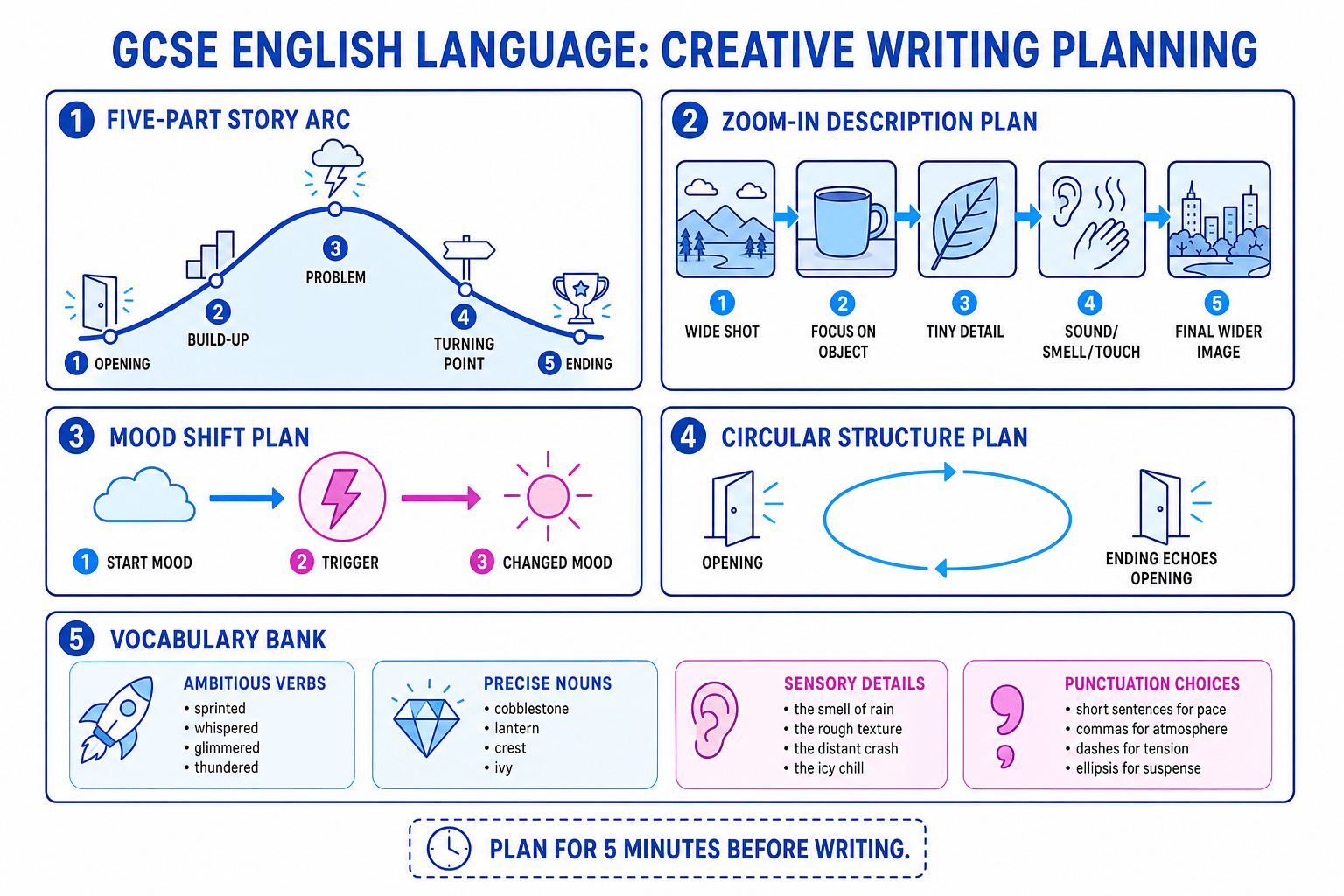
This diagram shows the main planning routes you can choose from.
Start with the task
A stimulus is the starting point you are given, such as a picture, title or written prompt. A prompt is the instruction telling you what to write about.
Before planning, decide what kind of writing you are producing:
- A narrative is a story with events, characters and change.
- A description focuses more on a place, person, object or moment.
- A hybrid piece mixes both: for example, a description that slowly reveals a character or a story that contains rich descriptive moments.
You do not need a complicated plot. In GCSE creative writing, a controlled small idea is usually stronger than an overambitious disaster movie.
Planning a whole novel
Do not plan ten characters, three locations and years of action. The task rewards a crafted piece of writing, not the biggest possible plot. Focus on one moment, one problem or one change.
Choosing the best planning route
Suppose the prompt is: Write about a surprising discovery.
- Decide whether the idea is mainly a story or a description. A “discovery” naturally suggests change, so a short narrative would work well.
- Narrow the focus. Instead of “someone discovers a lost civilisation”, choose a smaller moment: someone finds an old photograph behind a mirror.
- Choose a structure. A five-part story arc works because the writing can move from ordinary life to discovery, then to a changed understanding.
- Add one planned language focus. For example, the mirror can create imagery of reflection, secrets and broken identity.
The five-part story arc
A story arc is the shape of a narrative from beginning to end. It helps you control the order of events.
A simple five-part story arc is:
- Opening — introduce the setting, character or situation.
- Build-up — increase interest or tension.
- Problem — something changes, goes wrong or is revealed.
- Turning point — the character responds or realises something.
- Ending — leave the reader with resolution, uncertainty or a final image.
The key is that each part should change something. If the middle is just “more description”, the story may feel flat.
Plan the ending early
Before writing your first paragraph, decide roughly where you will end. A planned ending makes the whole piece feel more deliberate.
Building a five-part story arc
For the idea someone finds an old photograph behind a mirror, a quick plan could work like this:
- Choose the opening situation: a teenager is clearing an empty house after a relative has died, creating a quiet and reflective mood.
- Add the build-up: the mirror is loose, the room feels untouched, and small details suggest something has been hidden deliberately.
- Create the problem: behind the mirror, the character finds a photograph showing their relative with a stranger whose face has been scratched out.
- Decide the turning point: the character recognises the background of the photograph as their own school, making the discovery personal and unsettling.
- Shape the ending: return to the mirror, but now the character cannot look at their reflection in the same way.
The zoom-in description plan
A zoom-in description plan is a structure for descriptive writing. Instead of trying to describe everything, you move the reader’s attention from wide to narrow.
A useful sequence is:
- Wide shot: the whole place or scene.
- Focus: one object, person or area.
- Tiny detail: a specific mark, sound, movement or texture.
- Sensory detail: smell, sound, touch, taste or temperature.
- Final image: a wider view or memorable closing detail.
This works because description needs organisation too. You are guiding the reader’s “camera”.
Sensory detail
A sensory detail is a description linked to one of the senses: sight, sound, smell, touch or taste.
Planning a zoom-in description
For a description of an abandoned train station, you could plan it like this:
- Begin with the wide shot: the platform is empty, the tracks are rusted, and the sky presses down over the station.
- Shift focus to one object: a broken clock hangs above the ticket office, suggesting time has stopped.
- Zoom into a tiny detail: a cobweb trembles across the clock face whenever the wind enters.
- Add sensory detail: the air smells of damp paper, and the metal railing feels cold and gritty.
- End with a final image: far down the track, a signal light flickers even though no train is coming.
The mood shift plan
A mood is the emotional atmosphere of a piece of writing. A mood shift is when that atmosphere changes.
For example, a piece might move from calm to threatening, lonely to hopeful, or ordinary to strange.
A mood shift gives your writing a sense of movement even if not much “happens”. This is especially useful in descriptions.
Change creates interest
Creative writing often becomes stronger when something changes: the mood, the character’s understanding, the weather, the pace or the reader’s expectations.
Creating a mood shift
For a scene at a quiet bus stop, you could plan the shift like this:
- Start with calm details: soft rain, an empty road, regular drips from the shelter roof.
- Introduce a trigger: the timetable suddenly peels away from the glass, revealing a handwritten message underneath.
- Change the sentence style: move from longer, flowing sentences to shorter sentences as the character reads the message.
- End in a new mood: the bus stop is no longer peaceful; every approaching headlight now feels threatening.
The circular structure plan
A circular structure is when the ending echoes the beginning. It does not mean the ending is identical. It means the final image, sentence, object or idea links back to the opening.
This can make your writing feel crafted and complete.
For example:
- Opening: a door is locked.
- Ending: the same door is open.
- Opening: rain taps gently on a window.
- Ending: rain hammers against broken glass.
- Opening: a character refuses to look in a mirror.
- Ending: the character finally looks.
Use an object as your anchor
A circular structure is easier if you choose one repeated object: a key, mirror, photograph, clock, window, shoe, phone or letter.
Planning a circular structure
For a story about a lost key, you might plan the circle like this:
- Open with the key missing, making the character feel trapped outside a house.
- Use the middle to change the meaning of the key: it is not just for a door; it opens a box connected to a family secret.
- Return to the key at the end, but with a new meaning: the character can enter the house, yet no longer feels they belong there.
- Echo the opening image: the same doorstep appears again, but the character’s feelings have changed.
The vocabulary bank
A vocabulary bank is a small list of words and phrases you prepare before writing. It helps you avoid repeating basic words like “nice”, “scary”, “walked” or “said”.
Your vocabulary bank can include:
- Precise nouns: “corridor” instead of “place”; “lantern” instead of “light”.
- Ambitious verbs: “lurched”, “glimmered”, “splintered”, “murmured”.
- Adjectives used carefully: “brittle”, “stale”, “restless”, “jagged”.
- Sensory phrases: “the sour smell of rainwater”, “a grit of dust on the tongue”.
- Punctuation choices: a dash for interruption, a colon before a reveal, a short sentence for impact.
Precise noun
A precise noun names something accurately and specifically, such as “stile”, “alleyway”, “shutter” or “platform”, rather than a vague word like “thing” or “place”.
Forcing impressive vocabulary
Do not use ambitious words just to show off. A simple accurate word is better than a fancy word that does not fit the meaning or tone.
Creating a vocabulary bank
For an uneasy description of a narrow alley, a quick vocabulary bank might be built like this:
- Choose the atmosphere: uneasy, cramped and damp.
- Select precise nouns: “drainpipe”, “cobblestones”, “shutter”, “gutter”, “doorway”.
- Choose verbs that match the mood: “leaked”, “clung”, “flickered”, “scraped”, “crouched”.
- Add sensory phrases: “the metallic smell of rain”, “walls slick with cold”, “a distant bottle rolling”.
- Plan punctuation for effect: one short sentence after a longer descriptive sentence to create a sudden pause.
A simple 5-minute planning routine
You do not need a beautiful plan. You need a usable one.
Try this:
- Minute 1: decide your main idea and ending.
- Minute 2: choose your structure: story arc, zoom-in, mood shift or circular.
- Minute 3: plan 4–5 paragraph focuses.
- Minute 4: build a vocabulary bank.
- Minute 5: choose one sentence or punctuation technique you will deliberately use.
A paragraph focus means the main job of each paragraph. For example: “wide setting”, “object detail”, “problem appears”, “reaction”, “final image”.
Do not over-plan
If your plan takes too long, it starts stealing writing time. Aim for a quick working plan, not a perfect one.
What your plan might look like
Here is a compact planning template you can adapt:
- Idea: one sentence summary.
- Ending: final image or final change.
- Structure: story arc / zoom-in / mood shift / circular.
- Paragraphs: 4–5 bullet points.
- Vocabulary bank: 6–10 useful words or phrases.
- Craft choices: one repeated image, one sentence length contrast, one punctuation choice.
This is enough to give your writing direction while leaving room for creativity as you draft.
In the exam
- Spend about 5 minutes planning before you write; it can protect many more marks than it costs.
- Keep the idea small and controlled: one place, one moment, one problem or one change.
- Plan for AO5 and AO6 together: structure your ideas, then choose vocabulary, sentence forms and punctuation deliberately.
- Check the final 5 minutes for paragraphing, full stops, commas, tense control and spelling of common words.
Check yourself
- Can you explain the difference between a story arc and a zoom-in description plan?
- What object could you use as an anchor for a circular structure?
- If you had 5 minutes to plan, what would you decide first: vocabulary, opening sentence or ending?
