What you'll learn
- What viewpoint means in AQA GCSE English Language Paper 2.
- How to recognise opinion, attitude, bias, perspective, purpose, tone and audience.
- How to choose precise words like angry, nostalgic, critical or hopeful.
- How to turn viewpoint into clear exam comments with evidence.
Why viewpoint matters in Paper 2
AQA English Language Paper 2 is 1 hour 45 minutes, worth 80 marks / 50% of the GCSE. Section A is reading non-fiction, which means writing based on real people, events, issues or experiences. The sources are unseen, so you will not have studied them before.
Viewpoint is especially important when you are asked about writers’ ideas and perspectives. It can also help with language analysis because writers reveal what they think through their word choices and methods.
Viewpoint
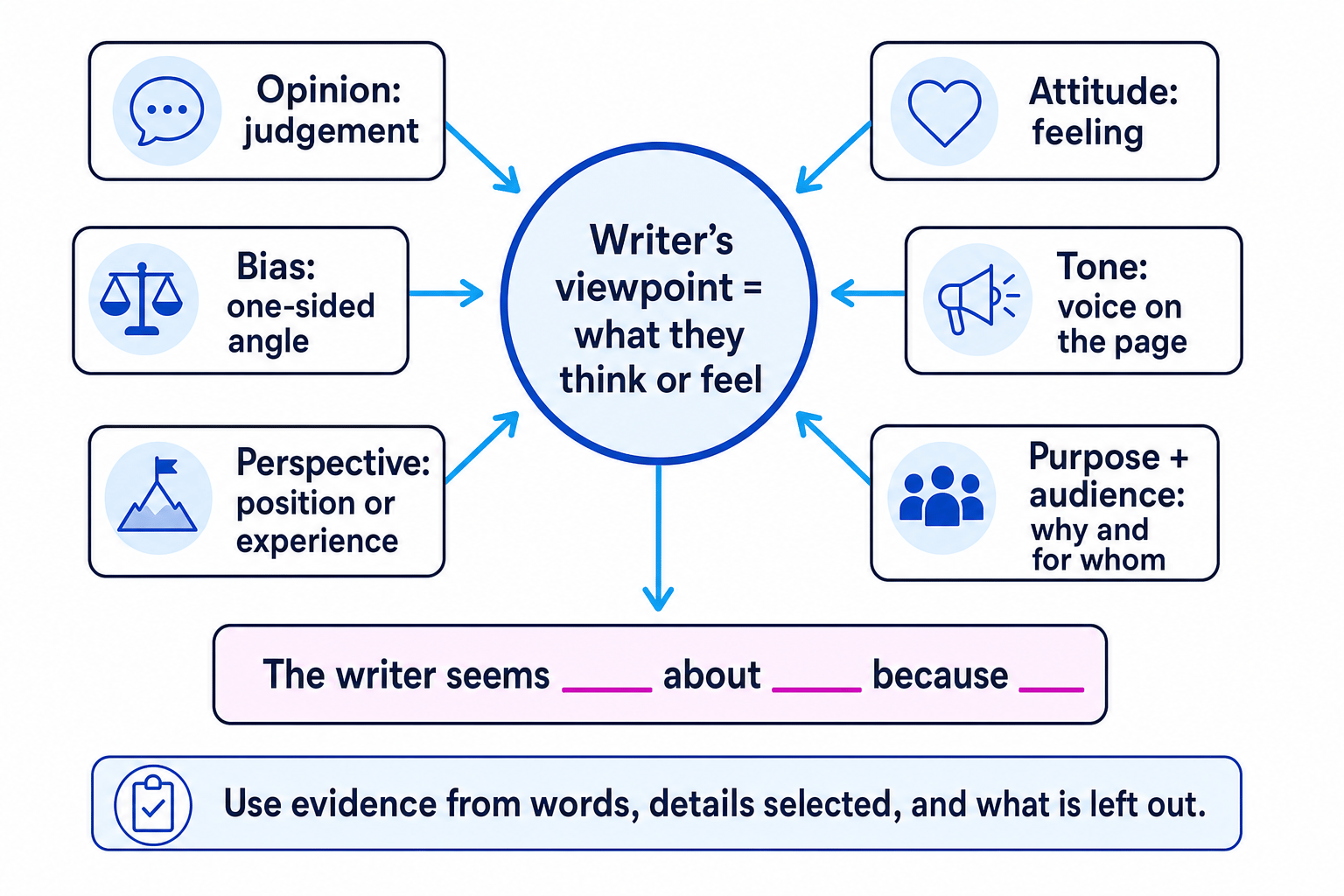
Viewpoint is what a writer thinks, feels or believes about a subject, including the angle they choose and the impression they want the reader to form.
Start simple: topic is not viewpoint
The topic is what the text is about. The viewpoint is what the writer thinks or feels about that topic.
For example, “school uniform” is a topic. “School uniform is unfair and restricts individuality” is a viewpoint.
Topic is not viewpoint
Do not stop at what the writer is writing about. Ask: what judgement, feeling or angle are they creating?
Separating topic from viewpoint
- Identify the shared subject: both writers discuss public transport, so “public transport” is only the topic.
- Compare the selected details: one writer focuses on access, community and need; the other focuses on delays, cost and inconvenience. This shows different judgements.
- Choose precise viewpoint words: the first writer seems supportive but concerned, while the second seems frustrated and critical.
- Turn it into a comparison: “Although both writers discuss public transport, Source A presents it as necessary and worth protecting, whereas Source B presents it as unreliable and in need of change.”
Explicit and implicit viewpoint
Sometimes a writer states their viewpoint directly. This is explicit, meaning it is openly said.
More often, you have to infer it. Implicit meaning is suggested indirectly through choices such as words, details, order and emphasis.
Inference
An inference is a reasonable conclusion you draw from clues in the text, rather than something the writer states directly.
Writers can imply viewpoint through:
- Loaded language: words carrying strong positive or negative judgement.
- Selected details: what the writer chooses to include or leave out.
- Contrast: placing differences side by side to shape the reader’s judgement.
- Anecdote: a brief personal story used to make an issue feel real.
- Statistics: number-based facts used to create authority or urgency.
- Direct address: speaking to the reader using words like “you” or “your”.
Inferring an implicit attitude
- Notice the pattern of details: if a writer repeatedly focuses on damage, unfairness and people being ignored, the viewpoint is unlikely to be neutral.
- Connect the method to feeling: loaded negative language suggests criticism, while personal anecdote suggests emotional investment.
- Judge the strength of the feeling: repeated negative emphasis may show the writer is not just mildly concerned, but angry, shocked or disappointed.
- Form the inference: “The writer implies a critical and disappointed attitude because they focus on the harm caused and present the situation as a failure of responsibility.”
Opinion, attitude, perspective and bias
These terms are closely linked, but they are not identical.
- Opinion means a judgement or belief, such as thinking something is wrong, useful or unnecessary.
- Attitude means the writer’s feeling towards the subject, such as anger, amusement or sympathy.
- Perspective means the writer’s position, experience or way of seeing the issue. A parent, tourist, campaigner or expert may all view the same issue differently.
- Bias means a one-sided tendency to favour one view, group or argument. Bias does not automatically mean the writer is lying; it means their presentation is slanted.
Calling everything biased
Do not say “the writer is biased” just because they have an opinion. Show how the text is one-sided: for example, by selecting only negative details, ignoring alternative views or using heavily loaded language.
Identifying bias from selection
- Compare what is included with what is missing: if a writer includes only business owners’ views and no residents’ concerns, the perspective is narrowed.
- Judge the effect of that selection: the reader is encouraged to sympathise with one group more than another.
- Link selection to viewpoint: the writer appears pro-business because they present traders as deserving support while leaving opposing voices unheard.
- Make the comment balanced: “The writer’s viewpoint seems sympathetic towards the business owners, and the selection of evidence creates a bias in their favour.”
Tone: naming the voice accurately
Tone is the “voice” of the writing: the attitude you can sense from the writer’s language, even when they do not state their feelings directly.
Precise tone words are much stronger than vague ones like “positive” or “negative”.
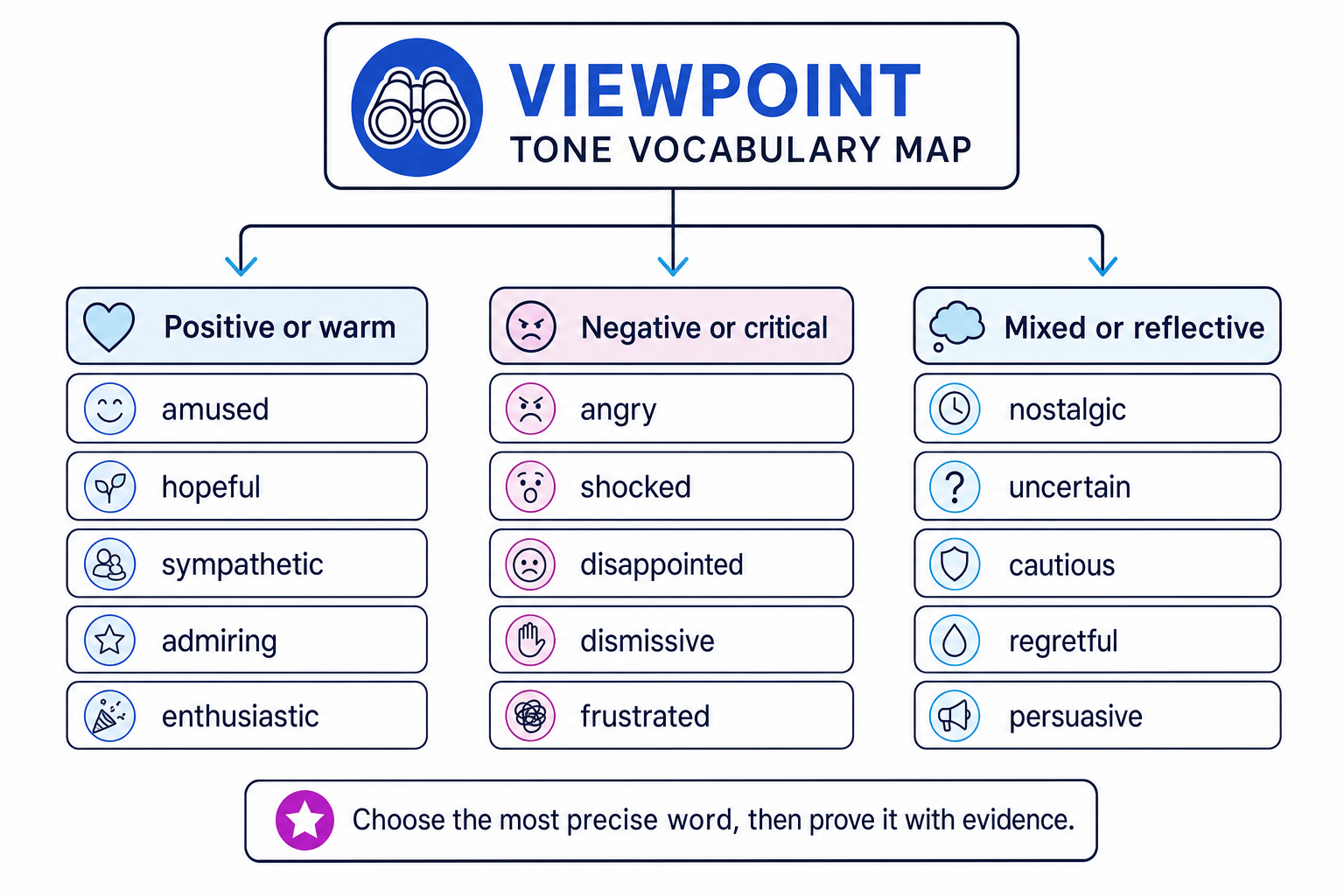
| Tone word | What it usually suggests |
|---|---|
| Angry | Strong disapproval, often about injustice or harm. |
| Amused | The writer finds something funny, silly or mildly ridiculous. |
| Nostalgic | Affectionate longing for the past. |
| Critical | The writer judges faults or weaknesses. |
| Sympathetic | The writer understands or supports someone’s suffering. |
| Shocked | Surprise, disbelief or horror at something serious. |
| Hopeful | Belief that improvement or success is possible. |
| Disappointed | The writer expected better and feels let down. |
| Persuasive | The writer is trying to change the reader’s mind or actions. |
Add a second adjective
If you call a writer persuasive, pair it with a feeling such as urgent, hopeful or critical. “Persuasive” explains what the writer is doing; the second word explains what they feel.
Choosing a precise tone word
- Separate similar emotions: critical means judging faults, shocked means reacting with disbelief, and disappointed means feeling let down after expecting better.
- Match the evidence pattern: if the writer contrasts promises with poor results, “disappointed” is more precise than simply “negative”.
- Add intensity: if the writer uses forceful loaded language and presents the problem as morally wrong, “angry and critical” may be more accurate.
- Write the judgement: “The writer’s tone is disappointed rather than merely critical because they suggest the situation has failed to meet earlier hopes or expectations.”
Purpose and audience
Purpose means why the text was written. Common purposes include to inform the reader, explain an issue, argue a viewpoint, persuade people to act, advise them what to do, or entertain them.
Audience means the intended reader. A writer addressing teenagers, parents, voters, travellers or campaign supporters will make different choices.
Purpose and audience shape viewpoint. A writer trying to persuade local residents may sound urgent and direct. A writer reflecting on childhood may sound nostalgic and thoughtful.
The full technique: clue → method → inference → effect
A method is a deliberate writer’s choice. In viewpoint questions, useful methods include loaded language, direct address, rhetorical questions, contrast and anecdotes.
A rhetorical question is a question asked for effect rather than because the writer expects an answer. A modal verb is a verb such as “must”, “should” or “could” that shows obligation, possibility or advice.
Use this chain:
- Clue: what you notice.
- Method: what the writer has chosen.
- Inference: what it suggests about viewpoint.
- Effect: how it guides the audience’s response.
Building a viewpoint comment
- Connect the method to the viewpoint: direct address makes the reader feel personally involved, so it often supports a persuasive purpose.
- Add the writer’s feeling: modal verbs such as “must” and “should” can suggest urgency because the writer presents action as necessary.
- Explain the audience effect: the reader may feel responsible or pressured to agree, rather than simply informed.
- Build the sentence: “The writer’s viewpoint is urgent and persuasive. By using direct address and modal verbs, they make the audience feel personally responsible and present action as necessary rather than optional.”
Technique spotting
Do not write “the writer uses a rhetorical question” and stop. The marks come from explaining what the method reveals about the writer’s viewpoint and how it affects the reader.
Comparing viewpoints across two sources
In Paper 2, you often need to compare two writers’ ideas and perspectives. This links to AO3, the assessment objective that rewards comparison of writers’ ideas and perspectives across texts.
A strong comparison does not just say “Source A is positive and Source B is negative.” It explains the degree and type of difference.
Useful comparison words include:
- similarly
- whereas
- while
- however
- both
- in contrast
- more strongly
- less personally
A precise comparison might sound like this:
“Both writers are concerned about the issue, but Source A is openly angry and demands change, whereas Source B is more reflective and disappointed, suggesting sadness rather than outrage.”
In the exam
- Name the viewpoint precisely: avoid vague words like “good”, “bad” or “negative” if a sharper word fits.
- Prove it with evidence from language, selected details or structure.
- Explain how the method reveals what the writer thinks or feels.
- Link viewpoint to purpose and audience where relevant.
- When comparing, use words like “whereas” and “similarly” so the comparison is built into your answer.
Check yourself
- Can you explain the difference between a topic and a viewpoint?
- Can you choose one precise tone word and justify it with evidence?
- Can you explain how purpose and audience shape the way a writer presents their views?
