Welcome to Paper 2! This paper is officially titled "Writers' Viewpoints and Perspectives". While Paper 1 asks you to explore creative, fictional worlds, Paper 2 brings you back to the real world. You will explore how real-world writers communicate their views, opinions, and experiences across different time periods.
In these notes, we will break down the exact structure of Paper 2 Section A (Reading), dissect the skills you need to develop, and look at how to manage your time effectively during the exam.
What you'll learn
- The exact structure, marks, and timing of Paper 2 Section A.
- The types of non-fiction texts you will encounter.
- The specific reading skills (Assessment Objectives) tested in Questions 1 to 4.
- How to read strategically and budget your time.
The Big Picture: What is Paper 2 Section A?
Paper 2 Section A is your non-fiction reading exam. It is worth 40 marks in total, which represents 50% of Paper 2 and 25% of your overall GCSE English Language grade.
You are given a Sources Booklet containing two real-world texts, labeled Source A and Source B.
The Time Periods and Genres
AQA will always select two texts from different time periods:
- One text will always be from the 19th century (the 1800s).
- The other text will be from either the 20th century or the 21st century.
These texts are non-fiction, but they can come from a wide variety of formats and genres.
Non-fiction
Non-fiction is writing that is based on real people, real places, and real events. Unlike fiction, it is grounded in reality, though it is often highly subjective, expressing the personal opinions, biases, and feelings of the writer.
The sources you encounter in the exam might include:
- Journalism: Newspaper articles, editorials, and feature pieces.
- Travel writing: Accounts of journeys, explorations, or guidebooks.
- Personal records: Private letters, diaries, autobiographies, and memoirs.
- Public texts: Speeches, reports, essays, sketches, and biographies.
The Power of Perspectives
Because these texts are written by real people about real things, the exam focuses heavily on perspectives.
Writer's Perspective
A writer's perspective (or viewpoint) is the specific lens through which a writer views a topic. It is their attitude, opinion, and emotional response to a subject, heavily shaped by their historical context, personal background, and purpose for writing.
A 19th-century Victorian doctor writing a private diary entry about a London cholera outbreak will have a very different perspective, vocabulary, and tone compared to a 21st-century journalist writing an online news report about a modern health campaign. Your job is to identify, analyse, and compare these different perspectives.
The Exam Structure and Timing
The entire Paper 2 exam is 1 hour and 45 minutes long.
You should allocate 1 hour to Section A (Reading) and 45 minutes to Section B (Writing). To give yourself the best possible start, you should divide your reading hour into a dedicated reading block followed by targeted writing windows for each question.
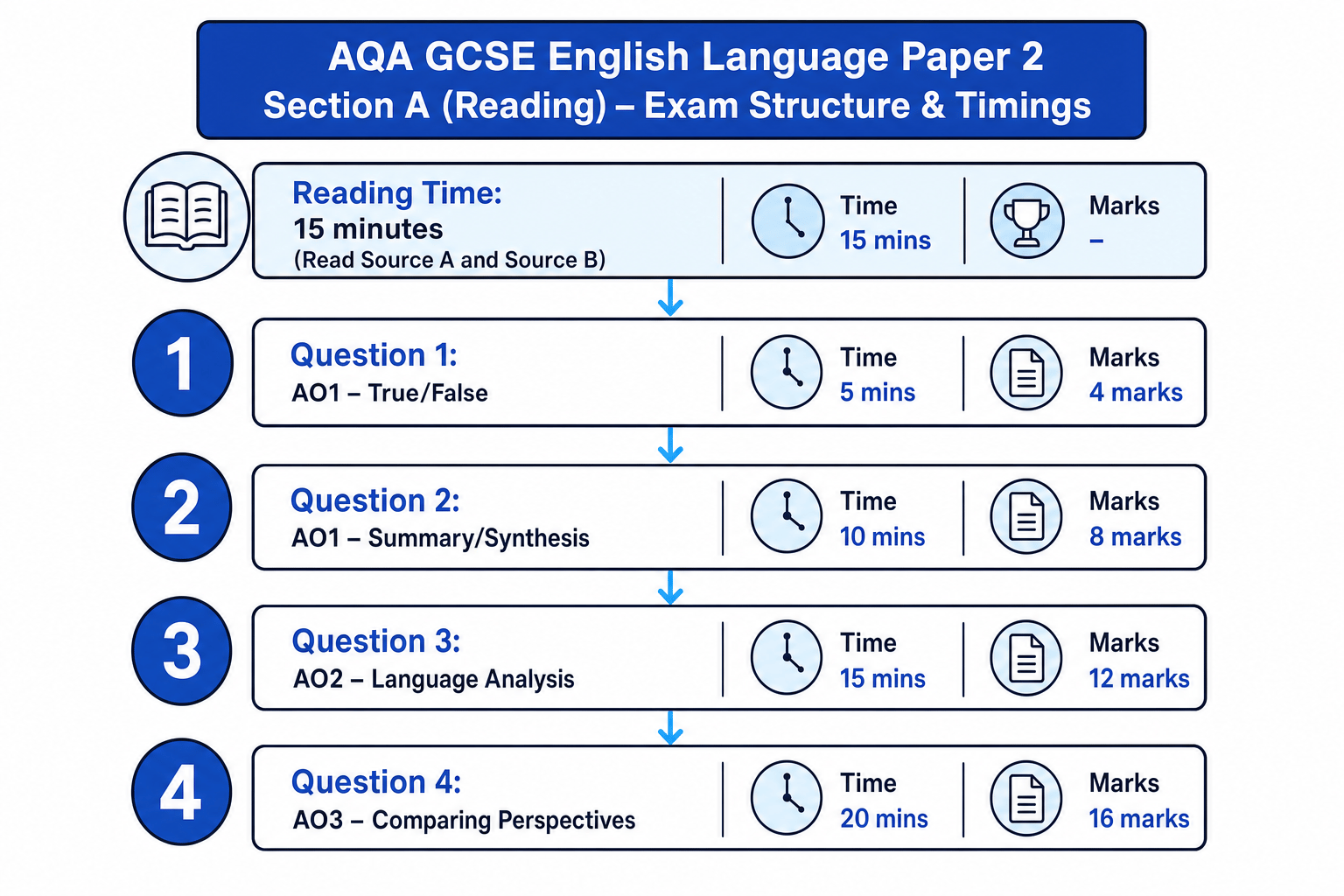
Recommended Timings:
- Reading and Planning (15 minutes): Read the background information boxes, read both sources thoroughly, and highlight key ideas.
- Question 1 (5 minutes): AO1 – True/False statements (4 marks).
- Question 2 (10 minutes): AO1 – Summarising differences/similarities (8 marks).
- Question 3 (15 minutes): AO2 – Language analysis (12 marks).
- Question 4 (20 minutes): AO3 – Comparing writers' perspectives and methods (16 marks).
The Four Reading Questions Explained
Each of the four questions in Section A targets a specific Assessment Objective (AO). Let's look at what each question expects you to do.
Question 1: Speed and Accuracy (AO1)
This is a quick, high-speed warm-up worth 4 marks. You are given a list of eight statements about a specified section of Source A. You must shade the circles next to the four statements that are true.
Question 2: Synthesising Information (AO1)
This is an 8-mark question that tests your ability to bring information from both sources together.
Synthesis
Synthesis is the process of combining information or ideas from different sources to create a single, clear summary of your findings.
You will be asked to write a summary of the differences or similarities between a specific aspect of Source A and Source B (for example, the different layouts of two school classrooms, or the differing experiences of two travelers).
The Q2 Trap
Question 2 is an information-gathering and inference task. You are not being asked to analyse language techniques, rhetorical devices, or sentence structures here. Do not waste precious time explaining how the writer writes; simply focus on what the texts tell us.
Question 3: Language Analysis (AO2)
This is a 12-mark question focused on a single source (usually Source A, but always check the prompt!). It asks you to analyse how the writer uses language to influence the reader or achieve a certain effect. This is the exact same skill you use in Paper 1 Question 2. You will look for:
- Words and phrases (noun choices, verbs, powerful adjectives).
- Language features and techniques (metaphors, similes, personification, hyperbole).
- Sentence forms and rhetorical structures (triplets, rhetorical questions, emotive language).
Question 4: Comparing Viewpoints (AO3)
This is the big-hitter of Section A, worth 16 marks. It tests AO3: your ability to compare writers' ideas and perspectives, as well as the methods they use to convey them, across both Source A and Source B.
To succeed here, you must compare:
- What their different perspectives are (their opinions and attitudes).
- How they convey those perspectives (their language, tone, structure, and rhetorical techniques).
Worked Example: Dissecting a Question 2 (Synthesis) Prompt
Because Question 2 and Question 4 look similar on the surface (both ask you to look at both sources), students often write the wrong type of answer. Let's walk through how to dissect a Question 2 prompt to ensure you target the right skills.
Dissecting a Question 2 prompt
Imagine you are given the following real-style prompt:
"Refer to Source A and Source B for this question. Use details from both sources to write a summary of the different experiences of the two writers during the storms."
Here is how you break down this question step-by-step to plan your answer:
- Highlight the target sources: Locate which texts you must use. The prompt says "Source A and Source B". You must refer to both texts. If you only write about one source, your mark is capped at a low band.
- Identify the exact focus of the synthesis: Isolate the target concept. Here, it is "experiences of the two writers". Your summary must focus exclusively on what happens to them, their surroundings, and their physical reality during the storms. Do not write about their opinions on climate change, or the history of the ships they are on, unless it directly shapes their physical experience.
- Locate matching points of contrast: Scan both texts for parallel experiences. For example, if the writer in Source A experiences physical injury due to falling debris, look at Source B to see if that writer remains physically safe inside a cabin.
- Draft a synthesis statement with an inference: Combine your findings using a comparative connective and an inference. Do not just quote; explain what the quote reveals.
- Example: "In Source A, the writer's experience is physically dangerous and exposed, as he is 'thrown across the deck' by the wind. In contrast, the writer in Source B experiences the storm from a position of relative security, remaining 'huddled safely below deck'. This suggests that while the writer in Source A is actively battling the elements, the writer in Source B is a passive observer waiting for the danger to pass."
Analysing language in Question 2
Writing about metaphors, personification, or sentence structures in Question 2 is a very common mistake. Because Question 2 is an AO1 (synthesis) question, examiners cannot award marks for language analysis. Save your structural and language analysis for Questions 3 and 4!
Use the background boxes!
At the top of each source text in your exam booklet, there is a short, italicised introduction box. Always read this! It tells you the author, the year of publication, and the context of the piece. This often gives you a massive clue about the writer's perspective before you even read the main text.
In the exam
- Stick strictly to your timings: Question 4 is worth four times as many marks as Question 1, and double the marks of Question 2. Do not let your writing time for earlier questions run over and eat into Question 4.
- Read the line boundaries carefully: Question 1 and Question 3 will specify exact line boundaries (e.g., "Refer to lines 4 to 15"). Draw a physical box around these lines on your source booklet so you do not accidentally pull evidence from the wrong part of the text.
- Keep quotes short: Embed single words or short phrases into your sentences. Avoid writing out long, multi-line quotes, as this slows down your writing speed and prevents you from focusing on precise interpretation.
Check yourself
- What are the time periods of the two sources you will find in Paper 2?
- Which of the four reading questions is the only one that does NOT require you to read both Source A and Source B?
- What is the difference between what is tested in Question 2 (Synthesis) and what is tested in Question 4 (Comparison)?
