What you'll learn
- What context means in AQA Paper 2 non-fiction reading.
- How to spot clues from older vocabulary, formal structures, social attitudes and historical references.
- How different audience expectations affect the way writers present viewpoints.
- How to use context briefly and safely in Paper 2 comparison and analysis answers.
Why context matters in Paper 2
AQA GCSE English Language Paper 2 is called Writers’ Viewpoints and Perspectives. You read two unseen non-fiction sources, often from different time periods, then answer reading questions in Section A. The whole paper is 1 hour 45 minutes, worth 80 marks and 50% of the GCSE. Section A is reading; Section B is writing.
Context
Context means the circumstances around a text: when and where it was written, who it was written for, what was happening at the time, and what beliefs or expectations may have shaped the writer’s choices.
In Language, context is not a separate “history mark”. You use it only when it helps explain the writer’s viewpoint.
Viewpoint
A viewpoint is the writer’s attitude, opinion or position on the subject. A writer might be angry, amused, critical, sympathetic, shocked, proud or doubtful.
The big idea
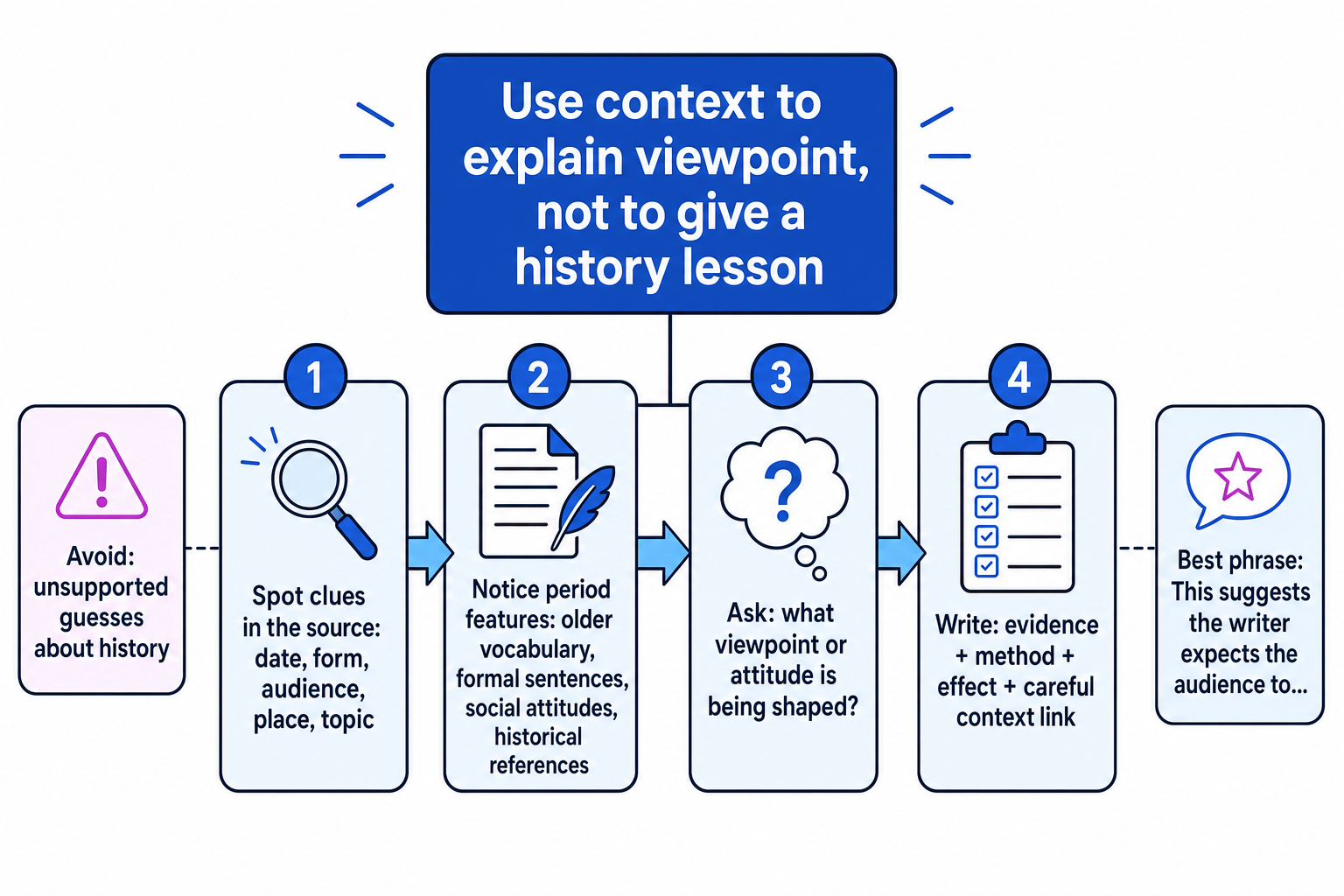
Context helps you explain why a text sounds the way it does. Do not write a history essay; link contextual clues to the writer’s viewpoint and methods.
A simple route is: notice a clue in the source, connect it to a period feature, ask how it shapes viewpoint, then write a careful explanation.
Start with the source information
Before reading the extract, look at the short introduction above it. It may tell you the date, form, writer, audience, place or topic.
Form and audience
The form is the type of text, such as a letter, article, diary, speech, report or autobiography. The audience is the person or group the text is aimed at.
These details give you safe context. They are better than guessing from general knowledge.
Reading the source information
Suppose the source information tells you that a text is a public letter from the late nineteenth century about poor housing.
- Use the form first: because it is a public letter, the writer may be trying to persuade readers, not just record private feelings.
- Use the date carefully: a late nineteenth-century text may use more formal language and may assume different social attitudes about class, charity or duty.
- Use the topic to focus your interpretation: poor housing suggests the writer’s viewpoint may involve criticism, concern, reform or moral responsibility.
- Turn it into a cautious sentence: “The public form suggests the writer wants readers to see the issue as a shared social problem rather than a private complaint.”
Older vocabulary
Older non-fiction may contain words that feel unfamiliar, formal or old-fashioned. Sometimes the word itself has changed meaning. Sometimes it carries attitudes that modern readers notice more strongly.
Connotation
A connotation is the feeling or association a word suggests beyond its literal meaning. For example, a word can sound respectful, dismissive, fearful, affectionate or judgemental.
Do not panic if you do not know every word. Use the surrounding sentence, the topic and the writer’s tone to infer the likely meaning.
Interpreting older vocabulary
Imagine an older source uses a word that seems to label a whole group of people rather than describe them as individuals.
- Identify what the word does: it may reduce people to a category, such as their class, job, age or social position.
- Consider the connotations: the label might sound official, distant, patronising or morally judgemental.
- Link it to viewpoint: the writer may be presenting that group as a social problem, a responsibility, or an object of sympathy.
- Make the context link brief: “This kind of collective label may reflect the more formal public language of the period, helping the writer present the issue as a social matter rather than a personal story.”
Guessing from one old word
Do not assume an entire viewpoint from one unfamiliar word. Check whether the rest of the extract supports your interpretation.
Formal sentence structures
Older texts often use more formal syntax.
Syntax
Syntax means the order and arrangement of words, phrases and clauses in a sentence.
You may notice long sentences, several commas, semicolons, balanced phrases, passive constructions, or a slower movement towards the main point. This does not automatically mean the writing is “boring”. It may create authority, seriousness, control or a sense of careful reasoning.
Complex sentence
A complex sentence contains a main clause and at least one subordinate clause. A main clause can make sense on its own; a subordinate clause adds extra information and depends on the main clause.
Explaining formal syntax
If a writer builds a long sentence with several extra clauses before reaching the main point, analyse what that structure makes the reader experience.
- Notice the pattern: the sentence delays the central idea while adding reasons, qualifications or details.
- Connect structure to effect: the delayed main point can make the writer seem careful, educated and measured.
- Connect effect to context: a nineteenth-century or formal public audience may have expected serious argument rather than quick, conversational statements.
- Shape the answer: “The controlled, extended syntax presents the writer as rational and authoritative, which may suit an audience used to formal public debate.”
Social attitudes
Social attitudes
Social attitudes are the beliefs, assumptions and values that are common in a society or group at a particular time.
In older sources, you might notice attitudes towards class, gender, childhood, work, poverty, education, empire, religion, crime or morality. You do not need detailed historical knowledge. Your job is to notice how the writer presents people and ideas.
A useful phrase is: “The writer seems to assume that…” This keeps your analysis focused on the text rather than making huge claims about the whole period.
Overgeneralising the past
Avoid sentences like “Everyone in those days believed…” or “People back then were all…”. It is safer to write: “The writer appears to assume…” or “A contemporary audience may have been more likely to…”
Handling an outdated attitude
If an older source seems to approve of an attitude that feels uncomfortable to a modern reader, keep your analysis precise.
- Separate the writer’s attitude from your reaction: identify what the writer appears to approve of, criticise or take for granted.
- Look for method: word choice, tone, sentence structure or examples may make the attitude seem normal, moral, humorous or authoritative.
- Compare audiences: a modern reader may question the attitude, while the original audience may have accepted it more readily.
- Write with balance: “The approving tone suggests the writer expects readers to share this assumption, although a modern audience may find the attitude more troubling.”
Historical references
A historical reference is a mention of a real event, institution, law, technology, place or social practice from a particular time. Examples might include references to workhouses, steam travel, wartime conditions, newspapers, factories, schools, servants or public campaigns.
You are not expected to know everything about these references. The source information and the extract usually give you enough.
Use context cautiously
If you are unsure, use careful modal verbs such as may, might, could and suggests. This avoids pretending you know more history than the text gives you.
Using a historical reference carefully
If a source refers to a period-specific institution or technology, use it to support interpretation, not to show off facts.
- Identify what the reference connects to: travel, work, poverty, communication, education, war, law or social status.
- Ask how the writer treats it: does it seem exciting, threatening, unfair, impressive, ordinary or shameful?
- Link it to viewpoint: the reference may help the writer criticise change, celebrate progress, expose hardship or appeal for reform.
- Keep it text-based: “The reference to this institution helps place the issue in a public social context, suggesting the writer wants readers to see it as part of a wider problem.”
Audience expectations
Different audiences expect different things. A modern online article may be direct, personal and quick to engage the reader. A nineteenth-century public letter or essay may be more formal, moralising and detailed. A diary may feel private and reflective. A speech may use direct address and rhetorical questions because it is designed to be heard.
Audience expectations
Audience expectations are assumptions about what readers already know, what style they will accept, and what arguments or emotions are likely to persuade them.
This is especially useful for Paper 2 because the two sources are often from different periods. You might compare not only what the writers think, but also how they expect readers to respond.
Comparing audience expectations
Imagine two sources both discuss travel, but one is an older travel account and one is a modern article.
- Compare the likely audiences: the older account may assume readers want detailed description and formal reflection; the modern article may assume readers want pace, personality and immediacy.
- Compare the methods: the older writer might use extended description and formal vocabulary, while the modern writer might use direct address, humour or a conversational tone.
- Link to viewpoint: the older writer may present travel as educational or morally significant, while the modern writer may present it as personal experience or entertainment.
- Build a comparative sentence: “Whereas the earlier source may expect readers to value careful observation, the modern source may aim for a more immediate relationship with the reader, shaping a more informal viewpoint.”
Turning context into marks
Context is most useful in Paper 2 Section A when it supports the assessment objectives already being tested.
For Question 2, you summarise and synthesise differences between the sources, so context can help explain why the writers focus on different aspects of the same topic. Synthesis means combining ideas from both texts rather than discussing them separately.
For Question 3, you analyse language in one source, so context can help explain why a word, tone or sentence style affects the reader in that particular way.
For Question 4, you compare writers’ viewpoints and methods, so context is especially useful. You can explain how different periods, forms and audiences shape different perspectives.
A strong context link usually follows this pattern:
Evidence or reference → method → effect → context link
Building a context-linked comparison
Use this process when comparing two writers’ viewpoints in Paper 2.
- Start with the viewpoint: decide how each writer seems to feel about the topic, such as critical, nostalgic, shocked, amused or approving.
- Choose a method from each source: this could be vocabulary, tone, sentence structure, direct address, anecdote, exaggeration or contrast.
- Explain the effect of each method: show how the method shapes the reader’s understanding of the issue.
- Add context only where it clarifies the difference: “This difference may reflect the writers’ different audiences, as the earlier source uses a more formal public voice, while the later source creates a more personal and immediate connection.”
- Keep comparing: use connectives like whereas, similarly, in contrast and both writers to keep both sources in view.
Context must not replace analysis
A paragraph full of historical background but with no reference to the writer’s choices will not score highly. AQA rewards interpretation, language/structure analysis and comparison.
In the exam
- Read the source information before the extract: note the date, form, audience and topic.
- While reading, mark only useful context clues: unusual vocabulary, formal syntax, social assumptions, historical references and signs of intended audience.
- When writing, use context in one sentence at a time and link it directly to viewpoint, method or reader effect.
- Avoid big claims about the whole period; use careful phrases like “may suggest”, “appears to assume” and “a contemporary audience might”.
- In comparison answers, explain how the two writers’ different contexts help create different viewpoints.
Check yourself
- Can you explain the difference between context and viewpoint?
- Can you identify one period feature without turning it into a history essay?
- Can you write one sentence that links date, audience or form to a writer’s method and effect?
