Welcome to your study notes for Paper 2, Section A (Reading Non-fiction). We are diving into Question 1, which asks you to select and retrieve information from a specific part of a source text.
While this is the very first question on the paper and is often seen as a "warm-up," it is also a place where students needlessly drop marks by rushing or falling into clever exam traps. Let's make sure you secure a perfect 4 out of 4 every single time.
What you'll learn
- How to pinpoint the exact search area in the source text so you never retrieve information from the wrong place.
- The difference between literal (explicit) facts and implied (implicit) meanings.
- A foolproof elimination method to separate true statements from convincing "distractor" statements.
Understanding the Basics of Question 1
Question 1 assesses Assessment Objective 1 (AO1).
Assessment Objective 1 (AO1)
AO1 requires you to:
- Identify and interpret explicit and implicit information and ideas.
- Select and synthesise evidence from different texts.
For Question 1, you only need to focus on the first part of AO1: identifying and interpreting information within one source.
The Exam Format
In the exam, you will be presented with:
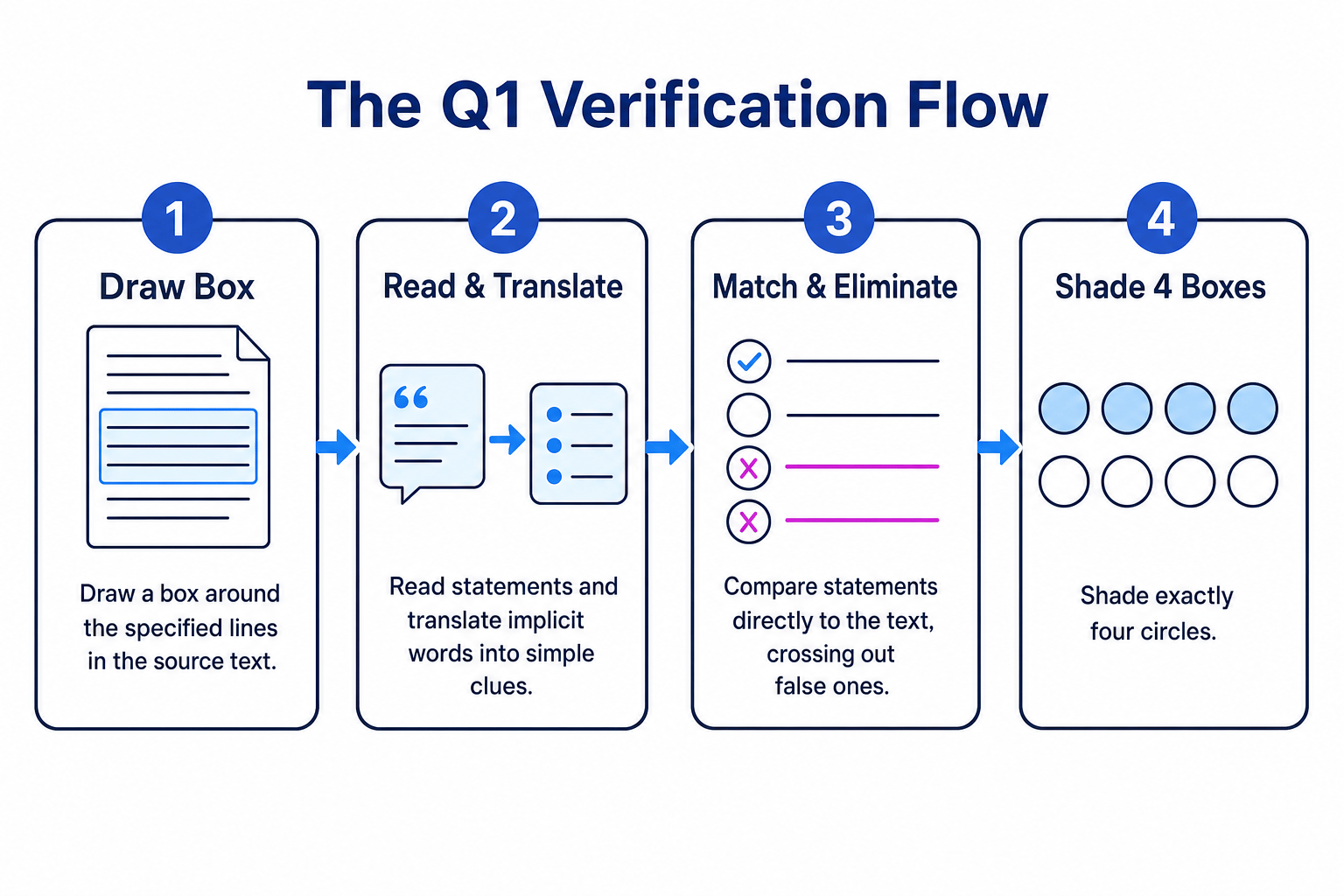
- A instruction telling you to look at a very specific, narrow band of lines (e.g., lines 1 to 12).
- A list of eight statements (labelled A to H).
- A task to shade the circles of the four statements that are true.
This question is worth 4 marks. Because the exam is 1 hour and 45 minutes long in total, you should spend no more than 5 minutes on this question.
Key Skills: Explicit vs. Implicit Information
To get all four marks, you must be able to read a text on two levels: what it says directly, and what it suggests underneath.
Explicit Information
Explicit information is directly, clearly, and literally stated by the writer. You do not have to guess or interpret it; the words are right there on the page.
For example, if a text says, "The wind howled at 60 miles per hour," the explicit information is that the wind was blowing at 60 mph.
Implicit Information
Implicit information is not directly stated. It is suggested, hinted at, or implied. You must use clues in the text to figure out the meaning (this is called making an inference).
For example, if a text says, "Arthur pulled his heavy woolen coat tightly around his shoulders and shivered," the implicit information is that Arthur is cold. The writer never uses the word "cold", but the details allow you to infer it.
The Golden Rule of Inference
An inference is not a wild guess. It must be backed up by a direct clue in the text. If you cannot point to a word or phrase that suggests your conclusion, your inference is likely incorrect.
Spotting the "Distractor" Traps
The examiners design the eight statements very carefully. Four are true, and four are false. The false statements are not always obvious nonsense; they are designed to look like correct answers. These are called distractors.
Here are the three most common distractor traps to watch out for:
- The "Out-of-Boundary" Trap: A statement is completely true according to the passage, but the information comes from outside the line range specified in the question (e.g., it is in line 25, but the question only asked about lines 1 to 10).
- The "Half-Truth" Trap: The statement starts off completely true but ends with a false detail, or combines two facts that do not belong together.
- The "Extreme Word" Trap: The statement uses absolute words like always, never, all, or none when the text only suggests sometimes, mostly, or some.
Relying on General Knowledge
Never use your own outside knowledge of the topic to answer the question. Even if a statement is factually true in real life, if it is not supported by the specific lines of the extract, it is false for this exam.
Verifying statements from a text extract
Let's work through a practical example. Read the following mini-extract, which represents lines 1 to 6 of a source:
"The rain lashed against the carriage windows, a relentless assault that had kept us captive inside for three hours. Arthur stared out into the gloom, his usual jovial expression replaced by a tight-lipped grimace. He muttered about the dampness of the cushions, though in truth, he was far more concerned with our delayed arrival at the estate."
Now, evaluate these three statements to determine which is true and why the others are false:
- Statement A: Arthur is unhappy because the carriage cushions are wet.
- Statement B: The travellers have been in the carriage for exactly three hours.
- Statement C: Arthur is anxious about arriving late.
Step-by-step verification:
-
Analyse Statement A against the text: The text says Arthur "muttered about the dampness of the cushions." However, the writer immediately adds, "though in truth, he was far more concerned with our delayed arrival." This means the damp cushions are just a cover-up for his real worry. Therefore, Statement A is false because it presents a surface excuse as his actual reason for being unhappy.
-
Analyse Statement B against the text: The text states the rain "had kept us captive inside for three hours." This matches the statement perfectly and is an explicit, literal match. Therefore, Statement B is true.
-
Analyse Statement C against the text: The text states Arthur was "concerned with our delayed arrival at the estate." The word "concerned" is a direct synonym for being worried or anxious. Therefore, Statement C is true because it accurately interprets the implicit and explicit meaning of Arthur's concern.
Use a physical barrier
When you open your exam paper, take a ruler and a pen. Draw a thick, physical box around the exact lines mentioned in Question 1. Do not let your eyes wander outside that box when choosing your four true statements!
In the exam
To guarantee 4/4 marks in under 5 minutes, use this structured checklist:
- Isolate the lines: Read the question carefully to find the line reference, then draw a box around these lines in your source booklet.
- Read the statements first: Read all eight statements (A-H) before you re-read the text. This gives your brain specific details to hunt for.
- Match and eliminate: Go through the statements one by one. If a statement is false, put a clear, physical 'X' next to it on your question paper.
- Prove the true statements: For every statement you think is true, highlight the exact word or phrase inside your boxed text that proves it. If you cannot highlight a specific proof, do not shade the circle.
- Check your count: Make sure you have shaded exactly four circles. If you shade more or fewer, you risk losing marks automatically.
Check yourself
Before moving on to Question 2, make sure you can answer these questions:
- What should you do on your source sheet the second you read the line boundaries in Question 1?
- What is the difference between an explicit fact and an implicit inference?
- Why might a statement that is 100% factually accurate in the text still be a wrong answer for Question 1?
