What you'll learn
- What tone and register mean in viewpoint writing.
- How to choose a voice that fits the audience, purpose and form.
- How to create formal, informal, serious, passionate, humorous, critical, angry, optimistic, balanced and reflective effects.
- How tone and register help you gain marks for AO5 and AO6 in AQA Paper 2 Section B.
Why tone and register matter
In AQA GCSE English Language Paper 2, Section B asks you to write from a viewpoint. It is one compulsory writing task worth 40 marks: 24 marks for AO5, which rewards clear communication and organisation, and 16 marks for AO6, which rewards vocabulary, sentence structures, spelling and punctuation.
Paper 2 is 1 hour 45 minutes in total, worth 80 marks and 50% of the GCSE. Your writing task is not just about having ideas. It is about making those ideas sound right for the situation.
The big idea
Students control how their writing sounds. Your voice should feel deliberate: chosen for the reader, the purpose and the form of the task.
Start with audience, purpose and form
Before you decide your tone or register, you need to understand the task.
Audience, purpose and form
The audience is who you are writing for. The purpose is what your writing is trying to do, such as persuade, argue, explain, inform or advise. The form is the type of writing, such as a letter, article, speech or leaflet.
These three choices control almost everything else. A speech to Year 11 students will sound different from a letter to a local councillor, even if both are about the same issue.
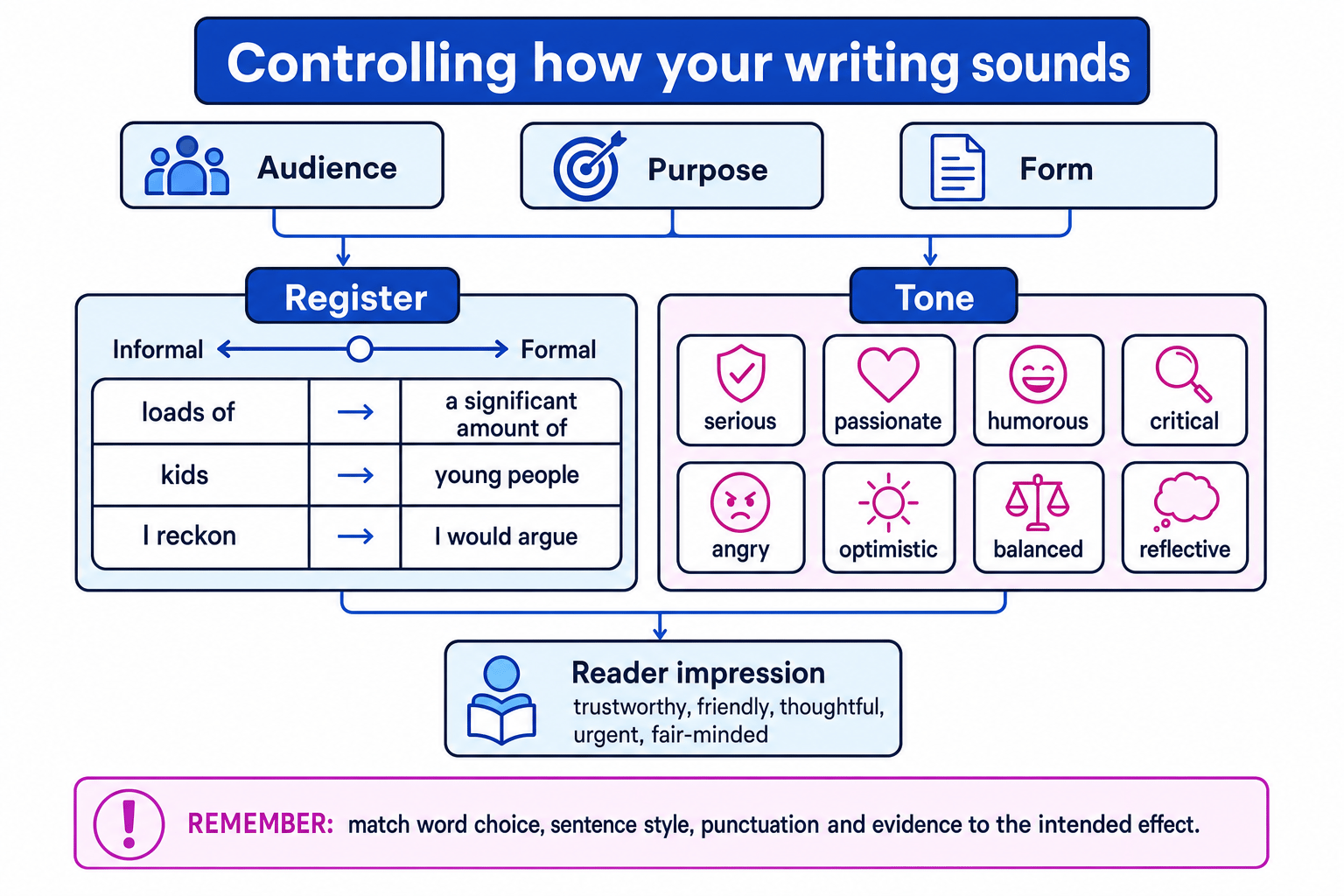
Reading the task before choosing your voice
Suppose a task asks you to write a letter to your local council arguing that a public park should be protected.
-
Audience: The reader is a local council, so you need a respectful, fairly formal register. Phrases like “I urge the council to consider” fit better than “you lot need to sort this out”.
-
Purpose: You are arguing for protection, so the tone should be serious and passionate. You want the council to feel the issue matters.
-
Form: It is a letter, so you should sound direct and purposeful, with a clear opening, developed paragraphs and a suitable sign-off.
-
Result: A controlled sentence might be: “I urge the council to protect this park because it is not merely a patch of grass, but a vital space for families, wildlife and community life.”
Tone: the attitude your writing creates
Tone
Tone is the attitude or emotional feeling created by your writing. It is how your writing sounds to the reader: serious, angry, hopeful, funny, thoughtful, critical, and so on.
Tone is not random decoration. It shapes the reader’s impression of you. A controlled tone can make you seem trustworthy, mature and convincing.
Serious tone
A serious tone suggests the topic is important and should be treated with care. Use precise vocabulary, clear reasons and restrained punctuation. Avoid jokes if the issue is sensitive.
Example: “The rise in food poverty should concern every member of this community.”
Passionate tone
A passionate tone shows strong feeling and commitment. You might use emotive language, which means words chosen to stir emotion, and repetition, where a word or phrase is repeated for emphasis.
Example: “We cannot ignore this. We cannot excuse this. We cannot wait for someone else to act.”
Humorous tone
A humorous tone uses wit or light exaggeration to entertain or engage. Hyperbole is deliberate exaggeration for effect.
Example: “At the moment, waiting for the bus feels less like transport and more like an outdoor endurance challenge.”
Critical tone
A critical tone judges faults or weaknesses. It is not the same as being rude. Strong critical writing gives reasons.
Example: “The current system is inconsistent, expensive and poorly explained.”
Angry tone
An angry tone shows strong disapproval. It can be powerful when writing about unfairness, but it must stay controlled.
Example: “It is unacceptable that residents are repeatedly promised improvements and repeatedly left disappointed.”
Optimistic tone
An optimistic tone is hopeful and solution-focused. Modal verbs, such as “can”, “should”, “must” and “might”, show possibility, obligation or certainty.
Example: “With sensible planning, safer streets can become a reality.”
Balanced tone
A balanced tone considers more than one side. It often uses concessive phrases, which admit a point before returning to your argument, such as “although”, “while” or “admittedly”.
Example: “Although budgets are limited, ignoring the problem will cost more in the long term.”
Reflective tone
A reflective tone sounds thoughtful and considered. It often looks back, questions assumptions or explores a change in understanding.
Example: “Perhaps we have become so used to noise, speed and pressure that we have forgotten what public spaces are for.”
Shifting the same idea into different tones
Core idea: the local bus service needs improvement.
-
To create a serious tone, focus on importance and consequences: “A reliable bus service is not a luxury; for many residents, it is the only route to work, school and medical appointments.”
-
To create an angry tone, focus on unfairness and stronger judgement: “It is disgraceful that residents are left stranded by cancellations they are not even warned about.”
-
To create a balanced tone, acknowledge difficulty while keeping your viewpoint clear: “Although running a bus service is expensive, the current level of unreliability is damaging local people’s daily lives.”
-
Compare the effects: the serious version sounds responsible, the angry version sounds urgent, and the balanced version sounds fair-minded.
Humour and anger can backfire
Humour can seem insensitive if the topic is painful or serious. Anger can become a rant if it turns into insults. Aim your criticism at the problem, policy or behaviour, not at personal abuse.
Register: the level of formality
Register
Register is the level of formality in your writing. It controls whether your writing sounds formal, informal, conversational, professional, respectful or relaxed.
Register is a scale, not a switch. You can be mostly formal with a few lively phrases, or mostly conversational while still using accurate Standard English.
Standard English means the form of English usually expected in formal writing, exams and public communication. It uses accurate grammar and avoids unclear slang.
Formal register
A formal register is usually best for letters to people in authority, newspaper articles, serious speeches and public arguments. It often uses:
- Standard English
- precise vocabulary
- full forms rather than contractions, such as “cannot” instead of “can’t”
- respectful address
- controlled sentence structures
Formal does not mean boring. It means clear, mature and appropriate.
Informal register
An informal register is more conversational. It may suit a speech to classmates, a blog aimed at teenagers or a lively article. It can use:
- contractions, such as “don’t” and “we’re”
- direct address, meaning speaking straight to the reader using “you”
- everyday vocabulary
- humour or personal comments
Informal does not mean careless. You still need accurate spelling, punctuation and grammar for AO6.
Moving from informal to formal register
Starting sentence: “Kids are getting a raw deal because buses are rubbish and loads of them can’t get to clubs.”
-
Replace informal or vague nouns: “kids” becomes “young people”, which sounds more respectful and suitable for public argument.
-
Replace vague judgement with precise criticism: “buses are rubbish” becomes “the bus service is unreliable”, which explains the problem more clearly.
-
Adjust the sentence structure: “loads of them can’t” becomes “many are unable to”, which creates a more formal register.
-
Final version: “Young people are being treated unfairly because the bus service is unreliable, leaving many unable to attend clubs, activities and community events.”
Formal does not mean fancy
Do not fill your writing with over-complicated words just to sound intelligent. “This issue affects many families” is stronger than “This problematic circumstance negatively impacts numerous familial units.”
Combining tone and register
Tone and register work together, but they are not the same.
You can have a formal, passionate letter. You can have an informal, humorous speech. You can have a formal, reflective article. The skill is matching both to the task.
For example:
- A letter to the headteacher about school lunches might be formal, critical and balanced.
- A speech to classmates about exam stress might be informal, humorous and reflective.
- An article about climate change might be serious, passionate and optimistic.
- A letter to a newspaper about litter might be formal, angry and solution-focused.
Plan a tonal journey
Sophisticated writing often changes tone. You might open reflectively, become critical in the middle, then end optimistically with a call to action.
Five ways to control how your writing sounds
1. Word choice
Your vocabulary is the quickest way to create tone. Evaluative adjectives are adjectives that judge something, such as “unfair”, “irresponsible”, “vital” or “inspiring”.
Compare:
- “The rule is bad.”
- “The rule is unfair, outdated and damaging.”
The second version sounds more critical because the word choice is sharper and more precise.
2. Sentence length
Short sentences can sound dramatic or angry.
Example: “This must change.”
Longer sentences can sound thoughtful, balanced or explanatory.
Example: “Although some people will argue that change is expensive, the long-term benefits for health, safety and community life are impossible to ignore.”
3. Punctuation
Punctuation affects voice. A question mark can challenge the reader. A colon can introduce an explanation. An exclamation mark can add energy, but too many can make your writing seem childish.
A rhetorical question is a question asked for effect, not because you expect an answer.
Example: “How many more warnings do we need before we act?”
4. Pronouns and direct address
Pronouns such as “we”, “us” and “our” can create unity. “You” can challenge or involve the reader.
Example: “We all benefit when our streets are cleaner, safer and more welcoming.”
5. Evidence and examples
Viewpoint writing is more convincing when it feels grounded. You can use general examples, brief anecdotes, imagined scenarios or statistics if they are believable. Do not invent wild facts that sound fake.
Random techniques
Do not add rhetorical questions, repetition or exclamation marks just because they are “techniques”. Use them only when they support the tone you want to create.
A quick tone and register checklist
Before you start writing, ask:
- Should I sound formal or informal?
- Should I sound serious, passionate, humorous, critical, angry, optimistic, balanced or reflective?
- Would this tone suit the audience?
- Would this register suit the form?
- Do my vocabulary, sentence structures and punctuation all create the same reader impression?
In the exam
-
Spend a few minutes decoding the task: identify the audience, purpose and form before writing.
-
Choose a main register and two main tones, such as “formal, critical and optimistic” or “informal, humorous and reflective”.
-
Plan a tonal journey: opening, development and ending should feel connected, not random.
-
Re-read for AO5 and AO6: check that your voice is appropriate, your paragraphs are organised, and your vocabulary, punctuation and sentence structures are accurate.
Check yourself
-
Can you explain the difference between tone and register without using the same definition for both?
-
If the task is a letter to a local MP, what register would you choose and why?
-
Which two tones would suit a speech encouraging students to reduce plastic waste?
