What you'll learn
- How to recognise the form of a leaflet or guide.
- How to write in an accessible advisory style.
- How to use headings, short paragraphs, direct address and clear guidance.
- How to balance an informative, persuasive and helpful tone for AQA Paper 2 Section B.
Where this fits in the exam
In AQA GCSE English Language, Paper 2 lasts 1 hour 45 minutes and is worth 80 marks, which is 50% of the GCSE. Section B is the writing task. It is worth 40 marks: 24 marks for AO5 — content and organisation — and 16 marks for AO6 — technical accuracy.
You may be asked to write in different forms, such as a letter, article, speech, essay, leaflet or guide. For a leaflet or guide, the examiner is looking for writing that is clear, organised and useful to the reader.
Form
Form means the type of text you are being asked to write, such as a leaflet, guide, article or speech. Form affects how your writing should look, sound and be organised.
Leaflet / guide writing
A leaflet or guide should help the reader understand what to do, why it matters and how to act. It should feel easy to follow, not like one long essay.
What is a leaflet or guide?
A leaflet is usually a short information text designed to be read quickly. It often promotes, advises or explains something.
A guide is a text that gives practical advice. It tells the reader how to approach a situation, solve a problem or make a better choice.
In the exam, you do not need to draw a real folded leaflet. You are being assessed on the writing: your ideas, organisation, tone, vocabulary, punctuation and accuracy.
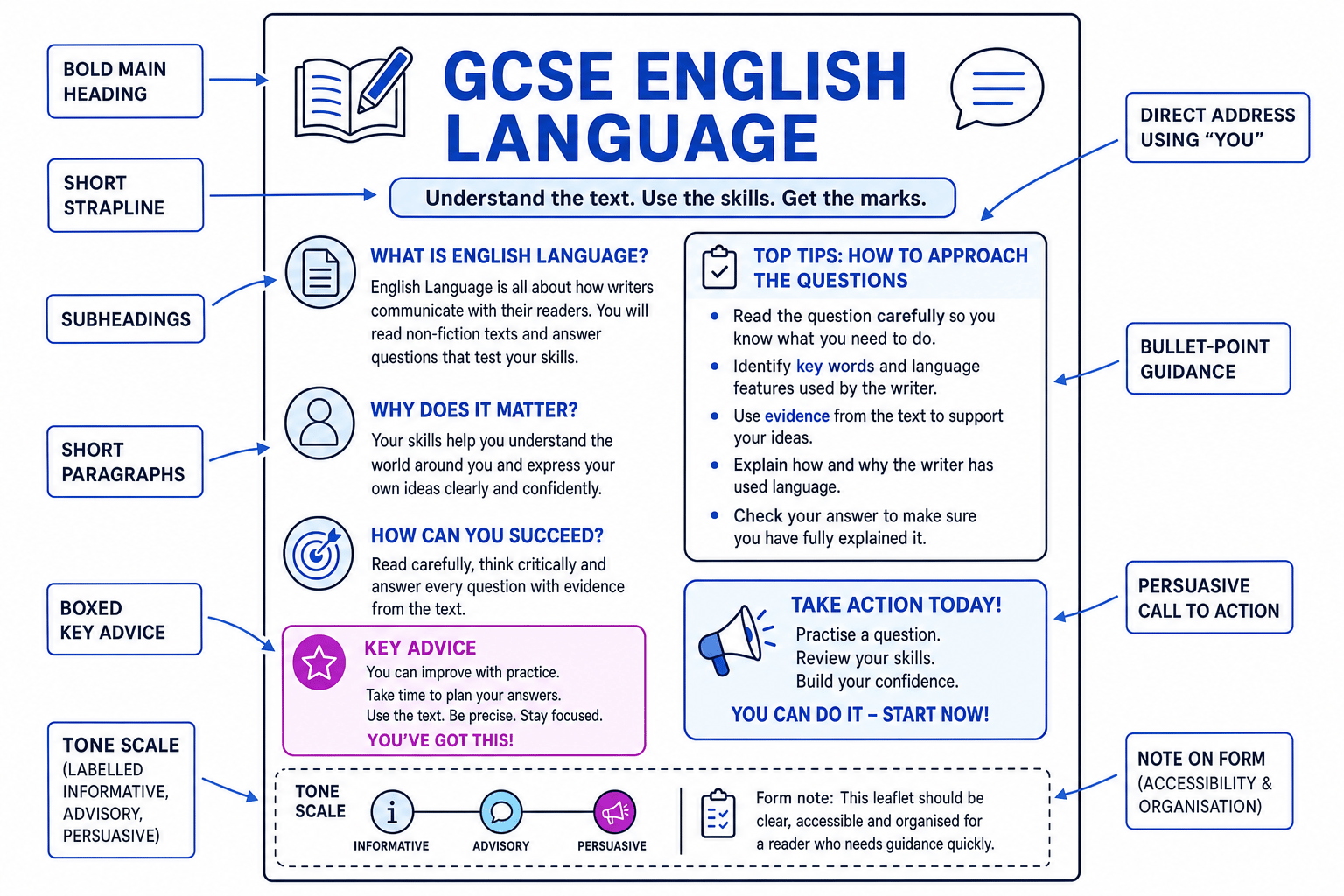
This diagram shows the main features that can help your answer feel like a leaflet or guide rather than a general essay.
Drawing instead of writing
Do not spend time making boxes, logos, pictures or columns. You can suggest leaflet form through headings, subheadings, short paragraphs and bullet points, but the marks come from the quality of your writing.
Start with purpose, audience and tone
Before you write, work out three things.
Purpose, audience and tone
Purpose is why you are writing. Audience is who you are writing for. Tone is the attitude or mood your writing creates, such as friendly, serious, urgent or reassuring.
For a leaflet or guide, the purpose is often to:
- inform the reader about an issue
- advise them on what to do
- persuade them to change their behaviour or attitude
The audience might be teenagers, parents, local residents, tourists, volunteers or school students. Your choices should fit them.
For example, a guide for younger students might sound warm and encouraging. A leaflet for local residents about road safety might sound practical, calm and responsible.
Choosing the right tone
Imagine the task asks you to write a guide for Year 7 students about settling into secondary school.
- Identify the audience: Year 7 students are likely to feel nervous, so the tone should be reassuring rather than bossy.
- Identify the purpose: you need to advise them, so the writing should include practical steps, not just opinions.
- Shape the voice: instead of writing, “Students must organise themselves properly,” you could write, “Keep your timetable somewhere easy to find, and give yourself a few minutes each evening to pack for tomorrow.”
- Add gentle persuasion: “Small habits like this can make the whole day feel calmer.”
Use a clear heading
A heading is the main title of your leaflet or guide. It tells the reader what the text is about.
A good heading is specific and useful. It should not be vague.
Weak heading:
A Few Things
Stronger heading:
How to Stay Safe Online: A Guide for Teenagers
The stronger version tells the reader the topic, purpose and audience.
Add a strapline if useful
A strapline is a short line under the heading that sums up the message or encourages the reader to continue.
Example:
How to Stay Safe Online: A Guide for Teenagers
Simple choices that protect your privacy, confidence and wellbeing.
The strapline is not compulsory, but it can quickly create a leaflet-like style.
Fast opening formula
Try: Heading + short strapline + direct opening sentence. This quickly establishes form, audience and purpose.
Organise with subheadings
A subheading is a smaller heading used to divide sections. In a leaflet or guide, subheadings are very useful because they make the writing easy to navigate.
Good subheadings often sound practical:
- Why it matters
- What you can do today
- Common problems
- Where to get help
- Three simple steps
Subheadings help your AO5 mark because they show controlled organisation.
Planning useful subheadings
Suppose the task is to write a leaflet encouraging students to volunteer in their community.
- Choose the main message: volunteering is worthwhile and manageable for young people.
- Break the message into reader-friendly sections: first explain the benefit, then remove doubts, then tell them how to start.
- Turn those sections into subheadings: Why volunteering matters, You do have time, How to get involved.
- Check the order: the reader moves from motivation, to reassurance, to action.
Keep paragraphs short
A paragraph is a group of sentences about one main idea. In a leaflet or guide, paragraphs should usually be short because the reader may be scanning for quick advice.
This does not mean every sentence must be simple. You can still use varied sentence structures for AO6. But avoid huge blocks of writing.
Long, dense version:
Many students find that when they start revising they feel overwhelmed because they have not organised their subjects properly and they often try to do too much at once, which makes them feel tired and frustrated.
Clear guide version:
Revision can feel overwhelming at first.
Start small. Choose one subject, one topic and one realistic target for the next 20 minutes.
The second version is easier to follow and sounds more advisory.
Use direct address
Direct address means speaking straight to the reader, usually using pronouns such as “you” or “your”.
Direct address
Direct address is when the writer speaks directly to the reader, often using “you”, to create a personal connection and make the advice feel relevant.
Direct address is especially useful in leaflets and guides because it makes the reader feel included.
Examples:
- You do not need to change everything overnight.
- Keep your phone away from your bed if it distracts you at night.
- If you are unsure, ask someone you trust.
Overusing you
Direct address is powerful, but too much can sound repetitive or pushy. Mix it with inclusive phrases like “we all”, “many people” or “it can help to”.
Give clear guidance
A leaflet or guide should not just describe a problem. It should guide the reader towards action.
Clear guidance often uses:
- imperative verbs: “choose”, “check”, “ask”, “avoid”
- numbered steps
- bullet points
- practical examples
- reassuring explanations
Imperative verb
An imperative verb gives a command or instruction, such as “try”, “remember”, “avoid” or “speak”.
Imperatives are useful, but they should not make you sound aggressive. Soften them with friendly phrasing when needed.
Too harsh:
Stop wasting time and organise yourself.
More helpful:
Start with one small change: pack your bag the night before.
Balance information and persuasion
A leaflet or guide often needs both:
- informative writing, which gives facts, explanations or useful details
- persuasive writing, which encourages the reader to agree or act
Persuasive tone
A persuasive tone encourages the reader to think, feel or act in a particular way. It may use rhetorical questions, emotive language, repetition or a call to action.
A call to action is a sentence that tells the reader what to do next.
Examples:
- Start today with one small step.
- Speak to a teacher, friend or family member if you need support.
- Make the choice now — your future self will thank you.
Turning information into advice
Topic: reducing plastic waste.
- Start with information: “Plastic waste can harm wildlife and pollute beaches, parks and rivers.”
- Add reader-focused advice: “You can reduce this by carrying a reusable bottle or saying no to unnecessary packaging.”
- Add persuasion: “These choices may seem small, but repeated every day, they become powerful.”
- Finish with a call to action: “Choose one swap this week and stick with it.”
Useful features for leaflet and guide writing
You do not need to use every feature. Choose the ones that fit the task.
| Feature | What it does | Example |
|---|---|---|
| Heading | Announces the topic | A Student Guide to Managing Stress |
| Strapline | Sums up the message | Small steps for calmer days |
| Subheadings | Organise sections | What can you do first? |
| Bullet points | Make advice easy to scan | - Plan breaks - Talk to someone - Sleep properly |
| Direct address | Involves the reader | “You are not alone.” |
| Imperatives | Give practical instructions | “Take five minutes to plan.” |
| Rhetorical question | Makes the reader think | “Why wait until you feel overwhelmed?” |
| Call to action | Ends with purpose | “Start with one change today.” |
Rhetorical question
A rhetorical question is a question asked for effect, not because the writer expects an answer. It encourages the reader to think about the issue.
A simple structure you can use
If you are unsure how to organise your answer, try this structure.
1. Heading and opening
Make the topic clear. Address the reader and establish why the issue matters.
Example:
A Guide to Making Revision Work for You
Revision does not have to mean panic, late nights or endless highlighting. With a few sensible habits, you can make your time more focused and less stressful.
2. Explain the problem or situation
Show that you understand the reader’s concerns.
Example:
Many students leave revision until they feel under pressure. That is understandable, but it often leads to rushed work and low confidence.
3. Give practical advice
Use short paragraphs, bullets or numbered steps.
Example:
Try this:
- choose one topic at a time
- remove distractions for a short period
- test yourself instead of only rereading notes
4. Persuade and reassure
Encourage the reader to believe the advice is worthwhile.
Example:
You do not need a perfect plan. You need a plan you can actually follow.
5. End with a call to action
Finish clearly and positively.
Example:
Start tonight. Ten focused minutes is better than another evening of worrying about tomorrow.
The best leaflet answers
The strongest leaflet or guide answers feel designed for a real reader: easy to follow, purposeful, practical and controlled.
Technical accuracy still matters
Even though a leaflet may use short sections and bullet points, you still need accurate spelling, punctuation and grammar for AO6.
Use a range of sentence types:
- Short sentence for impact: “Start small.”
- Compound sentence: “Plan your time, and give yourself breaks.”
- Complex sentence: “Although it can feel difficult at first, asking for help is often the quickest way forward.”
Check punctuation around headings, lists and sentences. Bullet points should be consistent. If they are sentence fragments, keep them short and parallel. If they are full sentences, punctuate them as full sentences.
Bullet points are not a shortcut
A whole answer made mostly of bullet points will not develop ideas enough for the top bands. Use bullets for selected guidance, then explain and persuade in developed paragraphs.
In the exam
- Spend a few minutes identifying the audience, purpose and tone before you write.
- Use a clear heading, helpful subheadings and short paragraphs to create the form without wasting time on drawings.
- Balance practical advice with persuasive encouragement: tell the reader what matters, what to do and why they should act.
- Leave time to check AO6: spelling, punctuation, sentence control and paragraph clarity.
Check yourself
- Can you explain the difference between a leaflet/guide and an essay?
- Does your writing use direct address and clear guidance without sounding bossy?
- Could a reader scan your answer quickly and still understand the main advice?
