What you'll learn
- How to use paragraphs to organise viewpoint writing in AQA Paper 2 Section B.
- How introductions, topic sentences, links and conclusions create a clear line of argument.
- How to develop ideas instead of simply listing them.
- How paragraphing and cohesion support AO5: clear communication and organisation.
Why paragraphing and cohesion matter
In AQA GCSE English Language Paper 2 Section B, you write your own viewpoint piece, such as an article, speech, letter or essay. The writing task is worth 40 marks: 24 for AO5, which rewards content and organisation, and 16 for AO6, which rewards technical accuracy.
Paragraphing and cohesion sit mainly in AO5. They help the examiner see that you can shape your ideas deliberately, not just produce a stream of thoughts.
Paragraph
A paragraph is a group of sentences focused on one main idea or one clear stage in your argument.
Cohesion
Cohesion means the parts of your writing connect smoothly, so the reader can follow how one sentence, paragraph or idea leads to the next.
Think of your answer as a journey
Good viewpoint writing has direction. You are guiding the reader from your opening position, through developed reasons and examples, towards a final impression.
A simple structure might look like this:
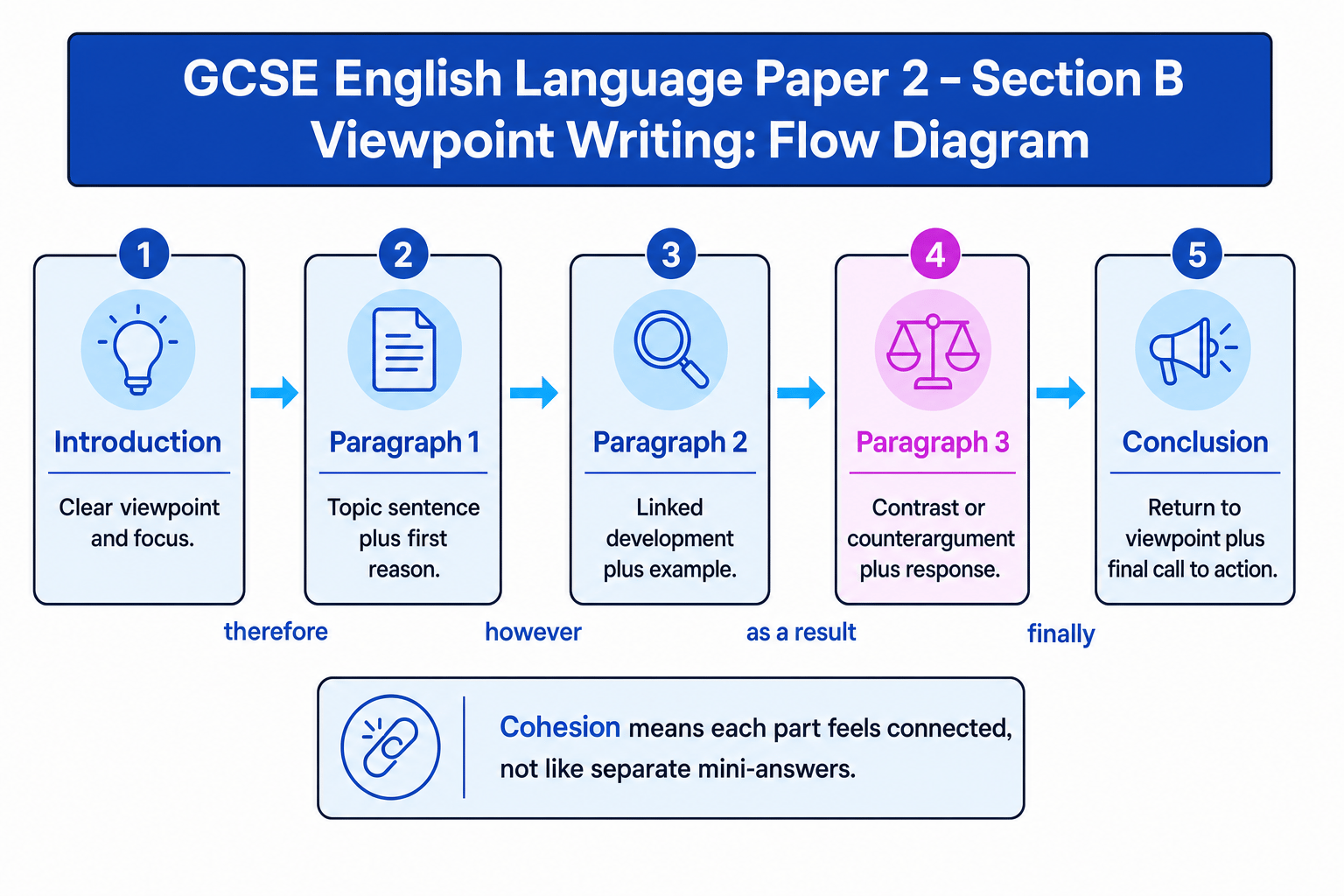
You do not have to use exactly five paragraphs every time, but you do need a sense of movement. Each paragraph should feel like it adds something new.
The main aim
Your paragraphs should not be random containers. Each one should perform a job in the overall argument.
Introductions: set up your viewpoint
An introduction is the opening section of your writing. In viewpoint writing, it should usually do three things:
- establish the issue
- suggest your viewpoint or angle
- make the reader want to continue
You do not need to reveal every point at once. A strong introduction gives the reader a clear route into your argument.
Shaping an introduction
Suppose the task asks you to argue your view on whether people should spend less time online.
- Choose the angle you want to take: you could argue that the problem is not technology itself, but thoughtless overuse.
- Establish the issue in a broad way: many people now move between school, work, friendships and entertainment through screens.
- Add a clear viewpoint: the real challenge is learning to control online habits before they control us.
- Shape it into an opening: “We do not need to declare war on the internet; we need to stop surrendering our attention to it. In a world where every spare minute can be filled by a screen, choosing when to disconnect has become a modern survival skill.”
A useful opening move
Try beginning with a contrast: “This is not about rejecting technology; it is about using it wisely.” Contrasts quickly create a thoughtful viewpoint.
Topic sentences: give each paragraph a clear job
A topic sentence is a sentence that introduces the main idea of a paragraph. It often appears at the start, although skilled writers may vary this.
A good topic sentence does more than name the topic. It also shows your direction.
Weak topic sentence: “There are problems with phones.”
Stronger topic sentence: “The biggest problem with constant phone use is that it trains us to avoid silence, boredom and proper concentration.”
The second version is better because it gives the paragraph a clear argument to develop.
Turning a point into a topic sentence
You want to write a paragraph about social media affecting confidence.
- Decide the precise claim: social media can make people compare their real lives with other people’s edited highlights.
- Add a judgement or viewpoint: this comparison is unfair and damaging.
- Turn it into a sentence that points forward: “Social media becomes most harmful when it persuades people to compare their ordinary, complicated lives with someone else’s carefully edited display.”
Topic-only openings
Do not begin every paragraph with vague phrases like “Another point is…” or “Social media is also bad.” These name a topic, but they do not create a clear line of argument.
Discourse markers: signpost the relationship between ideas
A discourse marker is a word or phrase that shows how one idea connects to another. Examples include however, therefore, moreover, for example, as a result, in contrast and finally.
Different discourse markers do different jobs:
- Adding: moreover, furthermore, also
- Contrasting: however, nevertheless, on the other hand
- Explaining cause and effect: therefore, as a result, consequently
- Giving examples: for instance, such as, to illustrate
- Concluding: ultimately, overall, in the end
Choosing the right discourse marker
Imagine one paragraph argues that online learning is convenient, and the next paragraph argues that it can also be isolating.
- Identify the relationship between the ideas: the second paragraph complicates the first by showing a drawback.
- Choose a contrast marker rather than an adding marker: however fits better than moreover.
- Build the link into the topic sentence: “However, convenience is not the same as connection, and online learning can leave some students feeling strangely alone.”
Linking words without logic
Do not use impressive-sounding links randomly. Furthermore means you are adding a similar idea; however means you are changing direction or challenging the previous idea.
Paragraph links: connect the stages of your argument
A paragraph link is a word, phrase or sentence that connects one paragraph to the one before it. This is where cohesion becomes more than just sprinkling in connectives.
You can link paragraphs by repeating a key word, developing a previous idea, or shifting perspective.
For example:
- Previous paragraph idea: young people need independence.
- Linked next paragraph opening: “Yet independence is difficult to build when every mistake is instantly judged, shared or mocked online.”
This works because independence is carried forward, but the new paragraph moves the argument into a different area.
Use the hinge technique
A strong paragraph opening can act like a hinge: it looks back to the previous idea and opens the door to the next one.
Development: go beyond listing points
Development means expanding an idea so the reader understands its importance. In viewpoint writing, development might include explanation, examples, consequences, contrasts, rhetorical questions or shifts in tone.
A thin paragraph makes a claim and then stops. A developed paragraph explores the claim.
Thin version: “Schools should teach students about money. It is important for the future.”
Developed version: “Schools should teach students about money because financial confidence is not something people magically acquire at eighteen. If young people can analyse contracts, understand interest and question ‘too good to be true’ offers, they are less likely to be exploited. Education should prepare students not just for exams, but for the decisions waiting outside the school gates.”
Developing a paragraph
You want to argue that public spaces matter.
- Begin with a clear claim: public spaces give communities somewhere to meet without needing to spend money.
- Explain why that matters: if every social activity costs money, poorer people become excluded from ordinary community life.
- Add a consequence: parks, libraries and youth centres can reduce loneliness and create shared responsibility.
- End by widening the point: “A town without welcoming public spaces is not just badly planned; it is quietly telling some people that they do not belong.”
Depth beats quantity
Three well-developed paragraphs are usually stronger than six rushed paragraphs that each make one undeveloped point.
Conclusions: leave a final impression
A conclusion is the final section of your writing. It should not simply repeat your introduction word for word. Instead, it should pull your argument together and leave the reader with a final thought, challenge or call to action.
A conclusion might:
- return to your central viewpoint
- sharpen the emotional impact
- look to the future
- urge the reader to think or act differently
For example:
“The question is not whether technology belongs in our lives; it clearly does. The question is whether we are brave enough to set boundaries, protect our attention and remember that a meaningful life cannot be lived entirely through a screen.”
Cohesion within paragraphs
Cohesion also happens inside a paragraph. Your sentences should connect, not feel like separate notes.
Useful methods include:
- Pronoun links: using words like this, that, it or they to refer back to a previous idea.
- Repeated key words: returning to important terms so the argument feels focused.
- Cause-and-effect links: showing how one point leads to another.
- Sentence variety: mixing shorter sentences with longer ones for control and emphasis.
Improving cohesion inside a paragraph
Start with these separate ideas: “Homework can cause stress. Students have lots of subjects. Some tasks are useful. Some tasks are just repetitive.”
- Identify the main argument: homework is not always bad, but it should be purposeful.
- Link the sentences using contrast and cause: although, because, when.
- Create a cohesive paragraph: “Homework is not automatically harmful; some tasks help students practise difficult skills. However, when every subject sets repetitive work at once, homework stops being useful and becomes a source of stress. The problem is not practice itself, but practice without purpose.”
Planning for cohesion before you write
Before you start your answer, spend a few minutes planning the order of your ideas. In Paper 2, you have 1 hour 45 minutes for the whole paper, and the writing task is substantial, so planning is not wasted time.
A quick plan could be:
- Introduction: establish viewpoint.
- Paragraph 1: first main reason.
- Paragraph 2: develop or widen the argument.
- Paragraph 3: contrast, counterargument or complication.
- Conclusion: return to viewpoint with final impact.
Counterargument
A counterargument is an opposing viewpoint that you acknowledge before responding to it. It can make your writing sound more balanced and mature.
For example, if you are arguing that school uniforms are useful, you might acknowledge that some people see them as limiting individuality. Then you could respond by arguing that individuality can be expressed through actions, interests and character, not just clothing.
In the exam
- Plan the order of your paragraphs before you write, so your argument moves forward rather than circling the same point.
- Start most main paragraphs with a precise topic sentence, then develop the idea with explanation, examples and consequences.
- Use discourse markers carefully: choose links that show the real relationship between ideas, such as contrast, addition or cause and effect.
Check yourself
- Can you explain the difference between paragraphing and cohesion?
- Does each paragraph in your writing have one clear job?
- Can you link two paragraphs without relying on vague phrases like “another point is”?
