What you'll learn
- How to plan a clear story or story opening for AQA GCSE English Language Paper 1 Section B.
- How to use character, setting, conflict, tension, climax and resolution without overcomplicating your plot.
- How narrative voice, viewpoint and dialogue help shape the reader’s experience.
- How to write for AO5 and AO6: imaginative communication, organisation and technical accuracy.
The exam job
In AQA GCSE English Language, Paper 1 is 1 hour 45 minutes, worth 80 marks and 50% of the GCSE. Paper 1 Section B is the creative writing task. It is worth 40 marks: 24 marks for AO5, which rewards clear, imaginative communication and organisation, and 16 marks for AO6, which rewards vocabulary, sentence structures, spelling and punctuation.
For narrative writing, your job is not to write a whole novel. Your job is to craft a controlled story or story opening that feels deliberate, shaped and readable.
Narrative writing
Narrative writing is writing that tells a sequence of events. In GCSE English Language, this usually means creating a short story, a story opening, or a focused scene where something changes.
Keep it small
A successful GCSE narrative usually has one main character, one main setting, one central problem and one clear change. Small and controlled is better than huge and unfinished.
The ingredients of a story
Before you plan, know the basic parts.
Core story terms
- A character is a person, creature or figure in the story.
- A setting is where and when the story happens.
- A problem is the specific difficulty the character faces.
- Conflict is a struggle between opposing forces, such as a character versus another person, nature, society, or their own fear.
- Tension is the feeling of pressure, uncertainty or danger that makes the reader want to continue.
- The climax is the most intense moment, where the problem reaches a turning point.
- The resolution is the outcome after the climax, even if not everything is fully fixed.
You do not need a complicated plot. In fact, complicated plots often become rushed. A strong narrative can be as simple as: someone enters a place, notices something wrong, faces a decision, acts, and leaves changed.
A simple five-part structure
A structure is the way a piece of writing is organised. For GCSE narrative writing, use a simple arc that you can complete in exam time.
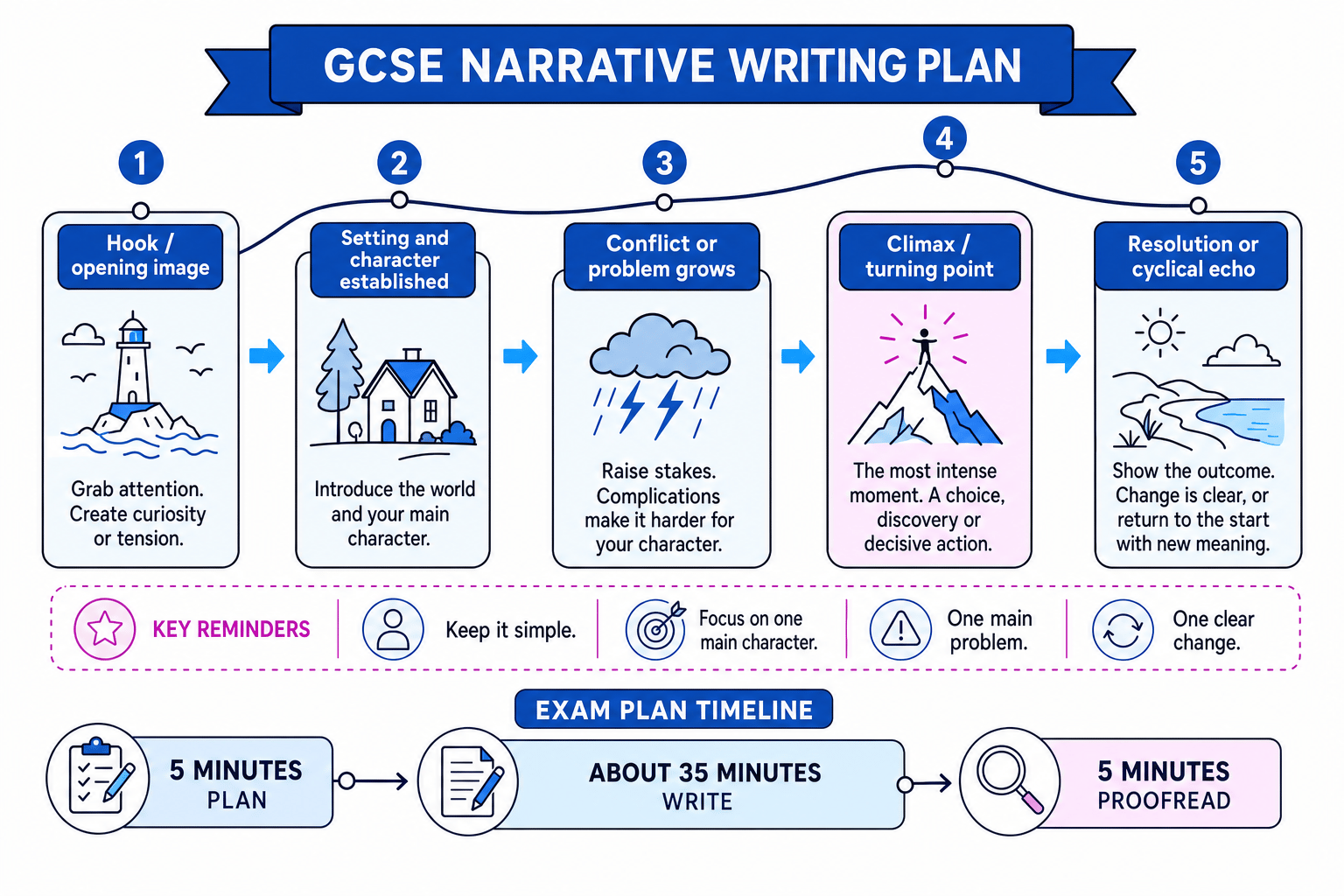
The five-part story arc
- Hook or opening image — grab attention with a striking moment, object, place or action.
- Setting and character — establish where we are and who matters.
- Problem grows — something becomes harder, stranger or more dangerous.
- Climax — the character makes a choice, discovers something or faces the worst moment.
- Resolution or cyclical echo — show the outcome, or return to the opening image with a new meaning.
A cyclical structure is when the ending echoes the beginning. For example, if the story opens with a broken streetlamp, it might end with the same streetlamp flickering back on after the character has changed.
Turning a broad prompt into a five-beat plan
Suppose the task asks you to write a story about a difficult decision.
- Choose a narrow situation: instead of “a whole life-changing adventure”, focus on one moment — a student finds a lost phone on an empty bus.
- Give the character a clear problem: the phone keeps receiving messages from someone asking for help, but the bus is about to leave the final stop.
- Build the story arc: opening image — the glowing phone under the seat; setting — wet evening, empty bus; growing conflict — messages become more urgent; climax — the student must decide whether to get off alone and investigate; resolution — they step into the rain and call the number.
- Add a change: at the start, the character wants to avoid trouble; by the end, they choose responsibility.
Over-plotting
Do not try to include explosions, five locations, three villains and a ten-year backstory. GCSE narratives are usually strongest when they focus on one vivid scene and develop it carefully.
Character: show the person through choices
Characterisation means the methods a writer uses to create a character. You can reveal character through actions, reactions, dialogue, thoughts and small physical details.
Instead of explaining a character’s whole personality, show one important trait under pressure. If your character is nervous, let the reader see it in their hands, breathing, thoughts or hesitation.
Showing character through action
You want to show that a character is anxious without writing “Mina was anxious.”
- Choose a physical action that suggests anxiety: Mina keeps smoothing the same folded ticket.
- Connect the action to the situation: she is waiting outside a locked office, so the repeated movement shows she feels trapped by the moment.
- Add a sentence that lets the reader infer the emotion: “Mina smoothed the ticket until the crease almost split, then pressed it flat against the locked office door.”
Setting: make the place do some work
A setting should be more than background decoration. It can create mood, increase tension and reflect the character’s feelings.
Mood and atmosphere
Mood or atmosphere is the emotional feeling created by the writing, such as unease, calm, excitement, loneliness or threat.
For example, an empty swimming pool at night suggests a different mood from a crowded school corridor at lunchtime. You can use sensory detail — what can be seen, heard, touched, smelt or tasted — but choose carefully. Two precise details are usually stronger than a long list.
Make setting active
Try asking:
- What can the character notice that matters?
- What detail hints that something is wrong?
- How does the setting make the problem harder?
A storm is not automatically dramatic. A storm becomes useful if it traps the character, hides a sound, cuts the power or mirrors their panic.
Conflict, problem and tension
Your story needs pressure. A problem is the situation that needs solving. Conflict is the struggle caused by that problem. Tension is how the reader feels while waiting to see what happens.
Conflict can be:
- External conflict — a struggle with something outside the character, such as another person, a locked door, a storm or a deadline.
- Internal conflict — a struggle inside the character, such as guilt, fear, jealousy or indecision.
Good tension often comes from delaying the answer to a question: What is behind the door? Will the character speak? Who sent the message? What happens if they fail?
Increasing tension in a moment
Start with the plain sentence: “The door opened.”
- Decide what the reader should worry about: the character is hiding, so the door opening could expose them.
- Slow the pace before the action: focus on tiny details such as the handle moving, the character’s breath stopping, or dust shifting under the door.
- Use sentence length for control: longer sentences can delay the reveal, then a short sentence can hit hard.
- Improved version: “The handle dipped once, then rose again. Behind the crates, Sami held his breath until his chest burned. The handle turned a second time. The door opened.”
Tension shortcut
Use this pattern: delay, detail, danger. Delay the main event, zoom in on one precise detail, then remind the reader what could go wrong.
Narrative voice and viewpoint
Voice and viewpoint
Narrative voice is the sound or personality of the narrator telling the story. Viewpoint is the position from which the events are told, such as first person or third person.
First person uses “I” or “we”. It can feel immediate and personal because the reader is inside the character’s experience.
Third person uses “he”, “she”, “they” or a character’s name. In third-person limited viewpoint, the narration mainly follows one character’s thoughts and experiences. This is often easier to control than jumping between many minds.
For GCSE, first person and third-person limited are usually the safest choices. They help you keep the story focused.
Choosing a viewpoint
You want to write about someone entering a dark house.
- Decide the effect you want. If you want panic and closeness, first person may work well because the reader experiences the fear directly.
- Test first person: “I pushed the door, although every part of me wanted to run.” This gives immediate access to fear.
- Test third-person limited: “Jonah pushed the door, although every part of him wanted to run.” This still follows one character closely but gives slightly more distance.
- Choose the one you can control best. If you often slip between tenses or reveal too much, third-person limited may be safer.
Dialogue: use speech sparingly
Dialogue
Dialogue is spoken conversation between characters. In narrative writing, direct speech is usually placed inside speech marks.
Dialogue should do something useful. It might reveal character, create conflict, increase tension or show a relationship. Avoid long conversations where characters explain the plot to each other.
Basic direct speech rules:
- Put the spoken words inside speech marks: “Don’t move.”
- Keep punctuation inside the speech marks: “Don’t move,” she whispered.
- Start a new paragraph when a new speaker speaks.
- Use dialogue tags, such as “said”, “asked” or “whispered”, only when needed for clarity.
Punctuating dialogue with action
You want two characters to argue quietly outside a locked room.
- Decide what the dialogue reveals: one character is cautious, while the other is impatient.
- Put the first spoken words inside speech marks and add a suitable dialogue tag: “We should wait,” Leila whispered.
- Start a new paragraph for the second speaker and add action to show impatience: Tom rattled the handle. “We’ve waited long enough.”
- Keep it short so the tension stays high. The action around the speech matters as much as the words.
Endings: resolution does not mean everything is solved
A resolution does not have to be happy. It just needs to show the outcome of the central problem. The reader should feel that the piece has been shaped on purpose.
A story opening may not fully resolve everything, but it should still have direction. By the end of the opening, the reader should understand the situation, the main character, and the problem that will drive the story forward.
Strong GCSE endings often use:
- A changed image from the opening.
- A final choice made by the character.
- A quiet consequence after the climax.
- A short sentence for impact, if it suits the tone.
The sudden ending
Avoid ending with “and then I woke up” unless you have built it carefully and it genuinely changes the meaning. It often feels like an escape route rather than a planned resolution.
Technical accuracy: make control visible
AO6 rewards accurate, controlled writing. This does not mean using the most complicated punctuation possible. It means your sentences are clear, varied and correctly punctuated.
Use:
- Paragraphs to guide the reader through shifts in time, place, focus or speaker.
- Sentence variety: short sentences for impact, longer sentences for flow or delay.
- Precise vocabulary: choose specific nouns and verbs, such as “stumbled”, “gripped” or “flickered”, rather than vague words like “went” or “nice”.
- Accurate punctuation: full stops, commas, apostrophes and speech marks matter more than forcing in semicolons.
Control beats chaos
A polished, focused story with accurate sentences will usually score better than an ambitious story that becomes confusing, rushed or technically messy.
In the exam
- Spend about 5 minutes planning: choose one character, one setting, one problem, one climax and one ending.
- Write for about 35 minutes: keep returning to the central conflict so the story does not drift.
- Save about 5 minutes to proofread: check sentence boundaries, paragraphs, speech punctuation, tense consistency and obvious spelling errors.
Check yourself
- Can you explain the difference between a problem, conflict and tension?
- Does your story plan include a clear climax or turning point?
- Have you chosen a narrative viewpoint and kept it consistent?
