What you'll learn
- What AQA Paper 1 Question 5 is really asking you to do.
- The difference between descriptive and narrative writing.
- How the 40 marks are split between AO5 and AO6.
- A simple way to choose, plan, write, and check your response.
The big picture: what is Question 5?
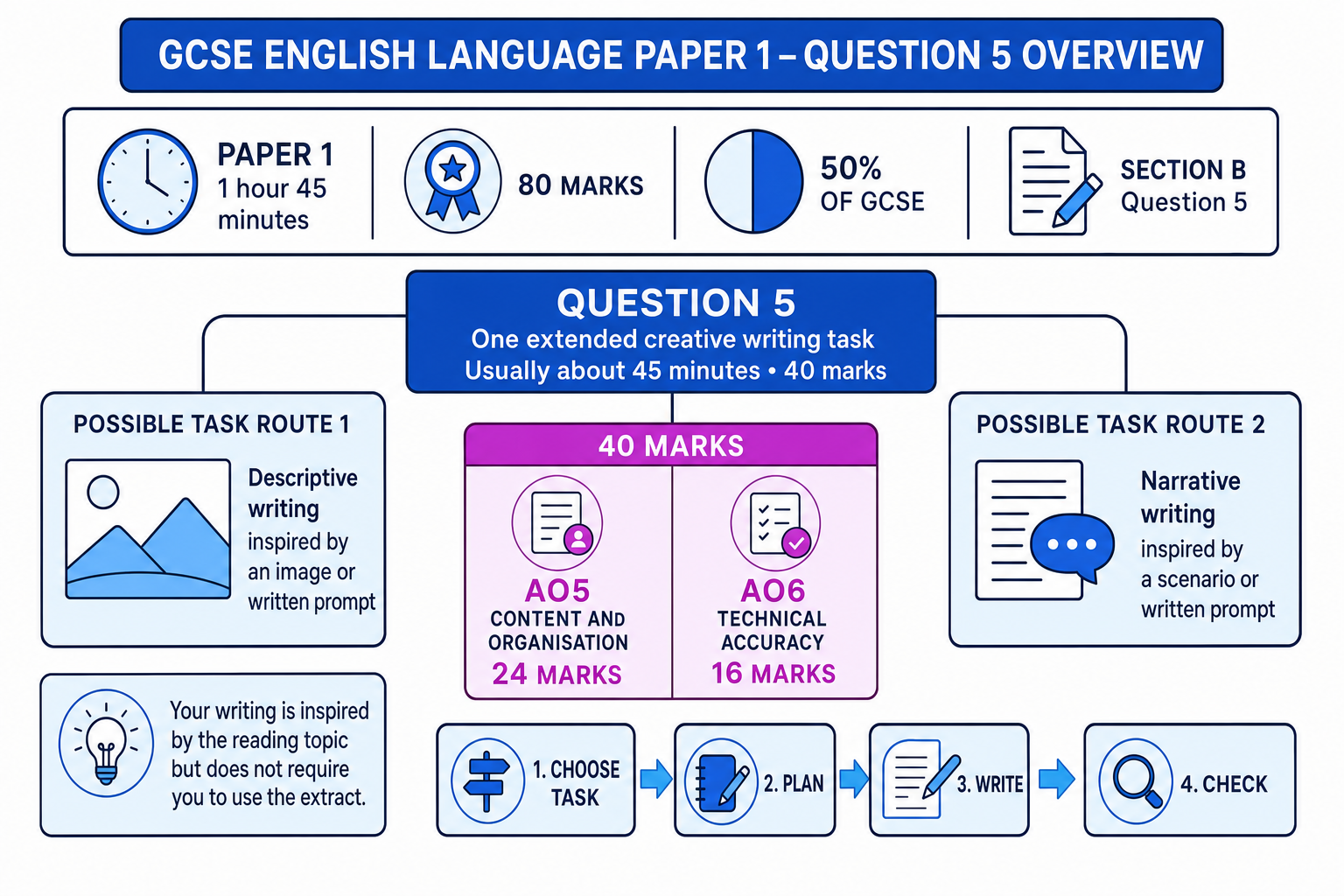
Paper 1 is called Explorations in Creative Reading and Writing. It lasts 1 hour 45 minutes, is worth 80 marks, and counts for 50% of your GCSE English Language grade.
Section A is reading. Section B is writing. Question 5 is the writing task: you produce one extended piece of creative writing.
Creative writing
Creative writing means original writing designed to engage the reader’s imagination. In Paper 1, this usually means writing a description or a narrative.
AQA says the Paper 1 writing task is inspired by the reading topic and assesses your narrative and descriptive skills. This does not mean you copy ideas from the extract. It means the task may share a broad theme, mood, setting, or situation with what you read earlier.
The core job
In Question 5, you are not being tested on how “wild” your imagination is. You are being tested on whether you can shape one clear, engaging piece of writing with controlled language, structure, spelling, punctuation, and grammar.
The task: description or narrative
You may be asked to write descriptively or narratively, often from a written prompt, a scenario, or an image.
Descriptive writing
Descriptive writing creates a vivid picture, atmosphere, or impression. It focuses on details such as setting, mood, objects, people, movement, sound, weather, light, and viewpoint.
Narrative writing
Narrative writing tells a story. It usually includes a character, a situation, a sequence of events, and some kind of change, tension, conflict, or discovery.
Sometimes the paper gives you a choice, for example a description suggested by an image or a story based on a written idea. Question 5 itself is compulsory, but if a choice is offered, choose the option you can control best.
How to choose the stronger option
Do not automatically choose the story because it feels easier. Stories can become too long, too complicated, or unfinished. Descriptions can score very highly when they are carefully structured and full of precise detail.
Choosing between a description and a narrative
Imagine you are offered these two options: write a description suggested by an image of an empty seaside café, or write a story about someone waiting for important news.
-
Compare control of structure. The café description could be organised by moving from outside to inside, then to one small detail on a table. The story needs a beginning, build-up, turning point, and ending. If you struggle to finish stories, the description may be safer.
-
Compare opportunity for language. The café allows sensory detail: salt smell, cold chairs, humming fridge, grey light, abandoned cups. The story allows tension and emotion: phone calls, hesitation, silence, relief or disappointment. Choose the one where you can produce more precise vocabulary.
-
Compare risk. A story about “important news” could become melodramatic or rushed. A café description could become a list of objects. The best choice is the one where you can avoid your usual weakness.
-
Make a clear decision. If you are good at atmosphere and detail, choose the café description. If you are good at shaping tension and character change, choose the waiting story.
The marks: AO5 and AO6
Question 5 is worth 40 marks. These marks are split into two assessment objectives.
AO5
AO5 rewards the quality of your content and organisation. In simple terms: what you write, how imaginative and clear it is, and how effectively you shape it for the reader. It is worth 24 marks.
AO6
AO6 rewards technical accuracy. This means vocabulary, sentence structures, spelling, punctuation, and grammar. It is worth 16 marks.
Because AO5 is worth more marks, your ideas and organisation matter a lot. But AO6 is still a large part of the question, so careless punctuation and sentence errors can seriously limit your mark.
Thinking big vocabulary is enough
Ambitious vocabulary only helps if it is accurate and meaningful. A simple, precise sentence is better than a long sentence packed with words that do not quite fit.
Timing: how long to spend
A sensible target is about 45 minutes for Question 5. You can adjust slightly, but do not leave yourself only 20 minutes. This task is worth half the marks on Paper 1.
A simple timing plan:
- 5 minutes planning
- 35 minutes writing
- 5 minutes checking and improving
Protect your checking time
Checking is not just “reading it again”. It is where you fix sentence boundaries, add missing punctuation, correct spellings, and improve weak words. Those changes directly affect AO6.
Planning: small plan, big impact
A plan should be short enough to use, but clear enough to stop you drifting. You do not need a perfect plan. You need a route.
For descriptive writing, plan a sequence of focus points. For narrative writing, plan a sequence of events.
A simple descriptive structure
A strong description often moves through a controlled pattern, such as:
- Wide view: establish the whole setting.
- Zoom in: focus on one striking detail.
- Shift: change the mood, time, sound, or movement.
- Human trace: suggest a person, memory, or emotion.
- Final image: end on a meaningful detail.
Planning a description from a prompt
Suppose the prompt is: “Write a description of a place just before a storm.”
-
Choose a clear setting. A school playground gives you objects and atmosphere: gates, benches, puddles, scattered paper, empty windows.
-
Decide the mood. Instead of simply “scary”, choose “tense and expectant”. This helps you select details that feel still, heavy, and waiting.
-
Order the focus points. Start with the sky over the playground, move to the fence rattling, zoom in on a crisp packet trapped against a drain, then end with the first hard drop of rain.
-
Build a final effect. The ending should not just stop. The first raindrop can feel like a signal that the whole scene is about to change.
A simple narrative structure
A narrative does not need ten characters and a dramatic plot twist. In GCSE writing, a small, controlled story is usually stronger.
A useful structure is:
- Opening situation: where are we, and who is involved?
- Trigger: something changes.
- Development: the character reacts or struggles.
- Turning point: a decision, discovery, or realisation.
- Ending: the result, echo, or final image.
Keep the story small
A short story for Question 5 should usually cover one key moment, not a whole lifetime. Depth beats scale.
Writing descriptively: make the reader notice
Good description is not a random list of adjectives. It is a carefully guided experience. You decide what the reader sees first, what they notice next, and what feeling they leave with.
Useful techniques include:
- Sensory detail: sight, sound, smell, touch, and sometimes taste.
- Figurative language: language that is not literally true, such as metaphor or simile.
- Personification: describing something non-human as if it has human qualities.
- Contrast: placing two different ideas or images near each other.
- Sentence variety: mixing short, medium, and longer sentences for effect.
Figurative language
Figurative language creates meaning through comparison or imagination rather than literal description. For example, “the windows stared blindly” suggests emptiness and unease.
A useful mini model:
The corridor held its breath. Lockers lined the walls in dull rows, their scratched doors catching the last strip of afternoon light. Somewhere, water tapped steadily into a plastic bucket.
Notice that the writing uses setting, sound, light, and personification. It does not need to explain the mood by saying, “It was creepy.”
Writing narratively: create movement and change
A narrative needs direction. The reader should feel that something is developing, even if the story is quiet.
A useful way to think about narrative is: someone wants something, but something gets in the way. The “something” can be small: confidence, time, fear, a locked door, a message, a misunderstanding.
Turning a simple idea into a narrative plan
Start with the idea: “A person finds an old key.”
-
Give the character a reason to care. The key belongs to a house the character’s family never talks about, so it creates curiosity and tension.
-
Add an obstacle. The character is not supposed to go there, and the house is being cleared the next morning. This creates urgency.
-
Choose the turning point. The character opens a drawer, not a door, and finds a photograph that changes what they understand about their family.
-
Plan the ending. Instead of explaining everything, end with the character putting the key back in their pocket, now knowing they will return.
Trying to write a whole novel
Avoid huge plots: murders, car chases, wars, disasters, and ten-year time jumps. You only have around 45 minutes. Focus on one moment and make it vivid.
Organisation: guide the reader
Organisation means the way your writing is arranged. It includes paragraphs, shifts in focus, sentence openings, and the overall shape of the piece.
Cyclical structure
A cyclical structure is when a piece ends by returning to an image, phrase, place, or idea from the beginning. It can make your writing feel complete and deliberate.
For example, a description might begin with a single streetlamp flickering and end with the same streetlamp finally going out. A story might begin with a character avoiding a letter and end with them opening it.
Use paragraphs for movement
Start a new paragraph when the focus, time, place, mood, or action changes. Paragraphs are not decoration; they show the examiner that you are controlling the reader’s journey.
Technical accuracy: AO6 matters
AO6 rewards control. You do not need to use every punctuation mark you know, but you should show a range used accurately.
Aim to control:
- Full stops and capital letters.
- Commas used for clarity, not sprinkled randomly.
- Apostrophes for possession and contraction.
- Speech punctuation, if you use dialogue.
- A range of sentence lengths.
- Accurate spelling of common words.
Dialogue can be risky
Dialogue can work well in narrative writing, but too much speech often leads to punctuation errors and slows the story. Use it only when it reveals character or creates tension.
A controlled sentence range might look like this:
The bus did not come. For twenty minutes, Mara watched the road shine under the streetlights, each passing car lifting a thin spray of rain. Then her phone buzzed.
The short sentences create tension. The longer sentence slows time down and adds atmosphere.
What success looks like
A strong Question 5 response usually has:
- A clear choice of task.
- A controlled plan.
- A strong opening that establishes mood, setting, character, or situation.
- Paragraphs that move the piece forward.
- Precise vocabulary linked to effect.
- Varied sentences.
- Accurate punctuation.
- An ending that feels shaped, not rushed.
In the exam
-
Choose the task you can control best. Pick the option that gives you the strongest structure and the most precise details, not just the one that looks easiest.
-
Plan for five minutes. Decide your opening, middle movement, and ending before you write. A small plan prevents drifting and repetition.
-
Write with AO5 and AO6 in mind. Shape your ideas clearly, use paragraphs deliberately, vary your sentences, and keep punctuation accurate.
-
Leave time to check. Fix sentence boundaries, capital letters, apostrophes, spelling, and any unclear phrasing.
Check yourself
- Can you explain the difference between descriptive and narrative writing?
- Can you remember how the 40 marks are split between AO5 and AO6?
- If you were given a prompt, could you create a five-part plan before writing?
