What you'll learn
- How to create a vivid setting using atmosphere, sensory detail and precise vocabulary.
- How to organise a description by zooming in, zooming out and shifting focus.
- How to include colour, sound, movement, weather, light, texture and mood without overloading your writing.
- How AQA rewards Paper 1 Section B writing through AO5 and AO6.
Where descriptive writing fits
In AQA GCSE English Language 8700, descriptive writing appears in Paper 1 Section B: Creative Writing. Paper 1 is 1 hour 45 minutes, worth 80 marks and 50% of the GCSE.
The writing task is worth 40 marks:
- 24 marks for AO5: clear, imaginative communication and organisation.
- 16 marks for AO6: vocabulary, sentence structures, spelling and punctuation.
Descriptive writing
Descriptive writing creates a clear, vivid picture in the reader’s mind. Its main job is to make the reader see, hear and feel a moment, place or atmosphere — not to tell a full sequence of events.
The main goal
A strong description is controlled. It feels like a camera moving carefully through a scene, not like a story rushing through a plot.
Description is not the same as story
A narrative is a story: it usually has events, characters, conflict and change over time. A description focuses on a scene, object, person or moment.
That does not mean nothing can move. You can include movement — wind shaking trees, light shifting, footsteps echoing — but the movement should help build the picture and mood.
A useful difference
- Story: “A girl ran into the station, missed the train, and argued with the guard.”
- Description: “The station yawned in the grey morning light; a single train waited, its windows misted, its metal sides trembling softly.”
The second one has movement and atmosphere, but it is not racing through events.
Accidental story
Many students start with a description, then accidentally turn it into a plot: someone arrives, something happens, then another thing happens. In a description, keep returning to the place, the mood and the details.
Start with setting and atmosphere
Setting
The setting is where and when the writing takes place. It can include location, time of day, season, weather, lighting and social environment.
Atmosphere
Atmosphere is the feeling or emotional quality created by the writing, such as calm, tension, loneliness, excitement, threat or wonder.
A setting becomes interesting when it has a clear atmosphere. “A beach” is just a place. “A deserted beach under a bruised evening sky” already suggests mood.
To build atmosphere, choose details that all point in the same emotional direction. This is sometimes called a semantic field, which means a group of words connected by meaning.
For example, a threatening semantic field might include: shadows, claws, hissed, cracked, swallowed, cold, jagged.
Creating atmosphere from a setting
Imagine the setting is an empty playground after rain.
- Choose the atmosphere you want. Here, you might choose loneliness, so your details should feel abandoned rather than cheerful.
- Select objects that support that mood: a still swing, puddles, peeling paint, a forgotten glove.
- Choose verbs that make the scene feel lifeless or unsettling: “hung”, “dripped”, “shivered”, “waited”.
- Shape the sentence so the mood is clear: “The swings hung motionless in the rain, their chains dripping steadily beside a single glove, darkening in the puddle.”
Use sensory detail carefully
Sensory detail
Sensory detail is description that appeals to the senses: sight, sound, smell, touch and taste.
You do not need all five senses in every paragraph. In fact, using too many can make the writing feel like a checklist. Choose the senses that best suit the mood.
Details you can control
- Colour: pale gold, rust-red, sickly green, silver-grey.
- Sound: a low hum, a sudden crack, distant traffic, whispering leaves.
- Movement: drifting, twitching, crawling, surging, trembling.
- Weather: rain, frost, heat, wind, fog, humidity.
- Light: harsh glare, dim glow, flickering neon, weak dawn.
- Texture: rough brick, slick pavement, brittle leaves, velvet darkness.
- Mood: peaceful, tense, eerie, joyful, oppressive, fragile.
Three strong details beat ten weak ones
Instead of listing everything in the scene, choose two or three precise details and develop them. Examiners reward control, not quantity.
Selecting sensory detail
Imagine you are describing a narrow alley at night.
- Decide the mood. If the mood is threatening, avoid cosy details like “warm golden light” unless you are using contrast deliberately.
- Choose one visual detail and one sound detail: “a strip of flickering light” and “water ticking in a drain”.
- Add texture or movement to make the place feel alive: “walls sweating with damp” or “shadows sliding across the bricks”.
- Combine the details into a controlled image: “A strip of light flickered above the alley while water ticked in the drain and the damp walls sweated quietly in the dark.”
Organise your description like a camera
Your writing needs structure. Structure means the order and shape of your ideas across the whole piece.
A strong description often moves like a camera:
- Begin with a wide view.
- Move closer to selected details.
- Zoom in on one striking image.
- Shift focus to movement, sound, weather or light.
- Pull back at the end, perhaps returning to the opening image.
Zooming in and zooming out
Zooming in means moving from a broad view to a small, specific detail. Zooming out means moving back from a close detail to the wider scene.
Shifting focus
Shifting focus means deliberately moving the reader’s attention from one part of the scene to another, such as from the sky to a window, or from a crowd to one hand gripping a ticket.
This diagram shows a useful planning route for a Paper 1 Section B description.
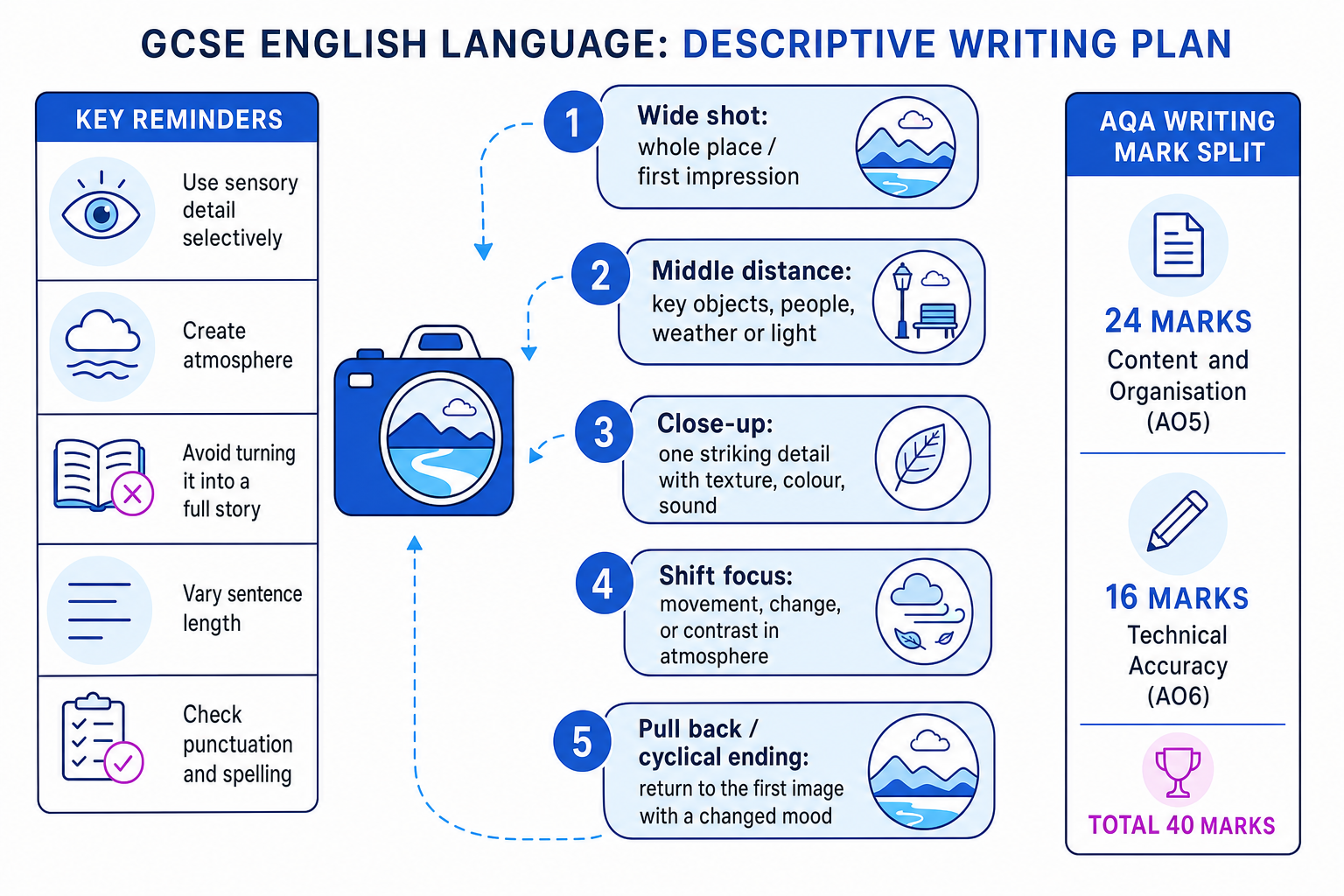
Planning a zoom-in description
Imagine the task asks you to describe a deserted market street before a storm.
- Start with the wide shot: “The market street lay empty beneath a low, swollen sky.” This establishes place, weather and mood.
- Move to the middle distance: describe stalls, signs, crates or shutters so the reader can locate themselves in the scene.
- Zoom in on one detail: a torn price label, a bruised apple, rain gathering on a striped awning. This makes the description specific.
- Shift focus to movement or sound: wind lifting paper, thunder rolling, metal shutters rattling. This prevents the scene from becoming static.
- Pull back to the whole street at the end, but slightly changed: “By the time the first drop fell, the whole street seemed to be holding its breath.”
Use language techniques for effect, not decoration
A language technique is a deliberate method a writer uses to create meaning or effect. In your own writing, techniques only help if they make the image clearer or the mood stronger.
Figurative language
Figurative language describes something in a non-literal way. Common examples include simile, metaphor and personification.
Three useful techniques
Simile compares one thing to another using “like” or “as”.
Example: “The moon hung like a cracked coin above the rooftops.”
Metaphor says something is something else, creating a stronger comparison.
Example: “The road was a black ribbon through the fields.”
Personification gives human actions or qualities to something non-human.
Example: “The wind worried at the loose window frame.”
Use these sparingly. One precise metaphor is better than five random comparisons.
Technique spotting in your own writing
Do not force in a simile just to prove you know what a simile is. AQA rewards the effect of your choices, not a checklist of techniques.
Choose precise nouns, verbs and adjectives
A noun names a thing, person or place. A verb shows an action or state. An adjective describes a noun.
Many descriptions become weak because they rely on vague words: “nice”, “bad”, “scary”, “big”, “small”, “thing”. Upgrade these by being specific.
Instead of vague description
“The place was scary and dark.”
Try precise description
“The corridor narrowed into a strip of darkness, its cracked tiles vanishing beneath the broken emergency light.”
The improved version gives the reader something to picture. It also creates atmosphere through detail rather than simply announcing an emotion.
Improving a flat description
Start with the sentence: “The forest was dark and scary.”
- Replace the vague noun or setting with a more specific focus: instead of “forest”, choose “the path”, “the trees” or “the canopy”.
- Replace the adjective “scary” with details that create fear: “branches knitted together”, “no birdsong”, “roots twisting across the path”.
- Choose verbs that add quiet movement: “pressed”, “crept”, “clung”, “blocked”.
- Write a stronger version: “Branches knitted themselves above the path, blocking the last of the light, while roots crept across the soil like black fingers.”
Control sentences for mood
A sentence structure is the way a sentence is built. For AO6, you are rewarded for using a range of sentence structures accurately.
Useful sentence types
- A simple sentence has one main idea: “The room was silent.”
- A compound sentence joins two main ideas, often with “and”, “but” or “so”: “The room was silent, and the clock had stopped.”
- A complex sentence includes a main idea plus extra information: “Although the room was silent, the curtains continued to stir.”
Sentence length affects pace. Longer sentences can create flow, detail or pressure. Short sentences can create shock, stillness or emphasis.
Mini model
“The fog pressed against the windows, softening the streetlights and swallowing the parked cars one by one. Somewhere, a gate creaked. Then silence.”
Notice how the final short sentence sharpens the mood.
Use punctuation as control
Commas, colons, semicolons and dashes can help you guide the reader through detail. Only use punctuation you can control accurately: a correctly used comma is better than a confused semicolon.
Build paragraphs with clear focus
A paragraph should not be random. Each paragraph needs a focus, such as:
- the whole setting
- the weather and light
- one object or detail
- sound and movement
- a final return to the opening image
You can think of each paragraph as a camera shot. When the camera moves, start a new paragraph.
A simple paragraph pattern
Try this pattern when you are unsure:
- Begin with the main image.
- Add one or two sensory details.
- Develop the mood through precise verbs or figurative language.
- End by shifting focus or changing sentence length.
Example paragraph:
“The harbour slept under a thin veil of mist. Ropes hung loose from the boats, dark with rain, and the water slapped softly against the stone wall. Above the roofs, a weak strip of morning light opened like a tired eye. Nothing hurried. Even the gulls seemed to wait.”
Keep a clear picture
A vivid description is not the same as a complicated one. The reader should always know where they are looking.
If every sentence introduces a new object, the scene becomes cluttered. Instead, link details together. Weather can affect the ground; light can affect colour; sound can travel through the setting.
Make details connect
The best descriptions feel unified. Colour, sound, movement, weather, light, texture and mood should work together to create one clear impression.
Planning your answer
In the exam, spend a few minutes planning before you write. A quick plan can stop your description becoming a story.
A useful five-part plan is:
- Wide shot: Where are we? What is the first impression?
- Light and weather: What affects the mood?
- Close-up: What tiny detail will stand out?
- Movement or sound: What changes or disturbs the scene?
- Final image: How will you end with control?
For Paper 1 Section B, a sensible timing guide is around 45 minutes for the 40-mark writing task, including a short plan and a final check.
In the exam
- Spend a few minutes planning a camera route: wide shot, close-up, shift focus, final image.
- Aim for controlled paragraphs rather than a long block of writing; each paragraph should have a clear focus.
- Use ambitious vocabulary only when it is accurate, and leave time to check spelling, punctuation and sentence boundaries.
Check yourself
- Can you explain the difference between a description and a story?
- Can you plan a five-part description using zoom in, shift focus and zoom out?
- Can you choose three sensory details that all create the same atmosphere?
