What you'll learn
- How to build clear analytical paragraphs for Paper 1 Section A.
- How to adapt your paragraph style for language, structure and evaluation questions.
- How to move from evidence to method to meaning, rather than just spotting techniques.
- How to avoid common paragraph mistakes that lose marks.
Why paragraph structure matters
AQA GCSE English Language Paper 1 is 1 hour 45 minutes, worth 80 marks and 50% of the GCSE. Section A asks you to read an unseen fiction extract and answer compulsory reading questions. Section B is the writing task, worth 40 marks: 24 for content and organisation, and 16 for technical accuracy.
In Section A, clear paragraphs help the examiner see your thinking. You are not just saying “there is a simile” or “the focus changes”; you are explaining how the writer’s choices create meaning.
Analytical paragraph
An analytical paragraph is a short, focused paragraph that makes a point about the writer’s choices, supports it with evidence, explains the method used, explores the effect, and links back to the question.
The main aim
A strong paragraph is not a checklist of labels. It is a chain of reasoning: point → evidence → method → effect → link.
The diagram below shows the flexible chain you can use, plus how it changes slightly for Paper 1 Questions 2, 3 and 4.
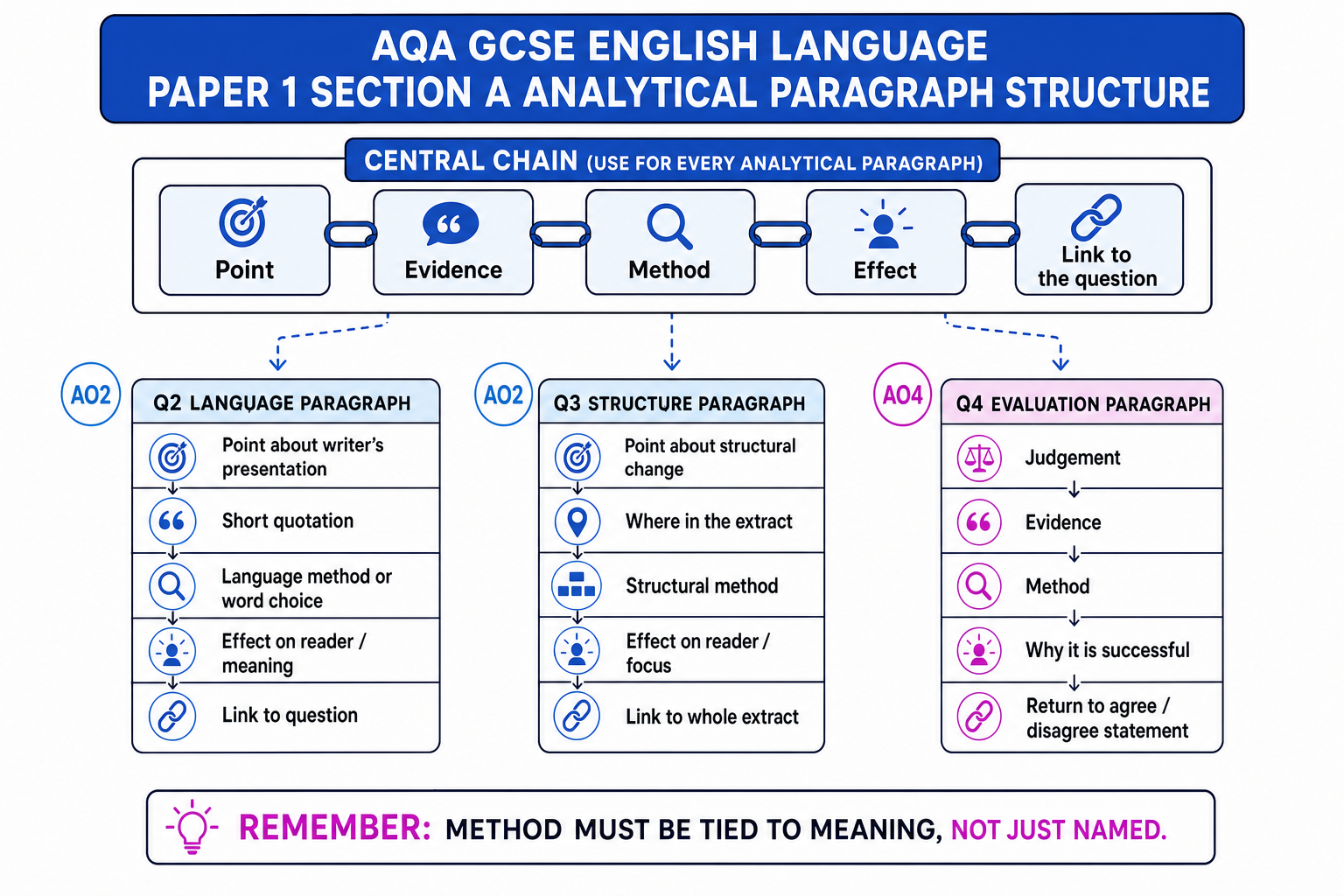
The basic paragraph chain
Point
A point is your answer to the question in one clear sentence. It should say what the writer presents, suggests or makes the reader notice.
Weak point: “The writer uses language.”
Better point: “The writer presents the setting as threatening and unpredictable.”
Evidence
Evidence is a short quotation or precise reference from the extract. A quotation is the exact wording copied from the source.
Keep evidence short. One or two words can be enough if you analyse them closely.
Method
A method is a choice the writer has made. In Paper 1, this could be a language method, such as a metaphor, verb or adjective, or a structural method, such as a shift in focus or a contrast.
Technique spotting
Do not name a method and stop. “This is a metaphor” is not analysis. You need to explain what the metaphor suggests and why it matters.
Effect
The effect is what the writer’s choice makes the reader think, feel, imagine or understand. You can also discuss the effect on meaning, atmosphere, tension or character.
Try to be specific. “This makes the reader want to read on” is often too vague unless you explain why.
Link
A link is the final connection back to the wording of the question. It proves that your paragraph has stayed focused.
A useful link might begin: “This reinforces the idea that…” or “This develops the writer’s presentation of…”
Building the paragraph chain
- Choose a point that answers the question directly: The writer presents [focus] as [clear idea].
- Select a short piece of evidence from the extract that proves the point, ideally a phrase or single key word rather than a long sentence.
- Identify a method only if it helps you explain meaning: for example, a verb might show action, an adjective might shape description, or a metaphor might create an image.
- Explain the effect by asking: What does this make the reader understand about the focus of the question?
- Combine the chain into a paragraph: The writer presents [focus] as [idea]. The phrase “[short quotation]” uses [method], particularly the word “[key word]”, to suggest [inference]. This makes the reader [effect], reinforcing [link to question].
Language paragraphs for Question 2
Question 2 is usually worth 8 marks and focuses on language. Language means the writer’s word choices, images, phrases and sentence forms. This question assesses AO2, which rewards analysis of how writers use language and structure to create effects.
You will usually be directed to a specific section of the source, so stay inside the given lines.
Language method
A language method is a writer’s choice at word, phrase or sentence level, such as a noun, verb, adjective, adverb, simile, metaphor, personification, semantic field, sentence length or repetition.
For Question 2, your paragraph should zoom in closely. The best answers often analyse one key word in detail rather than listing lots of techniques.
Model language paragraph
The writer presents [focus from the question] as [precise idea]. The phrase “[short quotation]” uses [language method], especially the word “[key word]”, which suggests [inference about meaning]. This makes the reader [specific reaction or understanding], developing the impression that [link back to question].
Writing a language paragraph
- Turn the question into a point: if the question asks how the writer presents a place, decide whether the place seems dangerous, peaceful, confusing, beautiful or something more precise.
- Choose evidence that gives you something to analyse, such as a powerful verb, unusual adjective, image or repeated idea.
- Focus on the most useful method. If a phrase contains both imagery and strong word choice, pick the one that gives you the richest explanation.
- Move from method to meaning: explain what the word or image suggests, then what it makes the reader feel or notice.
- Shape it into a paragraph using this frame: The writer presents the place as [idea]. The phrase “[quotation]” uses [method], with the word “[key word]” suggesting [meaning]. This creates a sense of [effect], so the reader understands the place as [link].
Zoom in before you zoom out
A strong language paragraph often zooms in on one word, then zooms out to the whole impression created by the writer.
Structure paragraphs for Question 3
Question 3 is also usually worth 8 marks and also assesses AO2, but it focuses on structure rather than language.
Structure
Structure means how the writer organises the text: the order of events, shifts in focus, changes in perspective, pacing, openings, endings, contrasts and patterns across the extract.
For Question 3, you should think about the whole extract. You do not need to analyse individual words in detail. Instead, ask: Why has the writer arranged the text in this order?
Useful structural methods include:
- Opening focus
- Shift in focus
- Zooming in or out
- Contrast
- Foreshadowing
- Withholding information
- Change in pace
- Cyclical structure
- Narrative perspective
- Ending or cliffhanger
Model structure paragraph
At [point in the extract], the writer shifts the focus from [first focus] to [new focus]. This structural change moves the reader’s attention towards [important idea]. By organising the extract in this way, the writer creates [effect, such as tension, curiosity, contrast or surprise]. This helps present [link to the question or whole extract].
Writing a structure paragraph
- Identify movement across the extract, not just one sentence: for example, the focus may move from a wide description to a close-up detail, or from calm to chaos.
- Name the structural method if it is accurate, such as a shift in focus, contrast, zoom in, or change in pace.
- Explain why the order matters: consider what the reader knows first, what is delayed, and what changes by the end.
- Connect the structural choice to reader response: tension may increase, curiosity may grow, or a character may seem more isolated.
- Build the paragraph: At the beginning/middle/end, the writer [structural choice]. This shifts attention from [first focus] to [second focus], making the reader [effect]. The structure is effective because [reason linked to the whole extract].
Retelling the story
In Question 3, do not simply say what happens. You need to explain how the order, focus or pace shapes the reader’s response.
Evaluation paragraphs for Question 4
Question 4 is usually worth 20 marks and assesses AO4. This is the evaluation question, often based on a statement such as “A student said…” followed by “To what extent do you agree?”
Evaluation
Evaluation means making a judgement about how successful, convincing or effective the writer’s choices are, supported by evidence from the text.
In Question 4, you still analyse methods, but your paragraph must include a clear judgement. You are deciding how far you agree with the statement.
Strong evaluation uses phrases like:
- “This is effective because…”
- “This supports the statement because…”
- “I largely agree because…”
- “However, the statement is only partly accurate because…”
Model evaluation paragraph
I [agree/largely agree/partly agree] with the statement that [key words from the statement]. When the writer describes [brief reference] as “[short quotation]”, the use of [method] suggests [meaning]. This is effective because [explain why the reader is persuaded, shocked, unsettled or made to sympathise]. Therefore, the statement is [convincing/partly convincing] because [final judgement].
Writing an evaluation paragraph
- Begin with a judgement, not a neutral point: decide whether you agree, mostly agree, partly agree or disagree with the statement.
- Choose evidence that helps you test the statement. The evidence should prove your judgement, not just look interesting.
- Analyse how the writer creates the effect, using language or structure if relevant.
- Evaluate success by explaining why the method is powerful, convincing, surprising or limited.
- Form the paragraph: I largely agree that [statement]. The writer’s use of “[quotation]” suggests [meaning], because [method] creates [effect]. This is successful as it makes the reader [response], so the statement is convincing because [judgement].
Use evaluative verbs
For Question 4, useful verbs include emphasises, intensifies, undermines, challenges, reinforces, positions and persuades.
How many paragraphs should you write?
There is no perfect number, because quality matters more than quantity. As a rough guide:
- For Question 2, aim for 2 developed language paragraphs.
- For Question 3, aim for 2 developed structure paragraphs covering different parts of the extract.
- For Question 4, aim for 3 developed evaluation paragraphs, because it is worth more marks.
A common time plan for Paper 1 is about 15 minutes reading, around 45 minutes on Section A answers, and around 45 minutes on Question 5 writing, leaving a few minutes to check. Your teacher may give you a slightly different timing plan, but the principle is the same: spend longer on the higher-mark questions.
Making your paragraphs sound analytical
Try to avoid vague phrases such as “this makes the reader interested” or “this creates an image in the reader’s head.”
Instead, be precise:
- “This makes the reader feel uneasy because…”
- “This suggests the character is losing control…”
- “This increases tension by delaying…”
- “This positions the reader to sympathise with…”
- “This reinforces the atmosphere of…”
Precision beats length
A shorter paragraph with a clear point, relevant evidence and developed explanation is better than a long paragraph that drifts away from the question.
In the exam
- Start each paragraph with a point that uses the wording of the question, so your answer stays focused.
- Use short evidence and analyse it closely; do not copy long chunks of the extract.
- Adapt your paragraph to the question: zoom in on words for language, track movement for structure, and make a clear judgement for evaluation.
- Link every paragraph back to the question so the examiner can see why your analysis matters.
- If you name a method, always explain its effect; terminology only earns marks when it is connected to meaning.
Check yourself
- Can you explain the difference between a language paragraph and a structure paragraph?
- In your last analytical paragraph, did you explain the effect of the method or just name it?
- For Question 4, did you make a clear judgement about how far you agreed with the statement?
