What you'll learn
- How evidence works in AQA GCSE English Language Paper 2 Section A.
- How to choose short, useful quotations instead of copying huge chunks.
- How to label Source A and Source B clearly in your answers.
- How to avoid mixing up evidence when comparing both sources.
Why evidence matters in Paper 2
AQA GCSE English Language Paper 2 is called Writers’ viewpoints and perspectives. It lasts 1 hour 45 minutes, is worth 80 marks, and counts for 50% of the GCSE. Section A is the reading section, worth 40 marks. Section B is the writing task, also worth 40 marks, split into 24 marks for content and organisation and 16 marks for technical accuracy.
In Paper 2 Section A, you read two unseen non-fiction sources, usually from different time periods. The questions are compulsory: there are no optional routes.
The key skill in this topic is simple but important: use quotations from both sources accurately when the question asks you to.
Evidence
Evidence means the words, phrases, details or references from the source that prove your point. In English Language, evidence is not just decoration: it must support your interpretation of the writer’s ideas, feelings or methods.
Evidence is proof, not padding
A quotation only earns marks when you use it to prove something. The examiner is not looking for “lots of quotes”; they are looking for well-chosen evidence explained clearly.
Which Paper 2 questions need evidence?
Not every question uses evidence in the same way.
| Paper 2 question | What evidence usually looks like |
|---|---|
| Question 1 | Selecting true statements from one source. No paragraph needed. |
| Question 2 | Using details or short quotations from both sources to summarise differences or similarities. This mainly rewards AO1 summary and synthesis. |
| Question 3 | Analysing language in one source, usually Source B. This rewards AO2 language analysis. |
| Question 4 | Comparing writers’ ideas and perspectives in both sources. This rewards AO3 comparison, including how ideas are conveyed. |
Source
A source is one of the unseen texts printed in the exam paper. In Paper 2, you will usually have Source A and Source B. Always name the correct source when using evidence.
Keep Source A and Source B separate
Before you start writing, treat the two sources like two separate boxes. Evidence from Source A should not accidentally be described as coming from Source B, and vice versa.
This matters most in Question 2 and Question 4, because those questions ask you to work across both texts.
The diagram below shows how evidence from Source A and Source B should stay separate until you deliberately compare them.
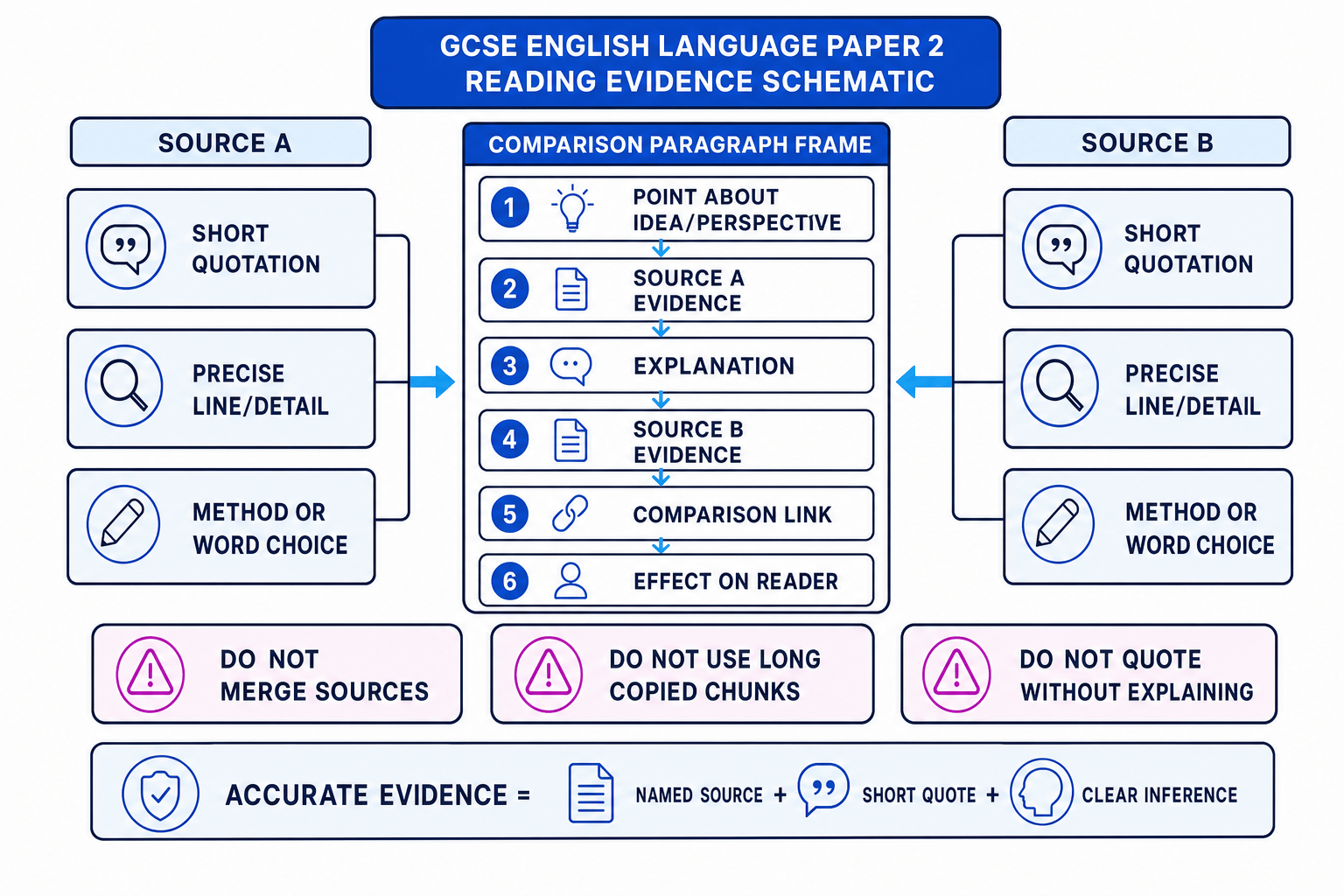
The source swap
A very common mistake is writing something like “Source A shows…” when the quotation actually comes from Source B. This weakens accuracy because the examiner cannot trust your evidence.
A simple evidence bank
When you read, create a quick mental or written evidence bank:
| Focus | Source A evidence | What it suggests | Source B evidence | What it suggests |
|---|---|---|---|---|
| The topic in the question | Short quote or detail | Your inference | Short quote or detail | Your inference |
Inference
An inference is a sensible conclusion you reach from evidence. It is not directly stated, but it is supported by the writer’s words.
Building an evidence bank
Suppose the question asks you to compare how the writers present an experience.
- Decide what aspect of the experience you are comparing, such as the writers’ feelings, the difficulty of the situation, or their attitude to other people.
- Put one short piece of evidence from Source A into the Source A column, and one short piece of evidence from Source B into the Source B column. Do not mix them into one messy list.
- Write an inference beside each piece of evidence: what does it suggest about the writer’s viewpoint?
- Pair the evidence by relationship: are the sources similar, different, or partly similar but with a different emphasis?
- Turn that relationship into a comparison sentence: “Source A presents the experience as…, whereas Source B presents it as…”
Use short quotations
Quotation
A quotation is the exact wording copied from a source, placed inside quotation marks. For example, in your own answer you might write: the writer describes the place as “
shortphrasefromthesource short phrase from the source shortphrasefromthesource”.
A good quotation is usually:
- a single word
- a short phrase
- a brief part of a sentence
You do not need to copy full sentences unless the whole sentence is genuinely useful. In fact, shorter quotations often lead to stronger analysis because you can focus on the writer’s choices.
The three-word test
Ask yourself: could I prove my point with three words or fewer from the source? If yes, use the shorter quotation and explain it properly.
Why shorter is usually better
Long quotations can hide your thinking. The examiner has already read the source; they do not need you to copy it back. They need to see what you understand about it.
A weak evidence sentence might look like this:
Source A shows the writer is upset because there is a very long quotation copied from the text.
A stronger evidence sentence looks more like this:
shortquotation short quotation shortquotationIn Source A, the phrase “
” suggests the writer feels overwhelmed because…
The second version is better because the quotation is focused and the explanation can go deeper.
Quote dumping
Quote dumping means dropping a quotation into your answer without explaining it. A quotation should always be followed by a clear comment about what it suggests, implies, reveals or emphasises.
Embed quotations smoothly
Embedded quotation
An embedded quotation is a quotation fitted smoothly into your own sentence, instead of being left floating on its own.
For example, rather than writing:
quotation quotation quotationThe writer is shocked. “
”.
You could write:
quotation quotation quotationThe writer’s description of “
” suggests shock because…
This helps your answer sound controlled and analytical.
Embedding a quotation
You have chosen a short quotation from Source A that supports your point about the writer’s attitude.
- Start with the source label and your point: “In Source A, the writer presents the situation as…”
- Attach the quotation to your own grammar: “through the phrase ‘ shortquotationshort quotationshortquotation ’…”
- Explain the inference: “which suggests that…”
- If useful, zoom in on a word class or method: “The adjective/verb/noun ‘ wordwordword ’ implies…”
- Link back to the question focus: “This helps present the experience as…”
Label sources clearly
When you use evidence, name the source:
- “In Source A, the writer…”
- “By contrast, Source B suggests…”
- “Similarly, the writer of Source B…”
Avoid vague labels like:
- “the first one”
- “the old text”
- “the other source”
- “it says”
Those can become confusing, especially when you are under exam pressure.
Label first, quote second
A safe pattern is: Source label → point → short evidence → explanation. For comparison, repeat the pattern for the other source and add a comparison word such as “whereas”, “similarly” or “however”.
Useful comparison connectives
Use comparison language to show the relationship between the two sources:
| If the sources are similar | If the sources are different |
|---|---|
| similarly | whereas |
| likewise | by contrast |
| both writers | however |
| in both sources | unlike Source A |
| this is also seen in | Source B presents a different view |
Labelling both sources in a comparison
You are writing a Question 4 paragraph comparing viewpoints.
- Make a clear claim about Source A: “In Source A, the writer seems to view the experience as yourinferenceyour inferenceyourinference .”
- Add accurate evidence from Source A: “This is suggested by ‘ shortquotationfromSourceAshort quotation from Source AshortquotationfromSourceA ’, which implies…”
- Choose the relationship between the sources: decide whether Source B is similar, different, or more extreme.
- Introduce Source B with a clear label: “By contrast, in Source B, the writer presents the experience as yourinferenceyour inferenceyourinference .”
- Add accurate evidence from Source B and explain it: “The phrase ‘ shortquotationfromSourceBshort quotation from Source BshortquotationfromSourceB ’ suggests…”
- Finish by comparing the writers’ perspectives, not just the events: “Therefore, Source A sounds…, while Source B sounds…”
Use evidence differently for Question 2 and Question 4
Question 2 and Question 4 both use both sources, but they do not do exactly the same job.
Question 2: summary and synthesis
Synthesis
Synthesis means bringing information from both sources together to form a combined understanding. In Question 2, you usually summarise differences or similarities using evidence from both texts.
In Question 2, you do not need heavy language analysis. You should focus on what you can infer from details in both sources.
A good Question 2 sentence might follow this pattern:
detailorshortquote detail or short quote detailorshortquoteIn Source A,
suggests…, whereas in Source B,
detailorshortquote detail or short quote detailorshortquoteimplies…
Notice that the sentence compares ideas or information, not individual language methods.
Question 4: comparison of perspectives
Perspective
A perspective is the writer’s viewpoint, attitude or way of seeing the topic. It includes what they think and how they want the reader to respond.
In Question 4, you should compare the writers’ ideas and perspectives, using evidence from both sources. You can also discuss methods such as tone, word choice, imagery, sentence structure or contrast — but only when they help explain the viewpoint.
A useful Question 4 paragraph shape is:
- Comparative point about both writers.
- Source A evidence and explanation.
- Source B evidence and explanation.
- Clear comparison of perspectives.
- Optional method comment if it strengthens your point.
Do not turn Question 4 into two mini essays
Avoid writing a whole paragraph on Source A and then a separate paragraph on Source B with no link. Keep comparing as you go: “whereas”, “similarly”, “unlike”, “both”, “however”.
Quote accurately
Accuracy means copying the writer’s words correctly and assigning them to the right source. If the source uses unusual spelling, old-fashioned phrasing or punctuation, keep it as it is.
You may shorten a quotation using an ellipsis, like this: “
startofquotation start of quotation startofquotation…
endofquotation end of quotation endofquotation”. Only do this if the meaning stays the same.
Do not improve the quotation
Do not change a quotation to make it sound more modern, more grammatical or easier to fit into your sentence. If the wording is awkward, change your own sentence around it instead.
Explain the evidence
After using evidence, ask: So what does this prove?
Useful analytical verbs include:
- suggests
- implies
- reveals
- emphasises
- presents
- conveys
- contrasts
- reinforces
Avoid vague comments like:
- “This makes the reader want to read on.”
- “This is effective.”
- “This gives a good image.”
- “This shows the writer uses language.”
Instead, explain the specific effect:
This suggests the writer feels powerless, encouraging the reader to see the situation as threatening rather than exciting.
Turning evidence into analysis
You have a short quotation and need to explain it properly.
- Identify what the quotation proves about the writer’s idea, feeling or attitude.
- Choose one precise analytical verb, such as “suggests”, “implies” or “emphasises”.
- Explain the meaning created by the quotation: what does it make the reader understand about the situation or viewpoint?
- If discussing language, zoom in on the most important word or method and explain why that choice matters.
- Link the explanation back to the question, so the evidence clearly supports your answer rather than drifting away.
A safe paragraph frame
Use this when a question asks you to use both sources:
idea/viewpoint idea/viewpoint idea/viewpointIn Source A, the writer presents
as
inference inference inference. This is shown through “
shortquotation short quotation shortquotation”, which suggests
explanation explanation explanation. However/Similarly, in Source B, the writer presents
idea/viewpoint idea/viewpoint idea/viewpointas
inference inference inference. The phrase “
shortquotation short quotation shortquotation” implies
explanation explanation explanation. This shows that while/both
comparisonofperspectives comparison of perspectives comparisonofperspectives.
You do not have to use this wording exactly, but it gives you a reliable structure.
Evidence without a point
Starting with a quotation before making a point often leads to unclear writing. Make your idea first, then use evidence to prove it.
In the exam
- Check which source or sources the question asks for before choosing evidence.
- Keep Source A and Source B evidence separate in your plan, then compare them deliberately.
- Use short, accurate quotations and label each source clearly.
- After every quotation, explain what it suggests about the writer’s idea, attitude or method.
- For Question 4, compare perspectives throughout instead of writing about the sources separately.
Check yourself
- Can you explain the difference between evidence, quotation and inference?
- In a comparison paragraph, how do you make it clear which quotation comes from Source A and which comes from Source B?
- Why is a short quotation often stronger than a long copied sentence?
