What you'll learn
- How Paper 1 Question 5 is marked out of 40.
- What the examiner rewards in content and organisation.
- What counts as technical accuracy.
- How to balance planning, writing and checking so you target both mark areas.
Where Question 5 fits
AQA GCSE English Language Paper 1 is called Explorations in Creative Reading and Writing. It lasts 1 hour 45 minutes and is worth 80 marks, which is 50% of your GCSE English Language grade.
Section A is reading, worth 40 marks. Section B is creative writing: Question 5, also worth 40 marks. That means Question 5 is not a “little extra” at the end — it is worth half of Paper 1.
Assessment objective
An assessment objective is a skill the exam is designed to reward. Paper 1 Question 5 mainly rewards AO5, which is about communicating and organising ideas, and AO6, which is about accurate, controlled writing.
Here is the core mark split you must remember:
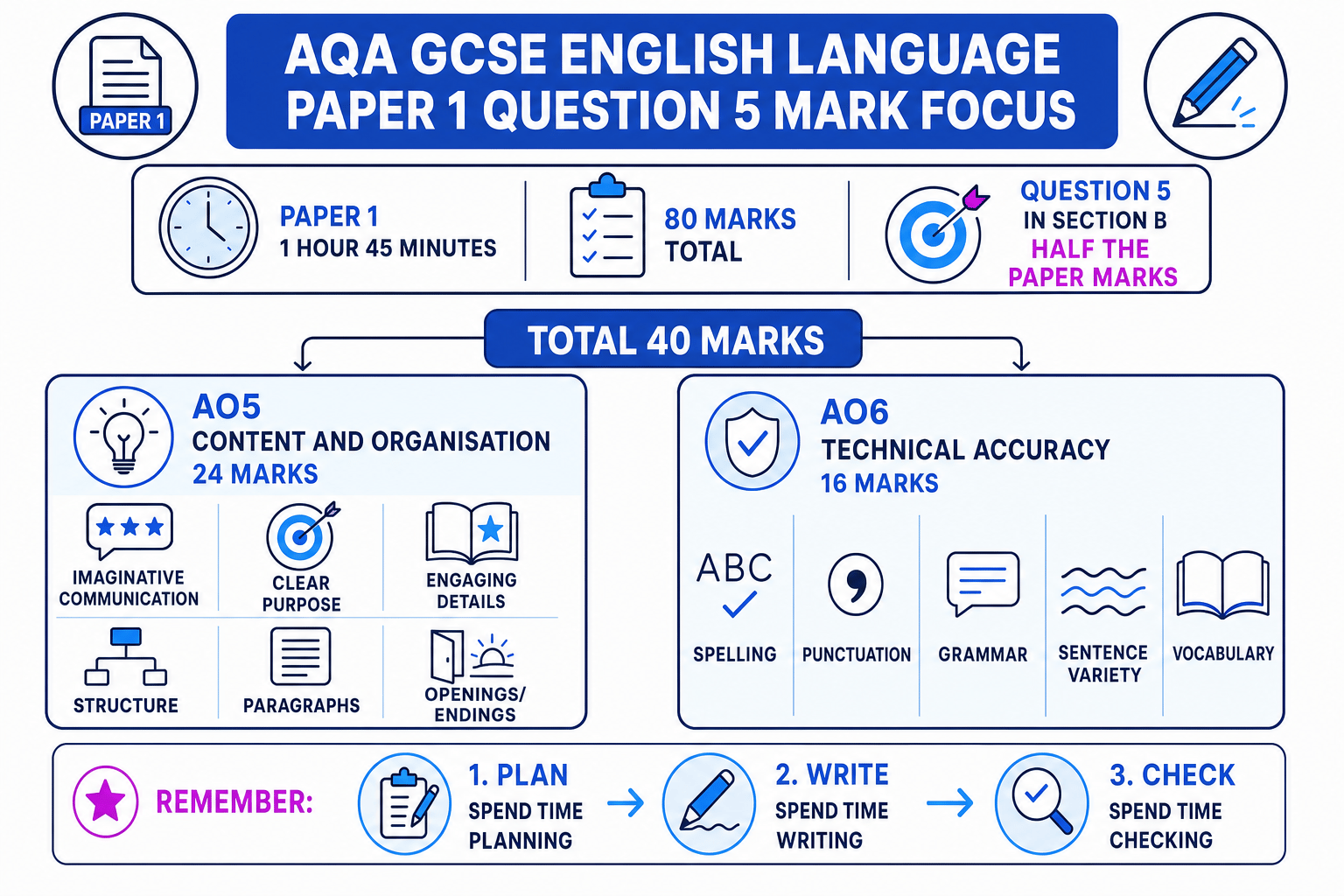
The mark split
Paper 1 Question 5 is worth 40 marks: 24 marks for content and organisation and 16 marks for technical accuracy. AO5 is the bigger section, but AO6 is too large to ignore.
Using the mark split to set priorities
- Compare the two mark areas: AO5 has 24 marks, while AO6 has 16 marks, so the examiner gives slightly more credit for what you create and how you shape it.
- Apply that to your writing: you need a clear idea, a controlled structure and engaging details before accurate spelling and punctuation can make the response feel polished.
- Protect the AO6 marks by leaving checking time, because avoidable errors in full stops, commas, tense and spelling can limit an otherwise imaginative answer.
AO5: content and organisation
AO5 is the part of the mark scheme that rewards your ideas and your control.
Content and organisation
Content means what you write: your ideas, details, viewpoint, atmosphere, character, setting or situation. Organisation means how you arrange those ideas: your opening, paragraphs, shifts of focus, pacing and ending.
In AQA wording, AO5 rewards writing that communicates clearly, effectively and imaginatively, while selecting tone, style and register for the task. It also rewards organising ideas so the response feels coherent.
Content: give the reader something worth imagining
For creative writing, your content should do more than list events or describe random objects. It should create a clear experience for the reader.
Useful content choices include:
- A focused setting, such as one street, room, beach, station or doorway.
- A clear atmosphere, such as tension, loneliness, excitement, peace or danger.
- A viewpoint, meaning the position or attitude from which the writing is told.
- Specific details, especially precise nouns and verbs.
- Imagery, meaning language that creates a mental picture or sensory impression.
Figurative language
Figurative language describes something in a non-literal way to create an effect. A simile compares using “like” or “as”; a metaphor describes one thing as if it is another; personification gives human qualities to something non-human.
Developing a basic description
Suppose the basic idea is: The street was scary.
- Choose a more precise focus: instead of the general word “street”, narrow it to “alley”, which suggests confinement and hidden danger.
- Replace the plain adjective “scary” with details the reader can sense: darkness, silence, broken glass or a flickering light.
- Shape the sentence so the atmosphere is implied rather than explained: The alley narrowed ahead, its broken windows catching the last of the light like watchful eyes.
Telling instead of creating
A sentence like “It was scary” names the feeling, but does not make the reader feel it. Aim to create the emotion through detail, imagery and atmosphere.
Organisation: shape the journey
Organisation is where many students gain or lose marks quickly. A high-mark response usually feels deliberately shaped, not like ideas arriving in the order they popped into your head.
Structure
Structure is the way a whole piece of writing is put together. It includes the order of ideas, paragraphing, shifts in focus, changes in pace, and how the ending connects to the beginning.
For Paper 1 Question 5, useful structures include:
- Zoom structure: begin with a wide view, then move into smaller details.
- Cyclical structure: end by echoing an image, phrase or idea from the opening.
- Narrative arc: move through a clear story shape, such as opening situation, build-up, turning point and ending.
- Contrast: move from calm to chaos, light to darkness, silence to noise, or confidence to fear.
Cohesion
Cohesion means the writing links together smoothly. You can create cohesion through repeated images, connected ideas, consistent tense, clear paragraphing and logical shifts in focus.
Planning an organised creative response
Imagine you need to write about a storm.
- Decide the overall movement: the writing will move from unnatural calm, to the storm arriving, to the aftermath.
- Divide the response into clear sections: paragraph one gives the still setting, paragraph two zooms in on the first signs of danger, paragraph three shows the storm at its peak, and paragraph four returns to silence afterwards.
- Add a structural echo: if the opening mentions “one leaf turning in the empty road”, the ending could return to that leaf, now flattened against the drain, showing the storm has changed the scene.
A simple AO5 planning method
Before writing, plan four movements, not a long plot: opening focus, first shift, strongest moment, final echo. This helps your response feel crafted even under time pressure.
AO6: technical accuracy
AO6 is the part of the mark scheme that rewards how accurately and skilfully you use written English.
Technical accuracy
Technical accuracy means correct and controlled spelling, punctuation, grammar, sentence structure and vocabulary. In Question 5, AO6 is worth 16 marks.
AO6 is not just about avoiding mistakes. The examiner also rewards range and control. That means you should use varied sentences and ambitious vocabulary, but only when you can use them accurately.
Sentence variety
A sentence is a complete unit of meaning. A main clause is a group of words that can stand alone as a sentence. A subordinate clause adds extra information but cannot usually stand alone.
Useful sentence types include:
- A simple sentence: one main clause. Example: The door opened.
- A compound sentence: two main clauses joined correctly. Example: The door opened, and the room fell silent.
- A complex sentence: a main clause with a subordinate clause. Example: Although the room was silent, the door opened.
Varying sentences for effect
Start with three plain sentences: The door opened. It was dark. I was scared.
- Keep one short sentence for impact: The door opened. This creates a pause and draws attention to the action.
- Add a complex sentence to develop tension: Beyond it, the corridor waited in darkness, swallowing every sound. This gives more detail while keeping the sentence controlled.
- End with another short sentence to show fear without overexplaining it: I stepped inside.
Punctuation control
Punctuation is powerful only when it is controlled. Full stops, capital letters, commas, apostrophes, colons, semicolons and dashes can all help your writing — but inaccurate punctuation can damage AO6.
Comma splice
A comma splice happens when two complete sentences are joined with only a comma. For example: The wind screamed, the windows shook is incorrect. Use a full stop, conjunction or semicolon instead.
Better versions would be:
- The wind screamed. The windows shook.
- The wind screamed, and the windows shook.
- The wind screamed; the windows shook.
Do not force advanced punctuation
A semicolon or colon will not impress the examiner if it is used incorrectly. Accurate basic punctuation is worth more than risky punctuation used for show.
How AO5 and AO6 work together
The best creative writing does not treat AO5 and AO6 as separate boxes. A strong sentence can earn credit for both.
For example:
The sea dragged itself up the shingle, tired and grey, before collapsing at my feet.
This sentence could help AO5 because it creates atmosphere through personification. It could also help AO6 because it uses accurate punctuation, a controlled sentence structure and precise vocabulary.
Control beats chaos
High marks usually come from controlled ambition: imaginative ideas, clear structure, varied sentences and accurate basics. Do not aim to sound “fancy”; aim to make deliberate choices.
What to check before you finish
Your final checking time should target the errors most likely to cost AO6 marks:
- Missing full stops or capital letters.
- Sentences that run on for too long.
- Commas joining two full sentences incorrectly.
- Shifts in tense, such as moving accidentally from past to present.
- Repeated basic words where a more precise word would help.
- Spellings of common words you know you often miss.
Quick checking order
Check in this order: sentence boundaries first, then punctuation, then spelling and vocabulary. Sentence errors usually cause more damage than one difficult misspelling.
In the exam
- Spend a few minutes planning the content and structure before you write: decide your focus, atmosphere, paragraph movements and ending.
- While writing, keep both mark areas in mind: AO5 needs imaginative, organised ideas; AO6 needs accurate sentences, punctuation and vocabulary.
- Leave time to check the basics, especially full stops, capital letters, tense consistency, comma splices and paragraph breaks.
Check yourself
- Can you explain the difference between AO5 and AO6 without looking?
- What does “24 marks for content and organisation” actually reward in your writing?
- Which three AO6 errors do you personally need to check for at the end?
