What you'll learn
- What AQA means by technical accuracy in Paper 1 Section B.
- How to avoid the GCSE errors that lose AO6 marks: comma splices, tense shifts, apostrophes, fragments and more.
- How to use punctuation and sentence structures deliberately, not randomly.
- A quick checking routine for the final minutes of the writing task.
Where technical accuracy fits
In AQA GCSE English Language 8700, both papers are 1 hour 45 minutes, worth 80 marks each, and each paper is 50% of the GCSE. In both papers, Section B is writing.
For Paper 1 Section B: Creative Writing, you answer one compulsory writing task worth 40 marks:
- 24 marks for AO5: content, organisation, communication and imagination.
- 16 marks for AO6: vocabulary, sentence structures, spelling and punctuation.
Technical accuracy
Technical accuracy means writing clearly and correctly: accurate spelling, secure punctuation, controlled grammar, varied sentence structures and vocabulary that suits your purpose.
The big idea
Technical accuracy is not about writing “fancy” sentences. It is about staying in control so the examiner can follow your ideas without being distracted by errors.
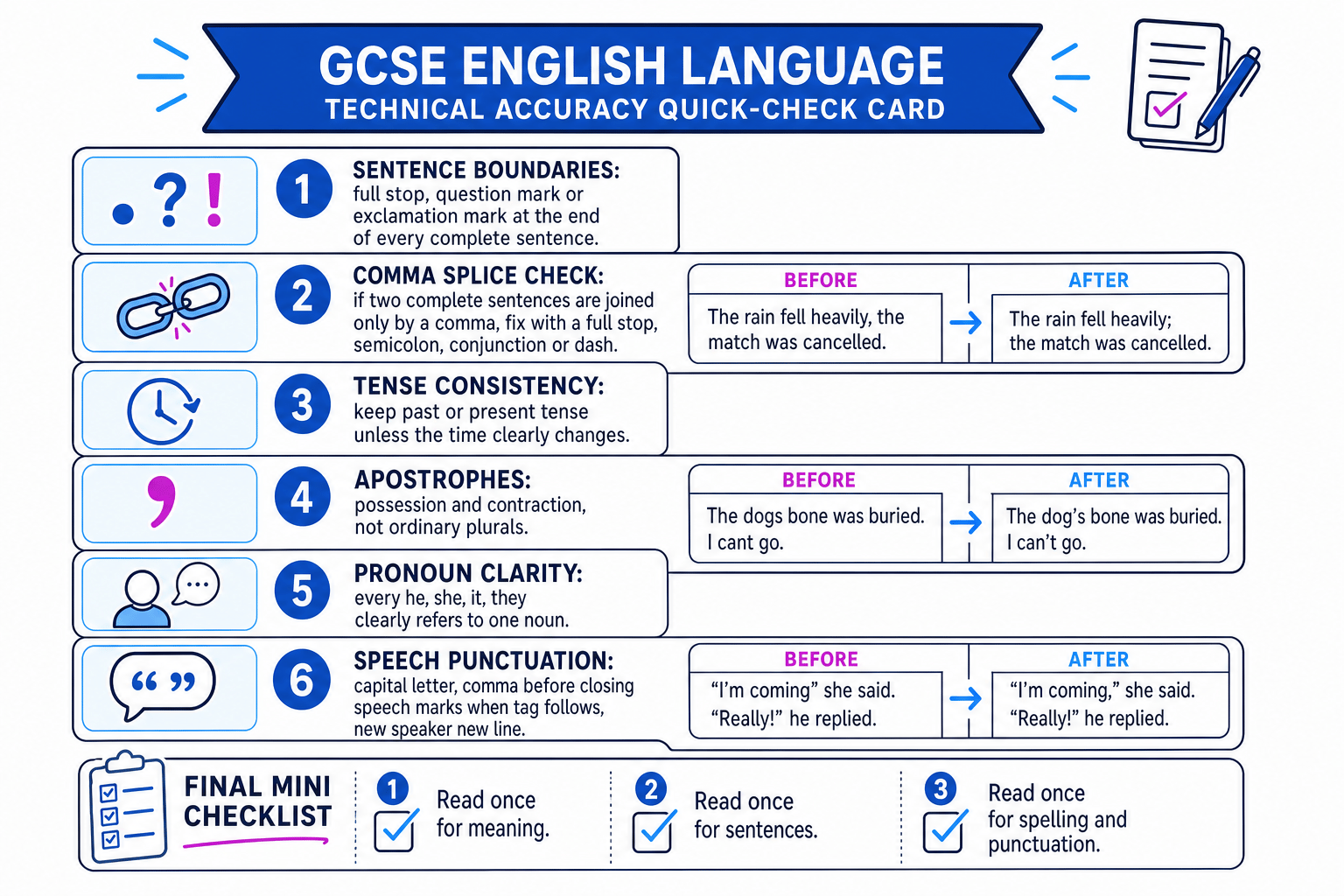
Use this quick-check card as a visual route through the main accuracy checks.
Start with the sentence
A sentence is a complete unit of meaning. In Standard English, it usually needs a subject and a verb.
- The subject is who or what the sentence is about.
- The verb is the action, state or process.
Example: “The door slammed.”
- Subject: “The door”
- Verb: “slammed”
A clause is a group of words built around a verb. An independent clause makes sense on its own as a full sentence. A subordinate clause depends on another clause to complete its meaning.
Independent and subordinate clauses
An independent clause can stand alone as a sentence: “The wind howled.” A subordinate clause cannot stand alone: “Although the wind howled…”
Missing full stops
A very common GCSE error is writing several ideas in one long sentence without proper boundaries. This can make your writing feel rushed or unclear.
Instead of letting everything run on, ask: Where does one complete thought end and the next begin?
Missing sentence boundaries
Do not rely on commas to do the job of full stops. If one complete idea has ended, you usually need a full stop, question mark, exclamation mark, semicolon, dash or a joining word.
Avoid comma splices
A comma splice happens when two complete sentences are joined with only a comma.
Wrong: “The corridor was silent, the lights flickered.”
Both sides could stand alone:
- “The corridor was silent.”
- “The lights flickered.”
So the comma is not strong enough.
Comma splice
A comma splice is the error of joining two independent clauses with only a comma.
You can fix a comma splice in several ways:
- Use a full stop: “The corridor was silent. The lights flickered.”
- Use a semicolon: “The corridor was silent; the lights flickered.”
- Use a conjunction: “The corridor was silent, and the lights flickered.”
- Use a dash for a dramatic link: “The corridor was silent — the lights flickered.”
Fixing a comma splice
Original: “The rain hammered against the window, I could hear footsteps outside.”
- Check whether each side of the comma could stand alone. “The rain hammered against the window” is complete, and “I could hear footsteps outside” is also complete.
- Decide the relationship between the ideas. The second idea increases the tension, so a dash or full stop would work well.
- Choose the punctuation that best controls the pace. “The rain hammered against the window — I could hear footsteps outside” creates a dramatic pause before the frightening detail.
Quick comma splice test
If both sides of a comma could be separate sentences, the comma may be too weak.
Sentence fragments: error or effect?
A sentence fragment is a group of words punctuated like a sentence even though it is not grammatically complete.
Fragment: “Behind the locked door.”
This has no main verb, so it is not a complete sentence. In creative writing, fragments can be used deliberately for tension, but they must look controlled.
Better as a full sentence: “Something moved behind the locked door.”
Deliberate fragment for effect: “Behind the locked door. A scrape. A breath.”
Sentence fragment
A sentence fragment is an incomplete sentence. It may be an error, unless it is clearly used deliberately for effect.
Controlling a sentence fragment
Original: “Running through the alley. The footsteps getting closer.”
- Identify what is missing. “Running through the alley” has no clear subject, and “The footsteps getting closer” needs a complete verb phrase.
- Decide whether you want smooth action or sharp tension. For smooth action, make the grammar complete; for tension, use fragments sparingly.
- Repair the sentence with control: “I ran through the alley. The footsteps were getting closer.” This is accurate and still tense.
Accidental fragments
Fragments often appear when students start with an “-ing” verb: “Walking slowly down the road.” Ask yourself: who is walking, and what is the complete action?
Keep your tense consistent
Tense shows when something happens. The two most common tenses in creative writing are:
- Past tense: “I walked”, “she whispered”, “the room was dark”.
- Present tense: “I walk”, “she whispers”, “the room is dark”.
A tense shift is when you accidentally move from one tense to another.
Incorrect: “I opened the gate and step into the garden.”
This shifts from past tense, “opened”, to present tense, “step”.
Correct: “I opened the gate and stepped into the garden.”
Tense shift
A tense shift is an unnecessary or accidental change from one tense to another.
Repairing a tense shift
Original: “Maya stared at the sea. The waves crash against the rocks and she felt afraid.”
- Identify the main tense. “Maya stared” and “she felt” are past tense, so the paragraph is mainly in the past.
- Find the verb that does not match. “Crash” is present tense, but it should match the past-tense narration.
- Change the inconsistent verb: “Maya stared at the sea. The waves crashed against the rocks and she felt afraid.”
Deliberate tense changes
Sometimes a writer changes tense for a flashback, memory or sudden present-tense moment. That is fine only if the time change is clear to the reader.
Make pronouns clear
A pronoun is a word that stands in for a noun, such as “he”, “she”, “it”, “they”, “this” or “that”. The noun it refers to is called the antecedent.
Unclear: “Lena pushed Amy towards the door because she was scared.”
Who was scared — Lena or Amy?
Clear: “Because Lena was scared, she pushed Amy towards the door.”
Pronoun reference
Pronoun reference means making it clear which noun a pronoun refers to.
Clarifying a pronoun
Original: “Tom grabbed Ben’s coat and threw it into the river because he was angry.”
- Identify the possible meanings. “He” could refer to Tom or Ben, so the reader may be unsure who is angry.
- Decide the intended meaning. If Tom is angry, name him again instead of relying on the pronoun.
- Rewrite for clarity: “Angry, Tom grabbed Ben’s coat and threw it into the river.”
Use apostrophes accurately
An apostrophe is the punctuation mark in words such as “don’t” and “girl’s”.
It has two main uses:
-
Contraction: showing missing letters.
- “do not” becomes “don’t”
- “I am” becomes “I’m”
-
Possession: showing ownership or connection.
- “the girl’s coat” means the coat belonging to one girl.
- “the girls’ coats” means the coats belonging to more than one girl.
Do not use apostrophes for ordinary plurals.
Wrong: “The window’s were broken.”
Correct: “The windows were broken.”
Choosing the right apostrophe
Sentence idea: “The bag belonging to one student was left outside.”
- Identify whether the noun is singular or plural. “One student” is singular.
- Decide whether possession is needed. The bag belongs to the student, so an apostrophe is needed.
- Put the apostrophe before the “s” for one owner: “The student’s bag was left outside.”
Apostrophes in plurals
Do not add an apostrophe just because a word ends in “s”. “Doors”, “shadows” and “windows” are ordinary plurals and need no apostrophe.
Punctuate speech correctly
Direct speech means the exact words a character says. It is usually placed inside speech marks.
A dialogue tag tells us who is speaking, such as “she said” or “he whispered”.
Basic pattern:
“Stay there,” she whispered.
Notice:
- The spoken words go inside speech marks.
- A comma often comes before the closing speech mark if a dialogue tag follows.
- The dialogue tag usually starts with a lower-case letter unless it begins with a name.
- A new speaker should usually start on a new line.
Punctuating dialogue
Original: “I can hear something” said Noor “Don’t move” replied Sam.
- Separate the two speakers. Noor speaks first, then Sam replies, so each speaker needs their own line.
- Add punctuation inside the speech marks. Noor’s sentence needs a comma before the tag; Sam’s command needs a comma before “replied Sam”.
- Write the dialogue accurately:
“I can hear something,” said Noor.
“Don’t move,” replied Sam.
Speech punctuation
Do not leave the comma outside the speech marks. Write “I’m leaving,” she said — not “I’m leaving”, she said.
Vary sentences without losing control
A simple sentence has one main clause: “The room was empty.”
A compound sentence joins two main clauses, often with “and”, “but” or “so”: “The room was empty, but the fire was still burning.”
A complex sentence includes a subordinate clause: “Although the room was empty, the fire was still burning.”
Sentence variety helps AO6 because it shows control. However, variety only helps if the sentences are accurate.
Control beats complication
A short, accurate sentence is better than a long, confused one. Aim for variety, but never sacrifice clarity.
Improving sentence variety
Original: “The house was old. The windows were cracked. The garden was dark. I felt nervous.”
- Identify the problem. The sentences are accurate, but the repeated short pattern becomes flat.
- Combine related details without creating a run-on sentence. The house and windows can be linked because they describe the setting.
- Keep one short sentence for impact: “The old house leaned into the darkness, its windows cracked and blind. In the garden, the trees shifted. I felt nervous.”
Spelling and vocabulary choices
AO6 also rewards accurate spelling and vocabulary. Vocabulary means the words you choose.
You do not need to force in impressive words. A precise word is usually better than a dramatic but inaccurate one.
Better: “The room smelled damp.”
Riskier: “The room smelled melancholy.”
“Melancholy” describes sadness, not usually a smell, so it may feel awkward unless handled very carefully.
Choose precise words
If you are unsure how to use a word, choose a simpler word you can control. Examiners reward clarity and accuracy.
A quick final check
In timed writing, you will not catch every error. But even two minutes of checking can protect marks.
Try this order:
- Read for sense: does the writing make sense?
- Read for sentence boundaries: are there full stops where complete ideas end?
- Read for common errors: apostrophes, tense, pronouns, speech punctuation and spelling.
In the exam
- Leave a few minutes at the end of Paper 1 Section B to check AO6, because 16 marks are available for technical accuracy.
- Prioritise the biggest errors first: missing full stops, comma splices and tense shifts usually damage clarity more than one difficult spelling.
- Use ambitious punctuation only when you understand it; secure full stops, commas, apostrophes and speech marks are more valuable than random semicolons.
Check yourself
- Can you explain the difference between a comma splice and a correct compound sentence?
- When you write dialogue, do you start a new line for a new speaker and keep punctuation inside the speech marks?
- In your last piece of creative writing, did you stay in one tense unless the time clearly changed?
