What you'll learn
- What AQA Paper 2 Question 4 is really asking you to compare.
- How to spot useful methods in two unseen non-fiction sources.
- How to compare tone, formality, imagery, rhetoric, sentence style and structure.
- How to build a clear comparison paragraph that links method to purpose.
Where Question 4 fits
AQA GCSE English Language Paper 2 is called Writers’ viewpoints and perspectives. The whole paper lasts 1 hour 45 minutes, is worth 80 marks, and makes up 50% of the GCSE. Section A is reading non-fiction; Section B is writing. Every question is compulsory.
Question 4 is the big comparison question in Paper 2 Section A. It is worth 16 marks and mainly rewards AO3: comparing writers’ ideas and perspectives, including how those ideas are conveyed.
Compare
To compare means to explain both similarities and differences. In Question 4, you compare two writers’ attitudes, perspectives and methods across Source A and Source B.
Method
A method is a deliberate choice a writer uses to create meaning or influence the reader. Methods include language choices, tone, formality, imagery, rhetorical methods, sentence style, openings, endings and overall structure.
Question 4 in one sentence
Compare what each writer thinks or feels with how their methods make that viewpoint clear.
Start with viewpoint before technique
Before you analyse methods, you need to understand the writers’ viewpoints.
A viewpoint is what a writer thinks about a topic. A perspective is the angle or position they write from. An attitude is the feeling or stance they show, such as admiration, anger, anxiety, excitement, frustration or sympathy.
Do not begin by hunting for techniques at random. First ask: What does Writer A seem to think or feel? What does Writer B seem to think or feel? Are they similar, different, or partly both?
Finding the comparison focus
-
Reduce each writer’s viewpoint to a precise phrase. For example, your annotations might suggest that Writer A shows cautious optimism, while Writer B shows angry disappointment. These phrases are more useful than vague words like “positive” and “negative”.
-
Decide the relationship between the viewpoints. Here, both writers may care about the same issue, but Writer A sees possible improvement, whereas Writer B focuses on failure or injustice.
-
Turn that relationship into a comparative point. A strong point could be: “Both writers present the issue as important, but Source A sounds cautiously hopeful, while Source B is more openly critical and frustrated.”
Technique first, meaning second
A weak answer says, “Both writers use adjectives,” then adds a vague effect. A stronger answer starts with the writers’ attitudes, then explains how particular adjectives, images, sentence choices or structural choices reveal those attitudes.
The methods you can compare
You do not need to write about every method in the source. You need to choose the methods that best help you explain the writers’ perspectives.
Use this toolkit to remind yourself of the main method categories you can compare.
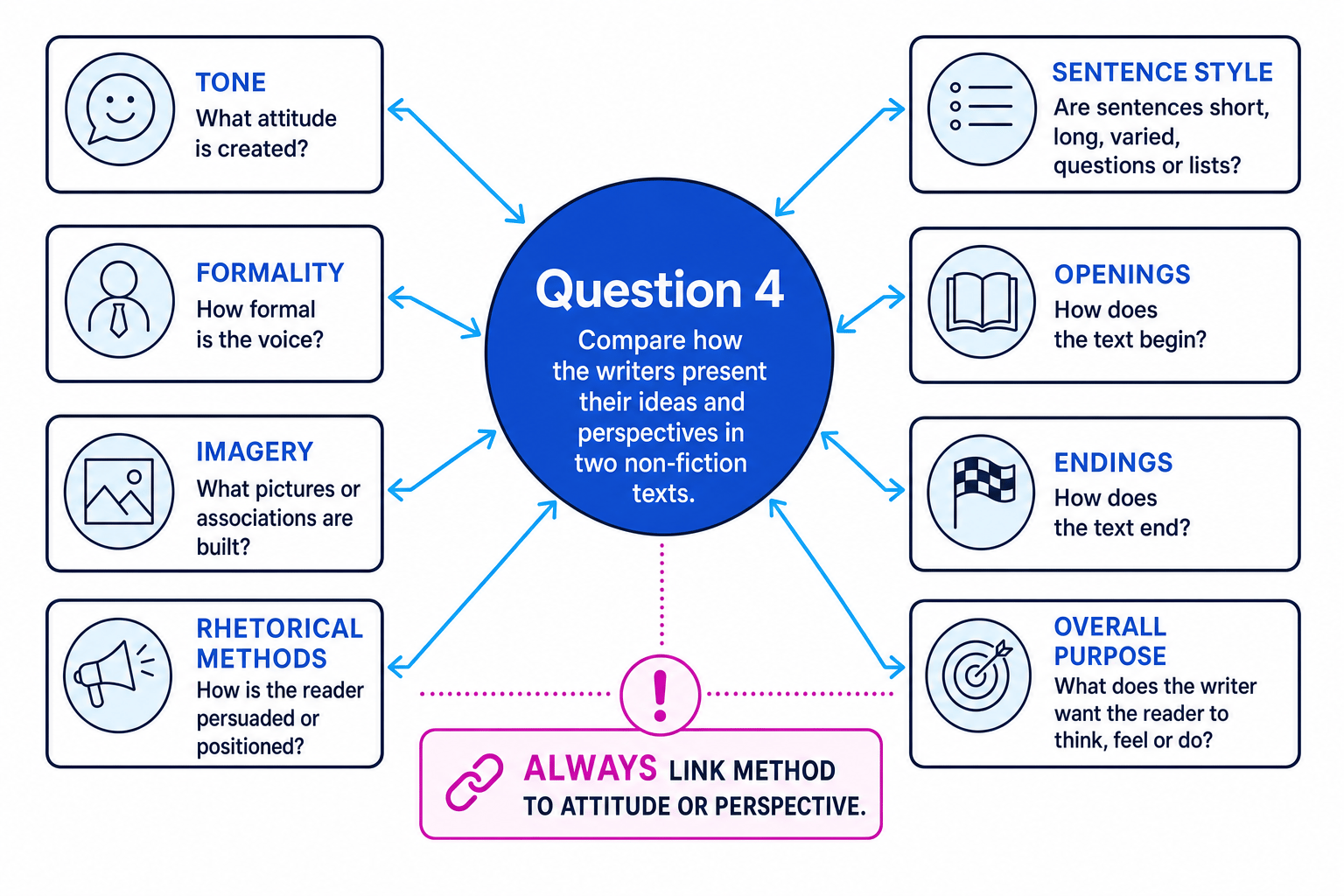
Tone and formality
Tone means the emotional voice or attitude created by the writing. It might be amused, bitter, respectful, anxious, sentimental, urgent or sarcastic.
Formality means how official, serious or conversational the writing sounds. A formal text may use controlled phrasing, complex sentences and precise vocabulary. An informal text may sound personal, chatty, direct or emotional.
Imagery
Imagery means language that creates pictures, sensory impressions or strong associations in the reader’s mind. This can include metaphor, where something is described as if it is something else; simile, where something is compared using “like” or “as”; and personification, where something non-human is given human qualities.
Rhetorical methods
Rhetorical methods are techniques used to persuade, influence or position the reader. Examples include rhetorical questions, direct address, repetition, lists, contrast and emotive language.
Sentence style
Sentence style means the writer’s choices about sentence length, sentence type and sentence pattern. Short sentences can create impact or certainty. Longer sentences can build detail, reflection, momentum or complexity. Questions can challenge the reader. Lists can suggest scale or accumulation.
Openings, endings and purpose
Structure means how a text is organised. In Question 4, useful structural choices include how each source opens, how it develops, how it ends, and what final impression it leaves.
Purpose means what the writer wants to achieve: to inform, persuade, criticise, entertain, warn, advise, describe, reflect or provoke sympathy.
Matching methods to perspective
-
Choose a method that actually reveals attitude. If Source A uses controlled, factual phrasing, that may support a calm or authoritative perspective. If Source B uses direct address and emotive language, that may support a more urgent or personal perspective.
-
Explain the effect of the method, not just its name. Instead of saying “Source B uses direct address,” explain that it may make the reader feel personally involved or responsible.
-
Link the two sources together. A comparison could say: “Where Source A builds authority through a measured tone, Source B creates pressure through a more direct and emotional voice.”
Comparing language without feature-spotting
Language means the writer’s choice of words and phrases. When analysing language, think about connotations: the feelings, ideas or associations attached to a word beyond its basic meaning.
For Question 4, language analysis should serve the comparison. You are not writing a separate Question 3 response. You are showing how language helps each writer communicate a viewpoint.
Useful language comparisons include:
- positive versus negative vocabulary
- calm versus emotive word choices
- factual detail versus personal anecdote
- admiration versus criticism
- humour versus seriousness
- sensory description versus abstract argument
- inclusive language such as “we” versus distancing language such as “they”
Use comparative verbs
Try verbs like presents, portrays, frames, suggests, implies, criticises, celebrates, questions, challenges and warns. They help you write about meaning, not just technique.
A strong comparison sentence often has this shape:
Whereas Source A uses [method] to present [topic] as [idea], Source B uses [different or similar method] to suggest [different or similar idea].
You would then add short quotations from the real sources you have been given.
Comparing structure: beginnings, development and endings
Structure matters because writers control the order in which the reader receives ideas.
An opening can establish authority, create curiosity, introduce a problem, set a scene or immediately reveal the writer’s attitude. An ending can leave the reader with hope, anger, shock, sympathy, a warning or a call to action.
Do not just say “the source begins” or “the source ends”. Explain why that placement matters.
Comparing openings and endings
-
Identify the structural movement in each source. Source A might move from problem to solution, while Source B might move from personal experience to wider criticism.
-
Connect that movement to attitude. A problem-to-solution structure may suggest confidence or reassurance. A personal-to-critical structure may suggest that the writer wants individual experience to stand for a larger issue.
-
Write the comparison around purpose. For example: “Source A’s structure becomes more reassuring as it develops, suggesting the writer wants to guide the reader towards confidence. By contrast, Source B’s ending intensifies its criticism, leaving the reader with a stronger sense of urgency.”
Do not overclaim from context
Use the source information to help you understand form, date and audience, but do not make unsupported claims about the writer’s whole life or historical period. Your evidence must come from the source.
Building a full comparison paragraph
A good Question 4 paragraph works like a bridge: it keeps moving between Source A and Source B while staying focused on one clear comparison.
This scaffold shows how your paragraph can combine comparison, evidence, method and effect.
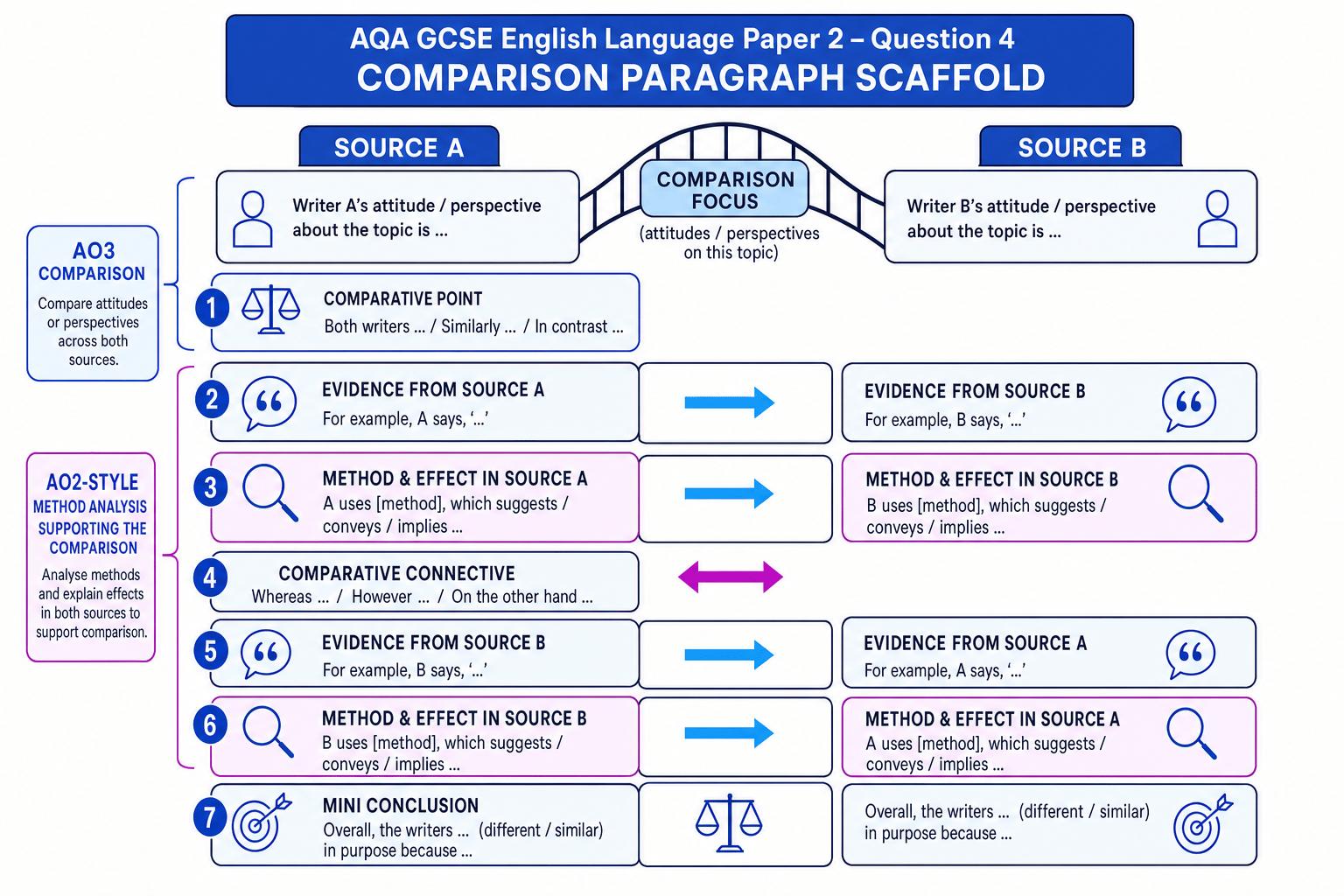
A reliable paragraph structure is:
- Make a comparative point about the writers’ attitudes or perspectives.
- Give evidence from Source A.
- Analyse a method in Source A and link it to the writer’s attitude.
- Use a comparative connective.
- Give evidence from Source B.
- Analyse a method in Source B and link it to the writer’s attitude.
- Finish with a mini comparison about purpose or effect.
Good comparative connectives include similarly, likewise, both, whereas, however, in contrast, on the other hand, unlike and although.
Writing a comparison paragraph
-
Begin with the comparison, not the quotation. Write: “Both writers present [topic] as significant, but Source A sounds [attitude], whereas Source B sounds [attitude].” This immediately answers the question.
-
Analyse Source A through method and effect. Add: “In Source A, the writer uses [method] in ‘[short quotation]’, which suggests [idea/effect] because [precise explanation].”
-
Bring in Source B as a direct comparison. Continue: “By contrast, Source B uses [method] in ‘[short quotation]’, creating a more [tone] impression and implying that [idea/effect].”
-
End by linking both methods to purpose. Conclude: “Overall, Source A seems to want the reader to [think/feel/do], while Source B is more focused on making the reader [think/feel/do].”
What stronger answers do
Higher-level Question 4 answers usually do three things well.
First, they compare throughout. They do not write one paragraph on Source A and then a separate paragraph on Source B with “similarly” added at the end.
Second, they choose evidence carefully. A short, well-chosen quotation is better than a long copied sentence. You only need enough words to prove the method and support the comparison.
Third, they explain the writer’s purpose. Purpose pushes your answer beyond “this creates an image” towards “this shapes how the reader understands the writer’s viewpoint”.
Equal coverage does not mean identical coverage
You should write about both sources, but you do not have to say exactly the same thing about each one. It is fine to compare a metaphor in Source A with a rhetorical question in Source B if both methods help reveal the writers’ different attitudes.
Quick planning grid
Before you write, make a tiny plan like this in the margin:
| Focus | Source A | Source B | Comparison |
|---|---|---|---|
| Attitude | What does A think or feel? | What does B think or feel? | Similar, different, or mixed? |
| Method | Which method shows this? | Which method shows this? | How do the methods shape perspective? |
| Purpose | What does A want the reader to think, feel or do? | What does B want the reader to think, feel or do? | Why does the difference matter? |
You can repeat this for two or three main comparison points. For 16 marks, aim for a clear, developed response rather than a rushed list of techniques.
In the exam
-
Spend a few minutes deciding each writer’s attitude before choosing quotations; Question 4 rewards comparison of perspectives, not technique-spotting.
-
Write about both sources in every main paragraph, using connectives such as “whereas”, “similarly” and “in contrast” to keep the comparison active.
-
For each quotation, name a relevant method only if you can explain how it reveals tone, viewpoint or purpose.
Check yourself
-
Can you explain the difference between a writer’s attitude and a writer’s method?
-
Can you compare two methods without forcing them to be the same technique?
-
Does your paragraph explain why each writer uses their chosen methods, not just what the methods are?
