What you'll learn
- What Paper 2 Question 4 is really asking you to do.
- How to compare Source A and Source B in the same paragraph.
- A paragraph structure that builds a developed comparative answer.
- Common traps that stop answers reaching the higher levels.
The exam context
AQA GCSE English Language Paper 2 is 1 hour 45 minutes long, worth 80 marks and 50% of the GCSE. Section A is the reading section on unseen non-fiction texts, and Section B is the writing task. Every question is compulsory.
Question 4 is the big comparison question in Paper 2 Section A. It is usually worth 16 marks and targets AO3: comparing writers’ ideas and perspectives across two texts.
You are normally asked to compare how the writers convey their different ideas, feelings or perspectives about a topic. You must use both Source A and Source B, often referring to the whole of both sources.
Perspective
A perspective is a writer’s viewpoint, attitude or way of seeing the topic. It is not just what happens; it is what the writer thinks or feels about it.
The key idea: compare throughout
A comparison is when you explain how two things are similar, different, or partly similar and partly different. In Question 4, the two things are the writers’ perspectives in Source A and Source B.
The biggest structural mistake is writing one paragraph about Source A, then one paragraph about Source B, and only comparing them briefly at the end. That becomes two mini answers, not one developed comparison.
Comparative structure
Comparative structure means organising your answer so that Source A and Source B are discussed together around the same idea, rather than in two separate chunks.
The main rule
Each main paragraph should make a point about both sources. Think: Source A, linked to Source B, then a sentence explaining the comparison.
From separate comments to comparison
Before you write, you need to turn your annotations into a comparative point. An annotation is a short note you make about what a text suggests.
A weak plan might say:
- Source A: positive about the experience.
- Source B: negative about the experience.
That is a start, but it is not yet developed. A stronger comparison explains the relationship between those ideas.
Turning notes into a comparative point
-
Decide the shared focus. Both sources are responding to the same broad topic in the question, such as an experience, place, person, event or social issue.
-
Decide the relationship between the perspectives. For example, Source A may present the topic as exciting and worthwhile, while Source B presents it as frightening or disappointing.
-
Turn that relationship into a sentence about both writers: “Both writers explore the same experience, but Source A presents it as rewarding, whereas Source B makes it seem unsettling and difficult.”
-
Add a reason for the difference if you can. For example, one writer may feel more confident, more experienced, more critical, more nostalgic, or more shocked.
What a developed comparison includes
A developed paragraph usually contains four things:
- A comparative point about both sources.
- Evidence from Source A.
- Evidence from Source B.
- Explanation of how the writers’ methods reveal their perspectives.
Evidence, method and effect
Evidence means a short quotation or precise reference from the text. A method is a choice the writer makes, such as word choice, tone, structure or a persuasive technique. The effect is what that choice makes the reader understand, imagine or feel.
The scaffold below shows the shape of a strong comparative paragraph. It keeps both sources linked all the way through, rather than saving the comparison for the final sentence.
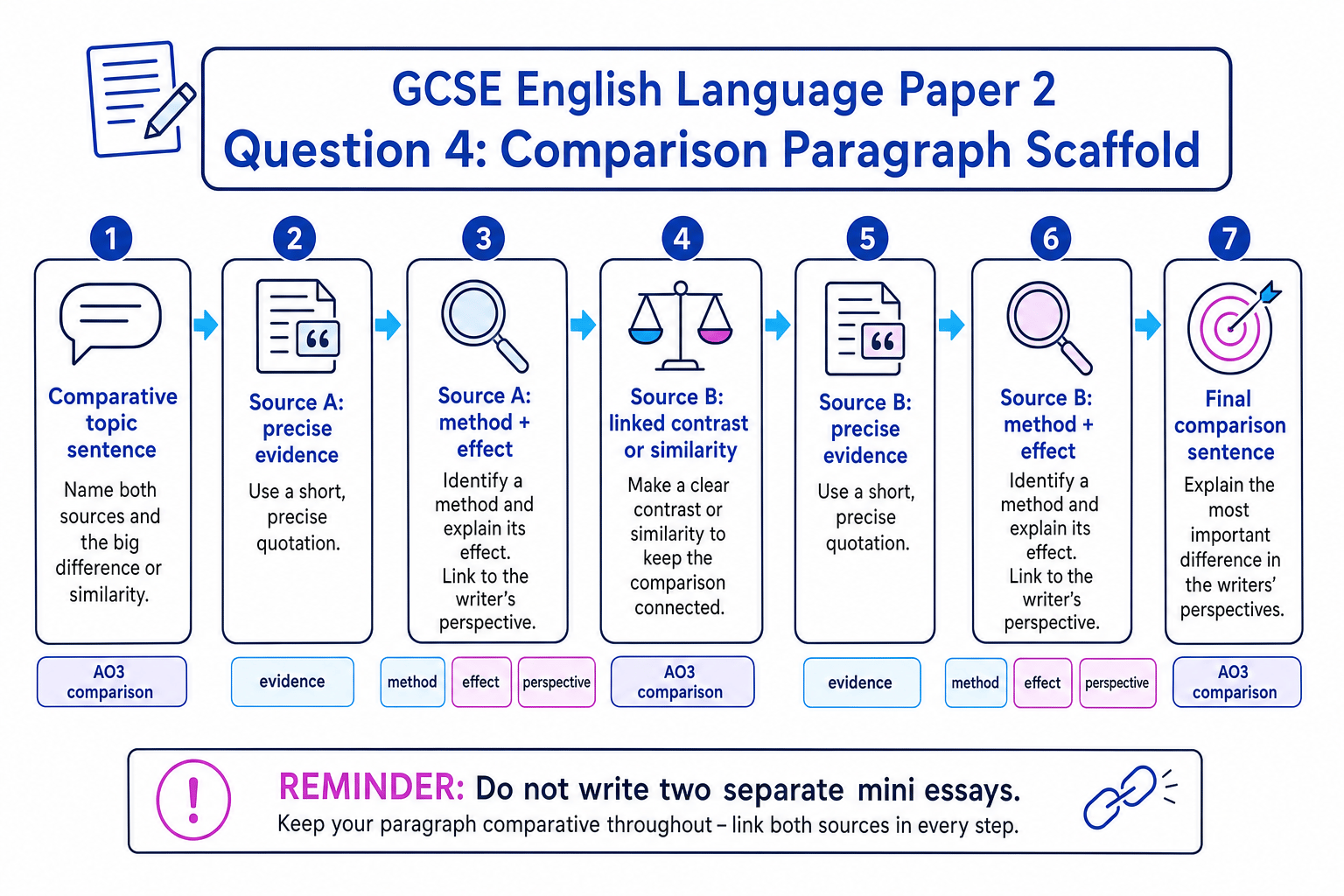
A practical paragraph structure
Use this structure when you are practising:
1. Comparative topic sentence
Start with both sources and the big comparison.
Useful sentence stems:
- “Both writers present ___, but Source A suggests ___ whereas Source B suggests ___.”
- “While Source A presents ___ as ___, Source B offers a more ___ view.”
- “The writers both feel ___ about ___; however, Source A is more ___, while Source B is more ___.”
2. Source A: evidence, method, effect
Give a short quotation or precise reference from Source A. Then explain how a writer’s method shapes the perspective.
A quotation is the exact wording from the text. Keep it short: one word or a short phrase is often enough.
3. Source B: linked evidence, method, effect
Move straight to Source B using a comparative link such as “whereas”, “in contrast”, “similarly”, or “however”. Choose evidence that matches the same comparison point.
4. Comparison sentence
End the paragraph by explaining the significance of the difference or similarity. This is where you show judgement.
For example:
This makes Source A’s perspective seem more hopeful, while Source B’s feels more critical because the writer focuses on the emotional cost of the experience.
Building an integrated paragraph
You do not need to memorise a full model answer. Instead, learn the thinking process. In the example below, the bracketed parts show where you would insert details from the actual unseen sources in front of you.
Building an integrated comparison paragraph
-
Start with the comparison you want to prove: Source A presents the topic as positive or empowering, while Source B presents it as negative or restrictive.
-
Write a topic sentence that includes both sources: “Both writers describe the experience as powerful, but Source A presents it as liberating, whereas Source B makes it seem limiting.”
-
Add Source A evidence and method: “In Source A, the writer’s use of [short quotation from Source A] creates a sense of [effect], suggesting that they view the experience as [perspective].”
-
Link Source B directly: “In contrast, Source B uses [short quotation from Source B], which suggests [effect] and reveals a more [perspective] attitude.”
-
Finish with a comparison sentence: “Overall, Source A’s writer seems to admire the experience because it offers [idea], while Source B’s writer is more critical because it leads to [idea].”
Using methods without drifting away from AO3
Question 4 is not mainly an AO2 language question, but methods still matter because the question often asks how writers convey their perspectives.
Useful methods include:
- Word choice: the specific words a writer chooses.
- Tone: the attitude or mood created by the writing, such as angry, amused, nostalgic, shocked or admiring.
- Contrast: placing two different ideas side by side to emphasise a difference.
- Anecdote: a short personal story used to make a point.
- Direct address: speaking directly to the reader, often using “you”.
- Rhetorical question: a question asked for effect rather than because the writer expects an answer.
- Structure: how the writing is organised, such as starting with a dramatic moment or ending with a reflection.
Feature spotting
Do not write, “Source A uses adjectives, while Source B uses verbs,” and stop there. A method only earns its place if you explain how it reveals the writer’s perspective.
Linking method to perspective
-
Choose a method that clearly affects the viewpoint. For example, a negative word choice, a shocked tone, or a personal anecdote may show how the writer feels.
-
Explain what the method suggests. Instead of saying “this creates imagery”, say what the image makes the topic seem like: dangerous, exciting, unfair, beautiful, chaotic or disappointing.
-
Link back to the comparison. Explain how this differs from, or matches, the other writer’s view of the same issue.
Balancing Source A and Source B
A strong Question 4 answer usually has two or three developed comparative paragraphs. Each paragraph should focus on one clear comparison point.
A sensible plan might look like this:
| Paragraph | Focus of comparison | What to compare |
|---|---|---|
| 1 | Overall attitude | Positive vs negative, confident vs anxious, admiring vs critical |
| 2 | Emotional response | Fear, anger, excitement, sympathy, disappointment |
| 3 | Writer’s message | What each writer wants the reader to understand or question |
You do not have to write the same amount about each source in every sentence, but your overall answer should feel balanced. If Source A gets a full paragraph and Source B gets one rushed line, the comparison will feel underdeveloped.
Use the whole source
Because Question 4 often asks you to refer to the whole of both sources, try to choose evidence from different parts of the texts if it helps: perhaps an early reaction, a later development, and a final reflection.
Comparative connectives that actually help
Connectives are linking words or phrases. They are useful, but they do not create comparison by themselves. The thinking after the connective matters most.
| Purpose | Useful phrases |
|---|---|
| Showing difference | whereas, however, in contrast, on the other hand, unlike Source A |
| Showing similarity | similarly, likewise, both writers, in the same way |
| Showing a sharper difference | while Source A suggests…, Source B instead implies… |
| Showing a more nuanced comparison | although both writers…, Source B is more…, whereas Source A is less… |
A simple “whereas” can be powerful if the ideas on either side are precise.
For example:
Source A presents the situation as manageable, whereas Source B presents it as overwhelming.
That is much better than:
Source A uses language, whereas Source B also uses language.
How to sound developed, not repetitive
A developed answer does not just repeat “this shows” after every quote. Try to move through layers:
- What is the writer’s viewpoint?
- Which evidence shows it?
- How does the method shape that viewpoint?
- How is the other writer similar or different?
- Why does that difference matter?
The best comparison sentence
A strong comparison sentence often uses because. It forces you to explain the reason behind the difference: “Source A feels more optimistic because…, while Source B feels more doubtful because…”.
What to avoid
Two separate mini essays
Avoid writing everything you know about Source A, then everything you know about Source B. Instead, organise by comparison point: one idea, both sources, clear link.
Vague comparison
Avoid empty phrases like “they are similar and different” or “the writers have different views”. Say exactly how: more positive, more critical, more emotional, more detached, more urgent, more sympathetic.
In the exam
-
Spend a few minutes planning two or three comparison points before you write; do not start with random quotations.
-
Begin each main paragraph with a sentence about both sources, then move between Source A and Source B within the paragraph.
-
Keep method analysis tied to perspective: explain how the writer’s choices reveal what they think or feel.
-
Use short quotations and precise references rather than copying long chunks of text.
-
Leave time to check that every paragraph contains an obvious comparison, not just two separate comments.
Check yourself
- Can you explain the difference between a perspective and a method?
- Does each of your Question 4 paragraphs mention both Source A and Source B?
- Can you turn “Source A is positive, Source B is negative” into a more precise comparative sentence?
