What you'll learn
- What Paper 1 Question 4 is really asking you to do.
- How to turn “I agree” into a developed, evidence-based judgement.
- How to evaluate character, atmosphere, tension, mood, setting and reader reaction.
- How to shape a strong 20-mark answer using clear sentence stems.
Where Question 4 fits
Paper 1 is Explorations in Creative Reading and Writing. It lasts 1 hour 45 minutes, is worth 80 marks, and makes up 50% of your GCSE English Language grade.
Question 4 sits in Section A: Reading Fiction. It is worth 20 marks, so it is the biggest reading question on Paper 1. It assesses AO4.
AO4: critical evaluation
AO4 means you judge how successfully a writer creates meanings and effects, supporting your ideas with textual references: short quotations or precise references to moments in the extract.
The big idea
Question 4 rewards a personal response: you decide how far you agree with a statement about the text, then prove your judgement using evidence and comments on the writer’s methods.
What the question usually looks like
AQA Question 4 often gives you:
- a specific part of the source to focus on
- a statement from a “student”
- the question: “To what extent do you agree?”
- bullet points reminding you to consider your impressions, evaluate the writer’s methods, and support with references
The statement might be about a character, setting, atmosphere, tension, mood, or the reader’s reaction.
Extent
Extent means degree. You might agree completely, agree to a large extent, partly agree, or mostly disagree. The question is not asking for a simple “yes” or “no”; it wants a reasoned judgement.
Useful opening sentence stems
You can begin with a clear judgement like:
- “I agree to a large extent because…”
- “The writer successfully presents…”
- “The statement is convincing because…”
- “Although there is some evidence for this view, I think…”
Reading the statement
-
Separate the topic from the judgement. If the statement says the scene is “tense and unsettling”, the topic is the scene and the judgement is that it creates tension and unease.
-
Decide your provisional extent of agreement. If several parts of the extract support the statement, you might choose “I agree to a large extent.” If the extract becomes more hopeful or calm later, you might choose “I partly agree.”
-
Turn that into a thesis sentence: “I agree to a large extent because the writer builds tension through the setting, the character’s uncertainty, and the way information is delayed.”
Evaluation is more than analysis
You already know that analysis means explaining how a writer creates meaning through choices such as vocabulary, imagery, sentence structure or narrative viewpoint.
Evaluation goes one step further. It asks you to judge how effective, convincing, powerful or successful those choices are.
A writer’s method is a deliberate choice, such as a word, image, structural shift, contrast, viewpoint, repeated detail, or change in pace.
For example:
- Analysis: “The writer uses short sentences to create a fast pace.”
- Evaluation: “The short sentences are effective because they force the reader to experience the character’s panic, so the scene feels urgent and tense.”
Notice the difference: the evaluative version makes a judgement.
What you can evaluate
You do not have to evaluate everything. Pick the most relevant focus for the statement.
Key response words
- Character: how a person in the story is presented, such as brave, vulnerable, cruel, confused or sympathetic.
- Atmosphere: the overall feeling created by the scene, such as threatening, calm, mysterious or oppressive.
- Tension: a feeling of pressure, danger or uncertainty that makes the reader want to know what happens next.
- Mood: the emotional tone of a moment, such as sadness, fear, excitement or unease.
- Setting: where and when the story takes place, including details of place, weather, time and social environment.
- Reader reaction: what the text encourages the reader to feel, think, question or expect.
A strong answer often links these together. For example, a threatening setting may create an uneasy atmosphere, which increases tension and shapes the reader’s reaction.
The best evidence is precise
In Question 4, do not copy huge chunks of the extract. Choose short, useful references.
Good evidence might be:
- a striking word or phrase
- a repeated image or detail
- a moment where a character reacts
- a contrast between two parts of the focus section
- a structural change, such as a shift in pace or viewpoint
Retelling instead of judging
A common mistake is to summarise what happens in the extract. Q4 is not asking for the plot. It is asking whether you agree with a statement and how successfully the writer creates that impression.
A strong paragraph pattern
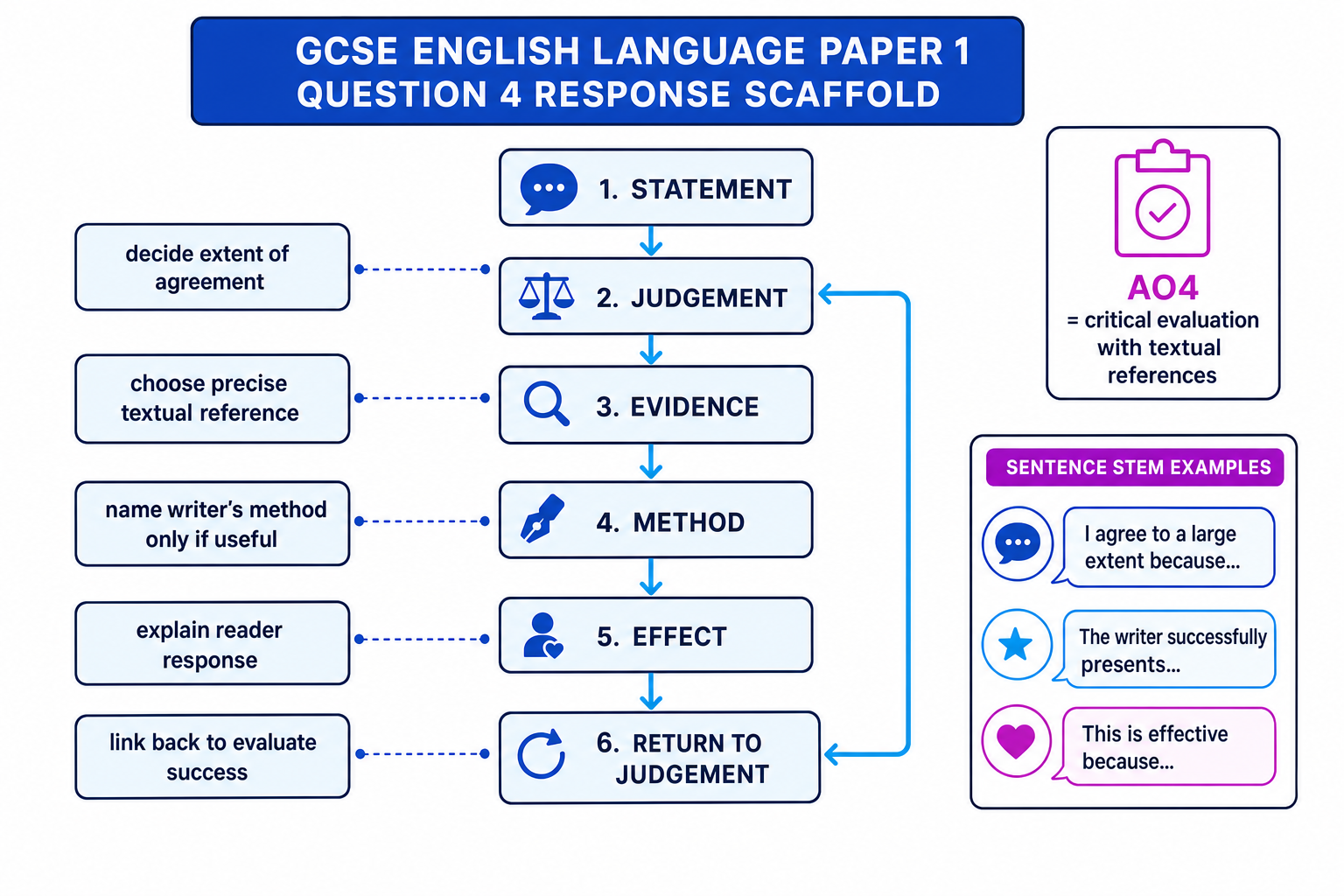
A helpful structure is:
- Judgement — say how far you agree and why.
- Evidence — use a short quotation or precise reference.
- Method — identify the writer’s choice if it helps.
- Effect — explain what this makes the reader think or feel.
- Return to judgement — link back to the statement.
The diagram below shows the basic movement of a strong Question 4 paragraph.
Method only if useful
Subject terminology is helpful, but only when it supports your point. If you are unsure whether something is a metaphor, simile or personification, it is safer to write “the phrase”, “the detail”, “the description” or “the structural shift” and explain the effect clearly.
Building a judgement paragraph
You can use this flexible paragraph frame:
“I agree to a large extent because the writer successfully presents [focus] as [judgement]. The use of [method] in ‘[short quotation]’ suggests [inference]. This is effective because [reader reaction]. Therefore, the statement is convincing because [return to judgement].”
You would replace the square brackets with evidence from the extract you have been given.
Building a judgement paragraph
-
Choose your angle. If the statement says the setting feels hostile, decide whether the extract supports that through description, character reaction, or the order in which details are revealed.
-
Select evidence that proves the same judgement in different ways. One quotation might show threatening description, while another moment might show the character feeling trapped or watched.
-
Attach methods carefully. You might comment on a harsh adjective, a semantic field of danger, a contrast, a shift in pace, or a delayed reveal — but only if that method genuinely appears in the extract.
-
Draft the evaluation: “This is effective because it does not simply tell the reader the place is dangerous; it makes the reader experience the same uncertainty as the character.”
-
Link back to the statement: “For this reason, I agree to a large extent that the writer makes the setting feel hostile.”
Developing a personal response
“Personal response” does not mean writing randomly about your feelings. It means offering your own thoughtful view of the statement.
Strong personal responses often use evaluative vocabulary:
- convincing
- effective
- powerful
- unsettling
- subtle
- striking
- successful
- deliberate
- ambiguous
- complex
For example:
“The writer successfully presents the character as vulnerable because the reader is encouraged to notice not only what happens to them, but also how little control they seem to have.”
That sentence is evaluative because it judges the writer’s success and explains the reader’s response.
Do you need to disagree?
Not always. You can get high marks by agreeing throughout, as long as your answer is detailed and evaluative.
However, a little nuance can make your response stronger. Nuance means adding a more precise or slightly more complex judgement.
For example:
- “I agree to a large extent…”
- “At first, the writer presents the atmosphere as calm, but this makes the later tension more effective.”
- “The character appears confident on the surface, but the writer also hints at uncertainty.”
Forced disagreement
Do not disagree just to sound balanced. If the statement is clearly supported, it is better to agree strongly and prove it well than to invent a weak counterargument.
Planning the whole answer
Because Q4 is worth 20 marks, you should usually spend around 20 minutes on it, or slightly longer if you have saved time from earlier questions.
A strong answer might have:
- a one-sentence opening judgement
- three developed paragraphs
- each paragraph focused on a different reason you agree or partly agree
- a final sentence that confirms your overall judgement
You do not need a long introduction or conclusion. The marks come from clear evaluation, relevant evidence and thoughtful explanation.
Line focus
Question 4 often tells you to focus on a particular section of the source. Keep your evidence inside that section, or you risk drifting away from what the question is assessing.
Sentence stems for Question 4
Use these to keep your writing evaluative:
- “I agree to a large extent because…”
- “The writer successfully presents…”
- “This is effective because…”
- “The reader is encouraged to feel…”
- “This makes the statement convincing because…”
- “A more subtle interpretation is…”
- “The writer’s choice is powerful because…”
- “This moment supports the statement as…”
In the exam
-
Read the statement as a claim you must test: identify the focus, decide your extent of agreement, and stay inside the specified lines.
-
Write three developed paragraphs using judgement, evidence, method, effect and a return to the statement.
-
Keep evaluating: use phrases like “successfully presents”, “this is effective because” and “I agree to a large extent because” rather than simply explaining what happens.
Check yourself
- Can you explain the difference between analysing a method and evaluating its success?
- Could you start an answer with “I agree to a large extent because…” and give two clear reasons?
- Do your paragraphs end by linking back to the statement, not just naming a technique?
