What you'll learn
- What AQA Paper 1 Question 3 is really asking you to do.
- How to spot structural choices such as shifts, reveals, contrast and pacing.
- How to explain effects like suspense, curiosity, surprise, sympathy and unease.
- How to build clear 8-mark paragraphs without drifting into language analysis.
Where Question 3 fits
AQA GCSE English Language Paper 1 is the fiction paper. The whole paper is 1 hour 45 minutes, worth 80 marks and 50% of the GCSE. Section A is reading, Section B is writing; the writing task is 40 marks, split into 24 for content and organisation and 16 for technical accuracy.
Question 3 is in Paper 1 Section A. It is worth 8 marks and assesses AO2: analysis of how writers use structure to create meanings and effects.
The question is usually about the whole source, not just one small section. AQA has said that from summer 2026 some wording will be adjusted to support students’ understanding, but the core skill stays the same: track a structural choice and explain its effect on the reader.
Structure
Structure means the way a writer organises a text: where it begins, how the focus changes, what information is delayed or revealed, how quickly events move, and how the ending is shaped.
The big idea
Question 3 is not asking, “Can you name a technique?” It is asking, “How does the writer guide the reader’s experience from the beginning to the end of the extract?”
Structure is different from language
In Question 2, you analyse language: words, phrases, imagery, sentence-level choices and language techniques.
In Question 3, you analyse structure: order, focus, shifts, viewpoint, pace, contrast, beginnings and endings.
A single short quotation can help you support your point, but you should not spend the paragraph zooming into individual words. The main focus should be on where something happens in the extract and why that position matters.
Language answer in disguise
Do not write a Question 2 paragraph for Question 3. If most of your answer analyses adjectives, similes or metaphors, you are probably drifting away from structure.
Sorting language from structure
- If your observation is “the writer describes the room as ‘silent’,” that is mainly language, because you are focusing on a word choice.
- If your observation is “the extract begins with a silent room before introducing the character,” that is structure, because you are focusing on the order of information.
- If your observation is “the ending returns to the same silent room,” that is also structure, because you are noticing how the end links back to the beginning.
Think in three movements: beginning, middle, end
A simple way to approach Question 3 is to divide the extract into three movements:
- Beginning: What does the writer focus your attention on first?
- Middle: What changes, develops or shifts?
- End: What are you left thinking or feeling?
This tracker shows how structural choices connect to reader effects across the whole extract.
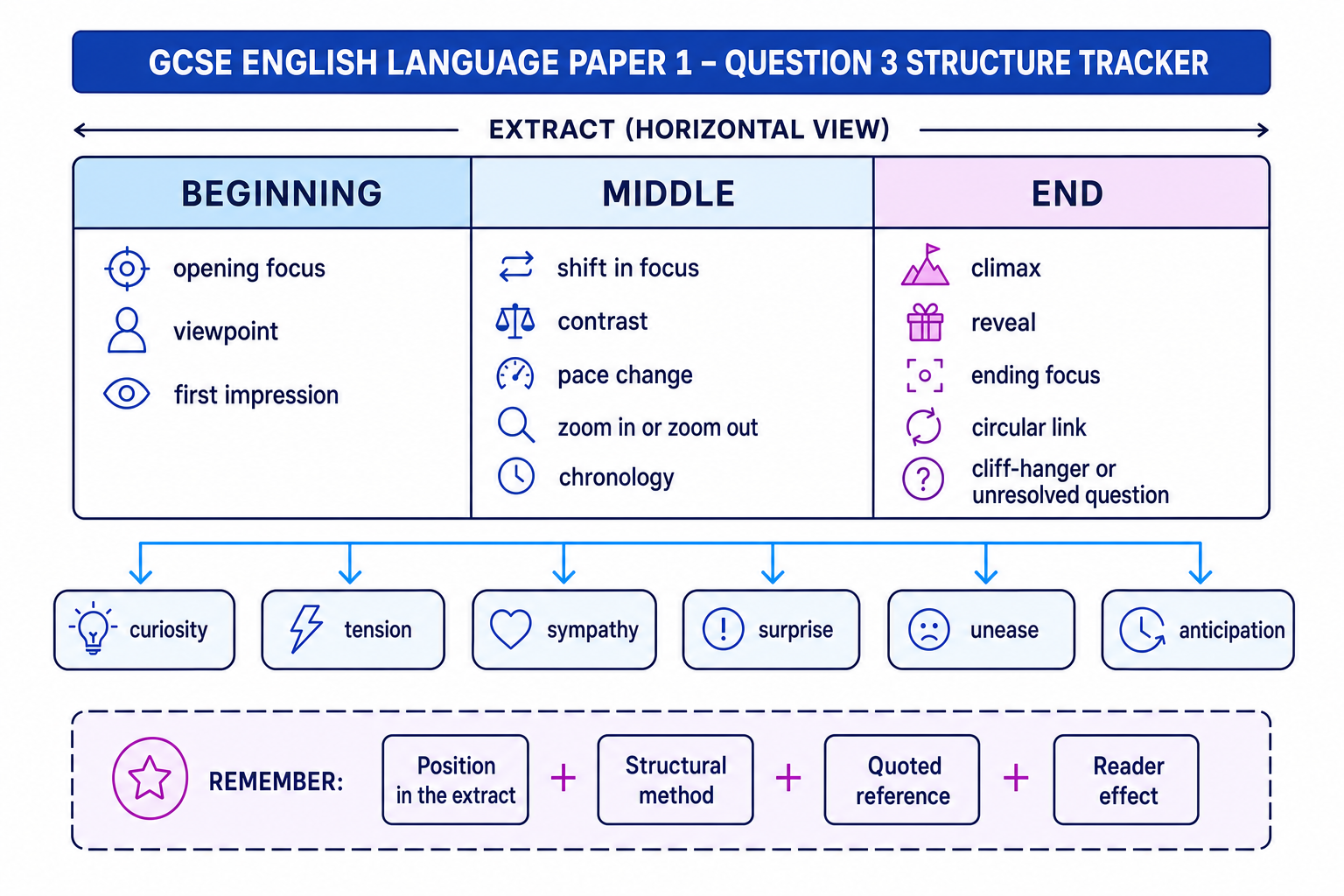
Focus
Focus means what the writer directs the reader’s attention towards at a particular point in the extract: a place, a character, an object, an action, a memory or a piece of information.
A good Q3 answer notices how focus moves. For example, a text might start with a wide focus on a setting, then narrow to one character, then end on a mysterious object. That movement matters because it changes what the reader feels.
Turning a structure map into analysis
- Compare the first focus with the later focus. For example, decide whether the extract moves from a wide view to a close view, from setting to character, or from calm to danger.
- Name the structural movement accurately. This might be a shift in focus, a zoom in, a contrast, or a reveal.
- Link the movement to a precise reader effect. A zoom in on one character might create sympathy; a delayed reveal might create curiosity or suspense.
- Turn it into a sentence: At the beginning, the writer focuses on [first focus], but later shifts to [new focus]. This change makes the reader feel [effect] because [reason the change matters].
Key structural methods
Shift
A shift is a change in focus, time, place, mood or viewpoint. Shifts are useful because they show development. The reader feels that the extract is moving somewhere.
A shift might create:
- curiosity, because the reader wants to know how the new focus connects.
- surprise, because the direction changes unexpectedly.
- tension, because the mood becomes more threatening.
Zoom in and zoom out
To zoom in means the writer narrows the focus, perhaps from a whole setting to one detail or one character. To zoom out means the writer widens the focus, perhaps from one person to the wider scene.
Zooming in often makes the reader feel closer to a character or detail. Zooming out can make events feel larger, more serious or more overwhelming.
Pace
Pace means how fast or slow the narrative feels. Pace can be affected by action, paragraphing, short moments of description, interruptions, or a rapid sequence of events.
A slow pace can build suspense because the reader is made to wait. A fast pace can create excitement, panic or shock because events seem to happen quickly.
Chronology
Chronology means the order of events in time. Most stories move forwards, but writers can interrupt that order.
A flashback is a movement to an earlier event. Foreshadowing is when the writer hints at something that may happen later. Both can create anticipation because the reader begins to connect past, present and future.
Contrast
Contrast means placing two different things next to each other so their differences stand out. A peaceful opening followed by sudden danger, for example, can create shock because the change is so sharp.
Reveal and withholding
To withhold information means to delay telling the reader something. A reveal is the moment when that information is finally given.
Withholding often creates suspense or curiosity. A reveal can create surprise, shock or relief depending on what is discovered.
Ending
A climax is the most intense or important point in the extract. A cliff-hanger is an ending that leaves a problem unresolved. A circular structure is when the ending links back to the beginning.
Endings matter because they control the reader’s final impression.
Use effect words precisely
Instead of saying “this interests the reader,” choose a sharper effect: suspense, curiosity, surprise, tension, sympathy, confusion, shock, anticipation, excitement or unease.
Effects you may be asked to track
Sometimes the question may guide you towards an effect. Even if it simply asks how the writer has structured the text to interest you, you should choose precise effects yourself.
Here is what common effect words mean:
- Suspense: anxious waiting because the outcome is delayed.
- Curiosity: wanting to know more.
- Surprise: a reaction to something unexpected.
- Tension: pressure, conflict or emotional strain.
- Sympathy: care or concern for a character.
- Confusion: uncertainty, often created deliberately.
- Shock: a strong sudden reaction.
- Anticipation: expecting something to happen.
- Excitement: energetic interest or involvement.
- Unease: discomfort or the feeling that something is wrong.
Explaining a delayed reveal
- Identify what is delayed. For example, decide whether the writer holds back a character’s identity, a danger, a reason for fear, or the outcome of an action.
- Explain the effect before the reveal. The delay may create curiosity, suspense or unease because the reader has incomplete information.
- Explain the effect at the moment of reveal. The new information may create surprise or shock because it changes how the reader understands earlier details.
- Build the analysis: By withholding [information] until the end, the writer makes the reader feel [effect]. This is effective because the earlier focus on [earlier detail] only becomes fully clear once [reveal] happens.
How to write a strong paragraph
A useful Question 3 paragraph needs four ingredients:
- Position: where in the extract the structural choice happens.
- Method: the structural technique or choice.
- Reference: a short quotation or clear reference to the text.
- Effect: what the reader feels, thinks or expects.
You can use this sentence frame:
At the beginning / later / towards the end, the writer [structural method]. This shifts the reader’s attention from [first focus] to [new focus], creating [effect] because [reason].
For higher marks, develop the effect. Do not stop at “creates tension.” Explain how and why the tension changes.
Feature spotting
Simply naming “a shift,” “a cliff-hanger” or “a change of focus” is not enough. The marks come from explaining how that choice affects the reader at that point in the extract.
A simple 8-mark plan
For Question 3, you do not need to write about everything. Two or three developed paragraphs are usually better than a long list of undeveloped points.
A strong plan could look like this:
- Paragraph 1: opening focus and first effect.
- Paragraph 2: shift, contrast or pace change in the middle.
- Paragraph 3: ending, reveal, climax or unresolved question.
Try to make your answer feel like a journey: at first, then, by the end.
In the exam
- Spend about 8–10 minutes on Question 3 and use the whole extract, not just one paragraph.
- Make a quick beginning-middle-end map: first focus, main shift, final effect.
- Write 2–3 developed paragraphs using position, structural method, reference and reader effect.
- If the question highlights a specific effect, such as suspense or surprise, keep returning to that effect throughout your answer.
Check yourself
- Can you explain the difference between analysing language and analysing structure?
- Can you track how the reader’s feelings change from the beginning to the end of an extract?
- Does each paragraph explain why the structural choice matters at that exact point?
