What you'll learn
- What AQA Paper 2 Question 4 is really asking you to compare.
- How to compare writers’ ideas, perspectives and methods.
- How to build an integrated comparison paragraph using both sources.
- How to avoid common mistakes like feature-spotting and writing two separate answers.
Where Question 4 fits
Paper 2 is the non-fiction reading and writing paper. The whole paper lasts 1 hour 45 minutes, is worth 80 marks, and makes up 50% of GCSE English Language.
Question 4 is the final reading question in Paper 2 Section A. It is worth 16 marks and targets AO3: comparing writers’ ideas and perspectives, as well as how these are conveyed, across two or more texts.
You normally need to refer to both Source A and Source B, often using the whole of each source rather than a small boxed section.
Question 4 key terms
- Comparison means explaining meaningful similarities and/or differences between two texts.
- An idea is what the writer presents about a topic, issue or experience.
- A perspective is the writer’s viewpoint, attitude or feeling about that idea.
- A method is a choice the writer uses to communicate meaning, such as language, tone, structure or viewpoint.
- A reference is a short quotation or precise detail from the text.
- An inference is a sensible conclusion you draw from evidence, even if it is not directly stated.
What Question 4 rewards
The best answers compare what each writer thinks or feels and how each writer makes you see it that way.
Start with the focus of the question
Question 4 will not ask you to compare everything in both sources. It gives you a focus: the specific topic, feeling, experience or issue you must compare.
For example, the focus might be the writers’ feelings about a place, their views on education, or their attitudes towards an experience. Your job is to stay tightly on that focus.
What to look for first
Before writing, ask:
- What exact topic or feeling does the question name?
- What does Source A suggest about that focus?
- What does Source B suggest about the same focus?
- Are the writers similar, different, or partly similar but different in intensity?
Narrowing the focus
-
Identify the focus named in the question, such as feelings about an experience. This tells you to ignore details that do not reveal feelings about that experience.
-
For Source A, choose two or three relevant references that show the writer’s attitude. Turn each one into a viewpoint word, such as enthusiastic, critical, anxious, nostalgic or admiring.
-
Do the same for Source B. Do not just ask “what happens?” Ask “what does the writer seem to think or feel about what happens?”
-
Decide the relationship between the two sources. You might write: “Both writers present the experience as challenging, but Source A makes it seem rewarding, whereas Source B presents it as damaging.”
Ideas and perspectives are not the same thing
An idea is the content: what the text is about. A perspective is the writer’s attitude towards that content.
Two writers can discuss the same idea but have completely different perspectives. For instance, two sources might both describe travel. One writer may present travel as exciting and freeing, while the other presents it as uncomfortable or dangerous.
Listing instead of comparing
Do not write, “Source A is about travel. Source B is also about travel.” That only spots a shared topic. A stronger comparison explains the writers’ different attitudes towards travel and how those attitudes are conveyed.
Methods: how writers convey perspectives
In Question 4, you are not just comparing opinions. You are comparing how those opinions are communicated.
A method can be any deliberate writing choice. You do not need to name dozens of techniques. It is better to choose a method that clearly links to the writer’s perspective.
| Method area | What you might notice | Useful question to ask |
|---|---|---|
| Language | Word choices, imagery, verbs, adjectives, pronouns, modality | What attitude do these words create? |
| Tone | Humorous, bitter, sincere, angry, formal, anxious | How does the writer sound? |
| Structure | Opening, ending, shifts, contrasts, repetition, order of ideas | How does the viewpoint develop? |
| Viewpoint or voice | First person, direct address, anecdote, reported facts | How does the writer position the reader? |
A semantic field is a group of words linked by meaning. Modality means words showing certainty, possibility or obligation, such as “might”, “should” or “must”. An anecdote is a brief personal story.
Choosing a meaningful method
-
Start with the perspective, not the technique. For example, decide that Source A feels personally involved while Source B feels more detached or critical.
-
Choose methods that help create those perspectives. Source A might use first-person voice, emotive language or anecdote. Source B might use formal tone, facts, statistics or repeated criticism.
-
Explain why the method matters. A first-person anecdote can make a viewpoint feel personal and lived; a formal tone can make a writer seem controlled, authoritative or distant.
-
Turn this into comparison: “Whereas Source A’s first-person voice makes the experience feel immediate and personal, Source B’s more formal tone creates a sense of distance, suggesting the writer is judging the issue rather than reliving it.”
Feature spotting
Do not write, “Source A uses adjectives and Source B uses a rhetorical question,” then stop. A method only earns real credit when you explain how it reveals the writer’s idea or perspective.
Build integrated comparison paragraphs
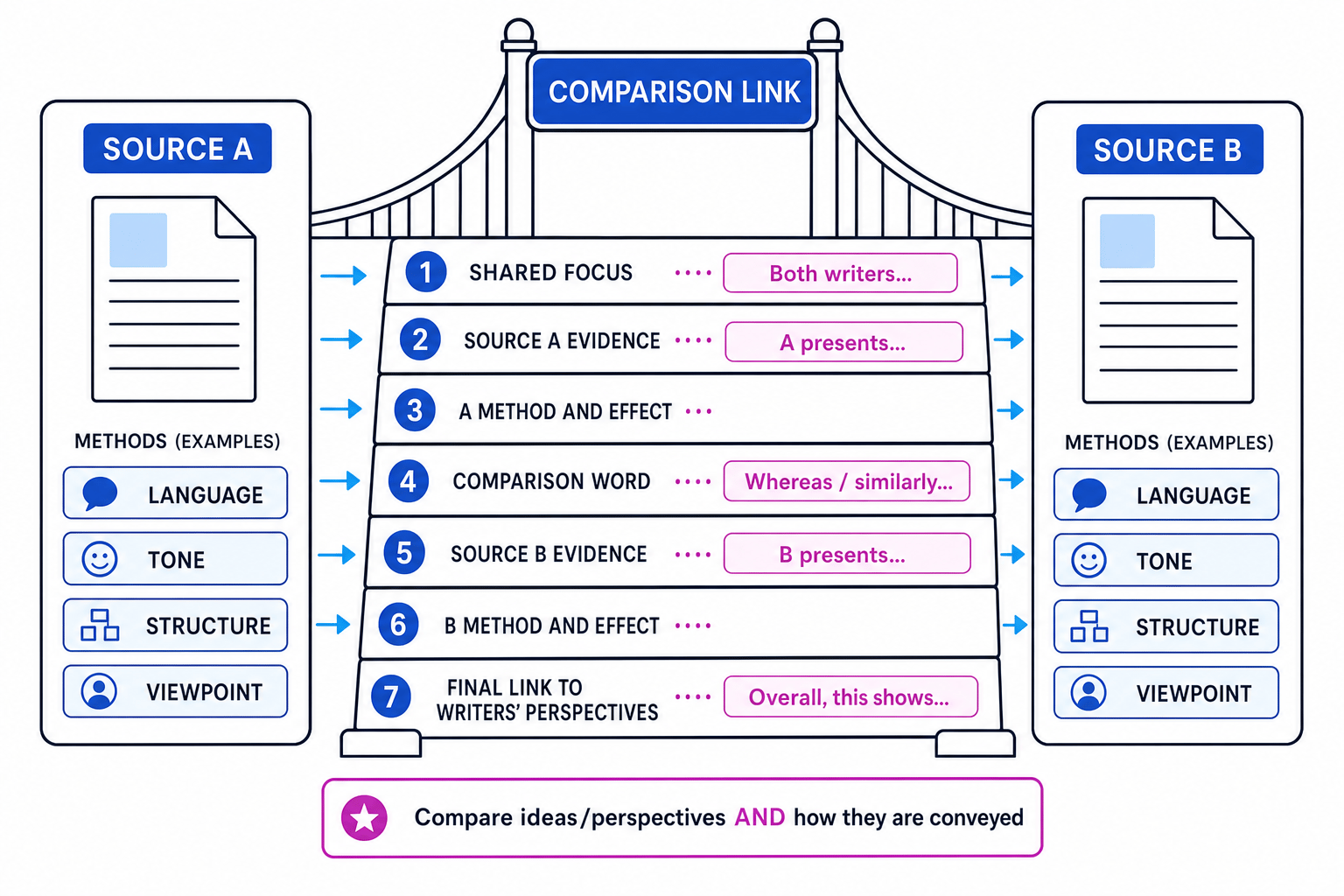
An integrated comparison is a paragraph that keeps both sources in the same argument. Instead of writing one paragraph on Source A and then one separate paragraph on Source B, you move between them.
The scaffold below shows how to build a comparison paragraph that links ideas, evidence, methods and perspectives.
The bridge paragraph
A strong Question 4 paragraph acts like a bridge: it begins with a shared focus, crosses from Source A to Source B, and ends by explaining the meaningful similarity or difference between the writers’ perspectives.
A useful paragraph shape
You can use this structure:
- Comparative point about both writers.
- Source A evidence and what it suggests.
- Source A method and its effect.
- Comparison word: “whereas”, “similarly”, “however”, “unlike”.
- Source B evidence and what it suggests.
- Source B method and its effect.
- Final comparative link back to the writers’ perspectives.
Building an integrated paragraph
-
Choose one focused comparison: Source A presents the topic as positive or hopeful, while Source B presents it as troubling or disappointing.
-
Add Source A evidence using a short reference from the real exam source: “In Source A, the reference to [short quotation or detail] suggests…”
-
Link that reference to a method: “The writer’s [method] creates a sense of…, making the reader feel…”
-
Shift clearly to Source B: “By contrast…”, “Whereas…” or “Similarly…”.
-
Add Source B evidence and method: “Source B uses [short quotation or detail], and the [method] makes the topic seem…”
-
Finish with a comparative judgement: “Overall, Source A’s perspective is more…, while Source B’s is more…, showing that the writers respond to the same issue in sharply different ways.”
Selecting evidence from both sources
Because Question 4 is worth 16 marks, you need enough evidence to support a developed comparison. However, you do not need huge quotations. Short, precise references are usually stronger.
Aim to choose references that:
- clearly relate to the question focus;
- reveal the writer’s attitude;
- contain a method you can discuss;
- can be paired with a reference from the other source.
Pair before you write
Before starting your answer, draw two quick columns for Source A and Source B. Pair evidence by focus: for example, both writers’ views on the place, both writers’ reactions to people, or both writers’ feelings at the end.
Useful comparison language
Good comparison language helps your answer feel connected rather than like two separate mini-essays.
Useful phrases include:
- Both writers present…
- Similarly, Source B…
- Whereas Source A…, Source B…
- Unlike the writer of Source A…
- This contrasts with…
- The difference suggests…
- Although both writers…, they differ because…
Try to compare throughout the paragraph, not just in the opening sentence.
Basic vs stronger comparison
Basic:
Source A is positive. Source B is negative.
Stronger:
Whereas Source A presents the experience as rewarding through its positive language, Source B creates a more critical perspective, using a harsher tone to make the same experience seem frustrating and damaging.
The stronger version compares the perspective and the method.
What a strong answer does
A strong Question 4 answer usually:
- keeps returning to the focus of the question;
- uses both sources in every main paragraph;
- compares perspectives, not just topics;
- discusses methods only when they reveal meaning;
- uses short references from both texts;
- makes clear whether the writers are similar, different, or partly similar.
You do not need to cover every method in the source. Depth is better than a long list.
In the exam
-
Spend a few minutes planning pairs of evidence from Source A and Source B before writing.
-
Write two or three developed comparison paragraphs rather than lots of thin points.
-
In each paragraph, compare the writers’ perspectives and at least one method used to convey them.
Check yourself
- Can you explain the difference between an idea and a perspective?
- Does each paragraph compare both sources, or have you written two separate mini-essays?
- Have you explained how the writers’ methods shape their viewpoints?
