Welcome to your study guide for Paper 2, Section A, Question 3. This is one of the most high-yield questions on the reading paper. Here, you get to play the role of a language detective, investigating how writers use deliberate techniques to influence their readers.
Whether a writer is trying to persuade, inform, argue, or shock, they never choose their words by accident. This guide will show you exactly how to spot those choices and write about them like an expert.
What you'll learn
- How to navigate the timing, marks, and assessment objectives for Paper 2 Question 3.
- The ultimate "Method Bank" of rhetorical and persuasive devices.
- A step-by-step formula to turn basic observations into high-scoring, analytical paragraphs.
Understanding the Question
Before looking at the language itself, let's understand exactly where this question fits in your exam and what the examiners are looking for.
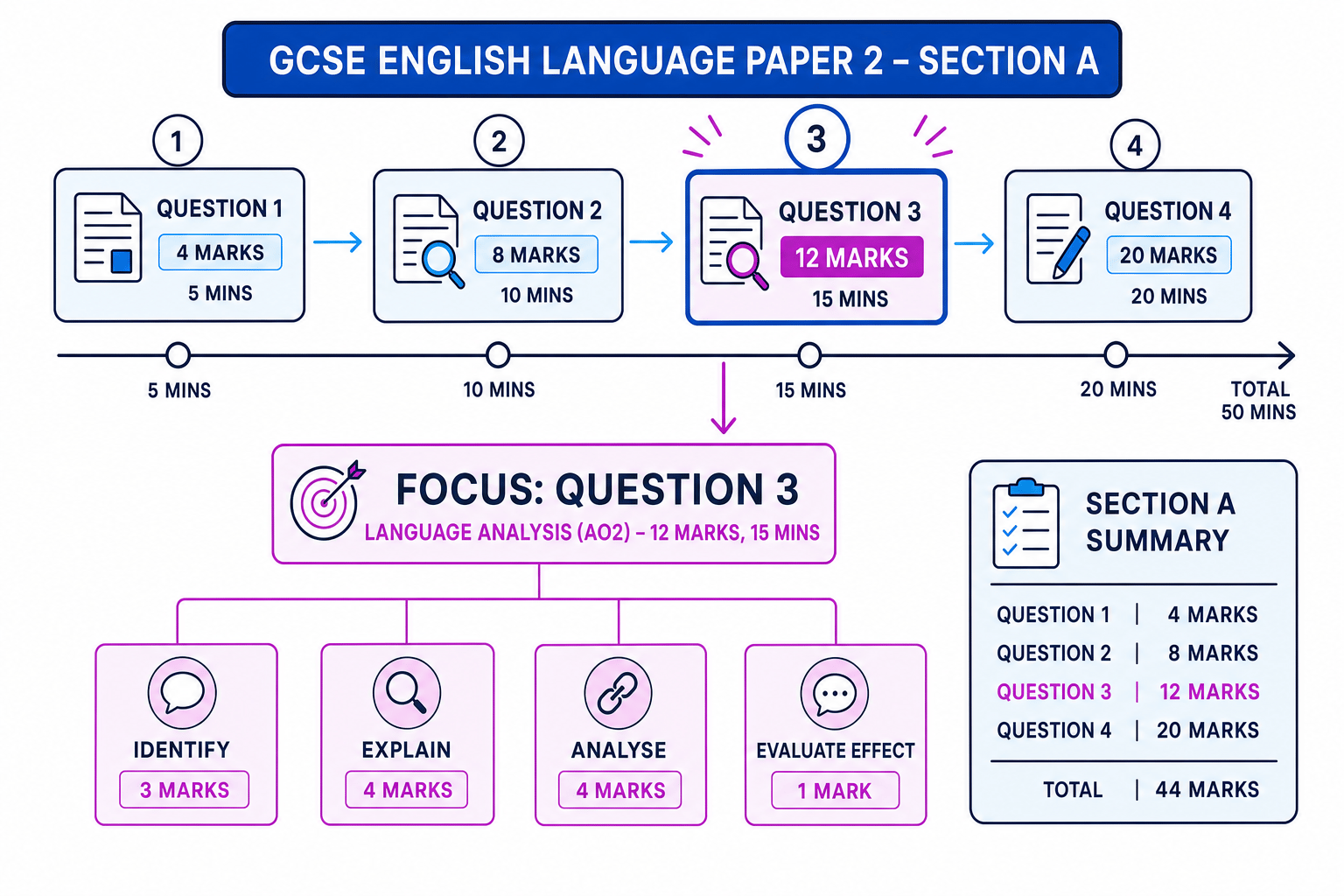
Paper 2 (Writers' Viewpoints and Perspectives) lasts 1 hour and 45 minutes in total. Section A is the Reading section, worth 44 marks.
Question 3 is your language analysis task. It is worth 12 marks and you should spend exactly 15 minutes on it.
The Assessment Objective (AO2)
Question 3 targets AO2: Explain, comment on and analyse how writers use language and structure to achieve effects and influence readers, using relevant subject terminology to support their views.
To get top marks, you must focus heavily on the effects of the language. Simply labeling techniques (e.g., "this is a metaphor") without explaining why the writer used it will cap your mark.
The Non-Fiction Method Bank
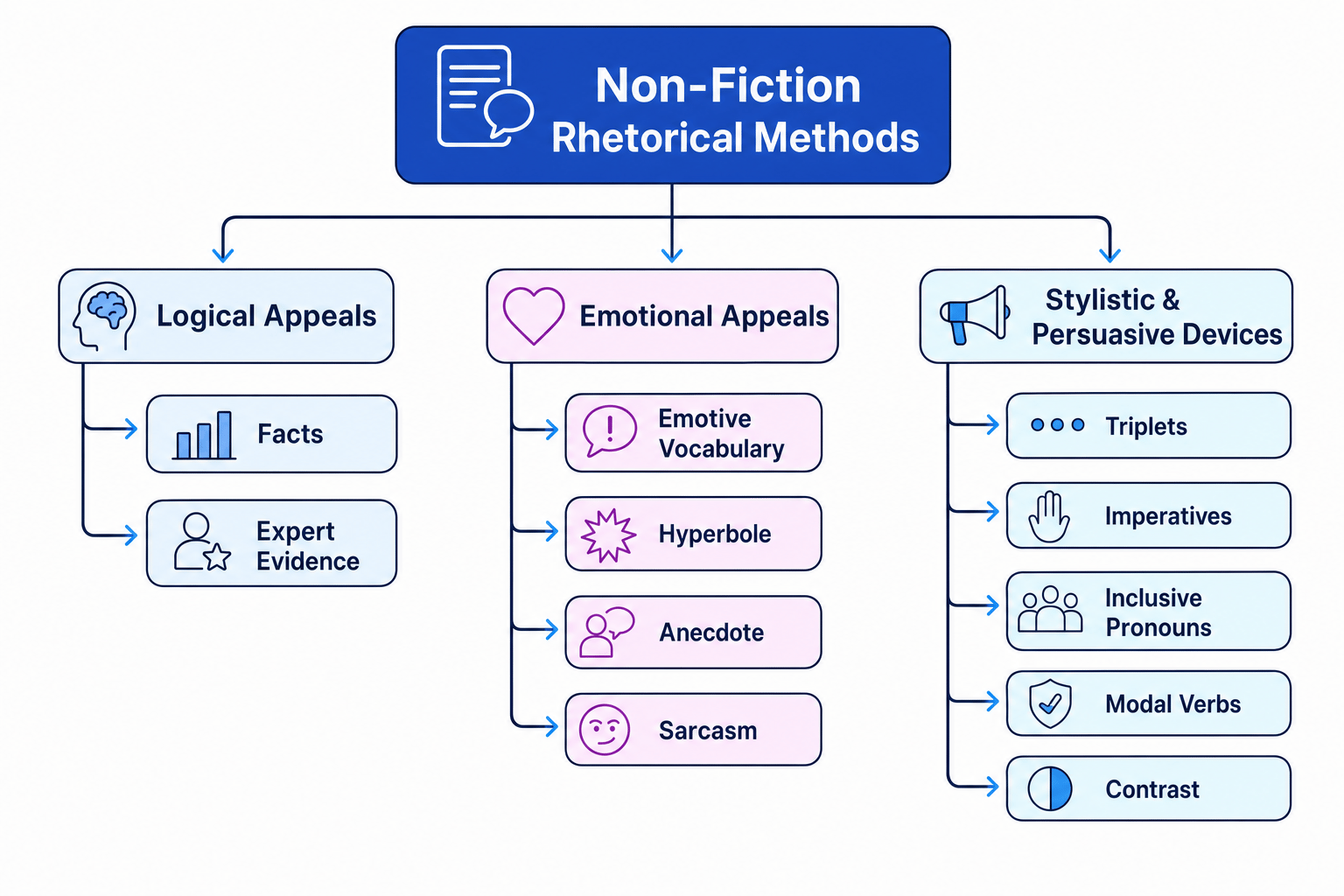
In Paper 2, you are dealing with non-fiction texts (such as journalism, letters, travel writing, or speeches). Writers of non-fiction want to make you see the world from their perspective. To do this, they rely on a specific toolkit of rhetorical and persuasive methods.
Rhetorical Method
A rhetorical method (or persuasive device) is any linguistic technique a writer uses to convince, influence, or evoke a specific emotional response from their reader.
Let’s break down the essential methods you must look for when reading the source:
1. Facts and Opinions
- Facts: Objective, verifiable pieces of information. They appeal to the reader's rational mind (logos) and make the writer's argument seem indisputable.
- Opinions: Subjective beliefs or attitudes. Writers often present opinions as if they are facts to assert authority and subtly sway your viewpoint.
2. Expert Evidence
- What it is: Referencing statistics, studies, or quotes from academic authorities, scientists, or professionals.
- Effect: It boosts the writer’s credibility (ethos), making the reader feel that the argument is backed by reliable, institutional power.
3. Personal Anecdote
- What it is: A short, personal story from the writer's own life.
- Effect: It humanises a dry or complex topic. It builds an immediate connection (rapport) between the writer and reader, making the issue feel real and lived-in.
4. Inclusive Pronouns
- What it is: Words like we, our, and us.
- Effect: These words break down the barrier between writer and reader. They create a sense of shared responsibility and collective identity, subtly forcing the reader to agree with the writer's stance.
5. Modal Verbs
- What it is: Verbs that show possibility or necessity, such as must, should, will, or ought.
- Effect: Using high-certainty modal verbs like must or will creates a strong sense of urgency, obligation, and confidence.
6. Imperatives
- What it is: Command words or verbs used to issue an order (e.g., stop, think, act, demand).
- Effect: They directly call the reader to action, leaving no room for passivity or hesitation.
7. Triplets (Rule of Three)
- What it is: Listing three related adjectives, nouns, or phrases in quick succession.
- Effect: Human brains are wired to recognise patterns. Triplets create an aesthetic rhythm, make the point memorable, and emphasize the scale of an issue.
8. Contrast (Juxtaposition)
- What it is: Placing two highly opposing ideas, images, or words close together.
- Effect: By highlighting extreme differences, the writer makes one option seem vastly superior, shocking, or absurd compared to the other.
9. Hyperbole
- What it is: Deliberate, dramatic exaggeration.
- Effect: It heightens the emotional stakes of an argument, often creating a sense of crisis, panic, or comedic absurdity.
10. Sarcasm and Irony
- What it is: Using language that normally signifies the opposite of what is literally said, often to mock or criticize.
- Effect: It alienates the opposing viewpoint, making it look foolish, outdated, or illogical.
11. Emotive Vocabulary
- What it is: Words loaded with intense emotional associations (e.g., devastating, miraculous, suffocating, vulnerable).
- Effect: They bypass the reader's logical defenses, provoking immediate feelings of sympathy, anger, fear, or pride.
Moving Beyond "Feature Spotting"
The biggest mistake students make is finding a technique, naming it, and saying: "The writer uses a triplet to make the reader read on." This is a generic, empty statement.
Instead, use the What, How, Why method to construct deep, analytical paragraphs:
- WHAT is the writer doing? (What point are they making at this moment in the text?)
- HOW are they doing it? (Quote the text and identify the specific method used.)
- WHY are they doing it? (What is the precise effect of that method on the reader, and how does it support the writer's broader purpose?)
<tip title="The "zoom-in" strategy">
To get into the higher mark bands, do not just analyze the overall sentence. Zoom in on the connotations of single, high-impact words within your quote. Explain how a specific verb, noun, or adjective carries emotional weight.
Worked Example: Deconstructing language
Let's look at how to analyze a brief persuasive line using our step-by-step formula.
Imagine you are analyzing this sentence from a campaign speech advocating for environmental action:
"We must act now to rescue our fragile, beautiful natural world before it is suffocated by the concrete tide."
Analyzing a persuasive fragment
-
Deconstruct the prompt and isolate the focus.
First, look at what the writer is trying to convey. Here, the focus is on the urgency of protecting the environment. Identify the most powerful language methods used in the sentence. We have a modal verb (must), an imperative (act), inclusive pronouns (we, our), and a metaphor (concrete tide).
-
Isolate a specific device and zoom in.
Select the metaphor: "suffocated by the concrete tide." Zoom in on the verb "suffocated". Literally, suffocation means to choke or be deprived of air. Metaphorically, this suggests that human industrialization is actively murdering nature by cutting off its life force.
-
Analyse the emotional and logical path to the reader.
Think about how this makes the reader feel. The verb "suffocated" is highly emotive and distressing; it evokes physical pain and helplessness, triggering guilt and fear in the reader. The contrast between "fragile, beautiful" and "concrete tide" highlights the destruction of something pure by something artificial and relentless.
-
Draft the analytical response using precise subject terminology.
Combine your insights into a paragraph. Lead with the writer's purpose (What), integrate your quote and terminology (How), and explain the deep impact on the reader (Why):
Draft: The writer utilizes a suffocating metaphor to emphasize the destructive power of urban expansion. By asserting that nature is being "suffocated by the concrete tide," the writer employs the highly emotive verb "suffocated" to evoke a claustrophobic sense of choking and helplessness. This violent imagery transforms urban development into an active, lethal predator, prompting the reader to feel a deep sense of guilt and panic. This emotional distress is heightened by the contrast with the adjectives "fragile" and "beautiful," forcing the reader to recognise their moral duty to protect a vulnerable ecosystem.
<commonmistake title="The "This makes the reader..." trap">
Avoid using vague, catch-all phrases like "this makes the reader visualise it" or "this makes the reader want to read on." Instead, use precise verbs to describe the psychological effect: "this compels the reader to feel guilt," "this provokes anger," "this demystifies a complex issue," or "this aligns the reader with..."
In the exam
- Highlight the key words in the question first. The prompt will always give you a specific focus (e.g., "How does the writer use language to try to influence the reader to support charity work?"). Only highlight quotes that link directly to this focus.
- Track the specified line numbers. Question 3 always points you to a specific section of the text (e.g., "Refer to Source B, lines 15 to 25"). If you pull a quote from outside these lines, you will get zero marks for it.
- Aim for 2 to 3 detailed "What-How-Why" paragraphs. Quality and depth of analysis always beat quantity. It is far better to write two highly detailed paragraphs that zoom in on specific words than four rushed paragraphs that only spot basic devices.
Check yourself
- Can you explain the difference between a fact and an opinion, and how writers use them to manipulate an audience?
- Why does using inclusive pronouns like we make an argument feel more persuasive?
- How does a modal verb change the tone of a sentence compared to a standard verb?
