What you'll learn
- What AQA Paper 1 Question 3 is really asking you to do.
- How to track a fiction extract from beginning to end.
- Key structural features: focus shifts, perspective, pace, tension, order and endings.
- How to write clear AO2 paragraphs without drifting into language analysis.
Where Question 3 fits
AQA GCSE English Language Paper 1 is 1 hour 45 minutes long and worth 80 marks / 50% of the GCSE. Section A is Reading Fiction, and Question 3 is the structure question. It is worth 8 marks and is compulsory.
Both English Language papers are worth 80 marks / 50%. In Paper 1, Section B is the writing task: 40 marks, split into 24 marks for content and organisation and 16 marks for technical accuracy. But Question 3 is in Section A, so it is a reading question.
Question 3 targets Assessment Objective 2 (AO2). AO2 rewards you for analysing how writers use language and structure. In this question, you focus on structure.
Structure
Structure means the way a writer organises a text: the order of events, what the reader is shown first or last, how the focus changes, and how pace, tension or perspective develop across the extract.
Question 3 in one sentence
Question 3 asks you to explain how the writer organises the whole extract to interest the reader.
Structure is not the same as language
Language analysis zooms in on words, phrases and methods such as similes, verbs or adjectives.
Structure analysis tracks how the text is built. You look at the journey of the extract: what happens at the beginning, how it changes in the middle, and what effect the ending creates.
An effect means the response or understanding created in the reader: curiosity, tension, shock, sympathy, uncertainty, relief, suspicion, or surprise.
Writing a Question 2 answer
If your paragraph is mainly about the connotations of one word, you are probably doing language analysis. For Question 3, your main evidence should be a movement, sequence, shift, delay or pattern across the extract.
Think of the extract as a timeline
An extract is the section of text printed in the exam. For Question 3, AQA often reminds you to think about the whole of the source.
The easiest way to do this is to treat the extract like a timeline. Ask: what does the writer focus on at the start, how does that focus change, and where does the reader end up?
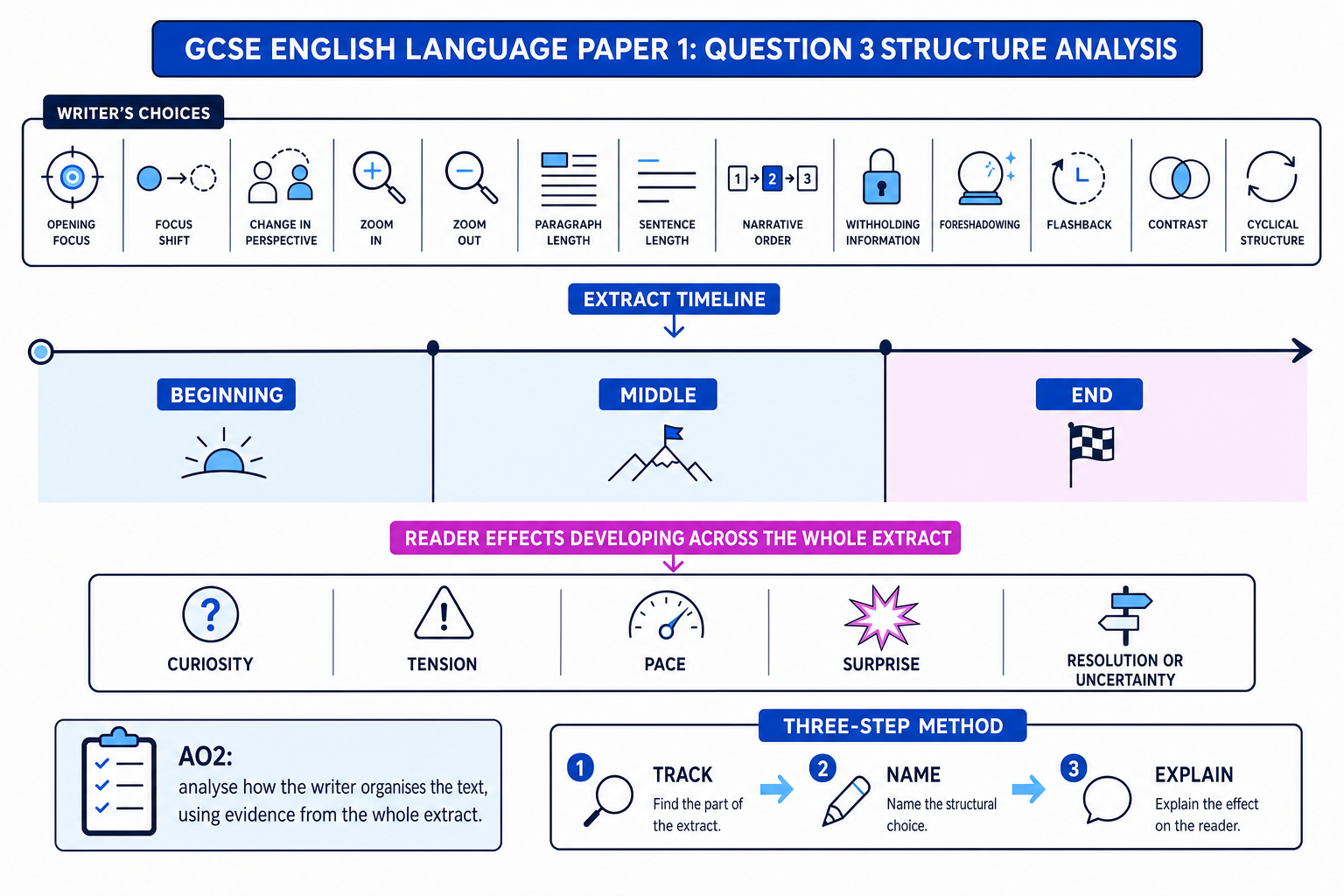
Focus
Focus means what the writer directs the reader’s attention towards. This might be a setting, a character, an object, an event, a sound, or a mystery.
A focus shift happens when the writer moves attention from one thing to another.
Tracking focus across an extract
-
Compare the beginning with the middle. If the extract begins with a wide description of a place, then moves to one character, the focus has narrowed from setting to individual.
-
Compare the middle with the ending. If the ending concentrates on a single unanswered detail, the writer may be making the reader suspicious or curious.
-
Explain the journey. The reader may begin as an observer of the scene, then become emotionally invested in one person, before being left with uncertainty at the end.
Beginnings and endings
The beginning of an extract often establishes the situation. It might introduce the setting, mood, character, conflict or mystery.
The ending is important because it controls the reader’s final feeling. It might resolve a problem, create a cliffhanger, reveal information, or leave the reader with unanswered questions.
A cyclical structure happens when the ending links back to the beginning. For example, the extract might return to the same place, image, idea or mood. This can create a sense of completion, inevitability, entrapment or irony.
Explaining a linked ending
-
Notice the link. If the end returns to something introduced at the start, identify what has come back: a place, object, image, question or mood.
-
Ask what has changed. The repeated detail may feel different because the reader now knows more, or because the character’s situation has changed.
-
Explain the effect. A linked ending can make the structure feel complete, but it can also suggest that the character is trapped in the same problem.
Perspective, zooming in and zooming out
Perspective means the viewpoint from which events are presented. This could be a narrator looking from the outside, or a viewpoint closely connected to a character’s thoughts and feelings.
A change in perspective happens when the writer alters what the reader can see or understand. For example, the extract might move from an outside view of a scene to a more personal focus on one character’s fear.
Zooming in means narrowing the focus onto a small detail, person or moment. Zooming out means widening the focus to a larger setting, group or situation. These are not literal camera movements, but they are useful ways to describe how attention is controlled.
Useful structure verbs
Use active verbs to explain movement: begins, opens, shifts, moves, narrows, widens, zooms in, zooms out, returns, delays, reveals, withholds, contrasts, ends.
Explaining a focus shift
-
Identify the first focus. The writer may begin with a broad setting, which places the reader at a distance and establishes atmosphere.
-
Identify the later focus. The writer may then narrow attention to one character, making the situation feel more personal.
-
Connect the shift to the reader. This movement can make the reader move from general curiosity about the setting to concern for a specific person.
Paragraph length, sentence length and pace
Paragraph length means how much text the writer puts into each paragraph. A short paragraph can isolate a moment, slow the reader down, or make an event feel sudden. A longer paragraph can immerse the reader in description, build pressure, or create a flowing pace.
Sentence length means how long or short the sentences are. Short sentences can create shock, speed or bluntness. Longer sentences can slow the pace, build detail, or suggest a character’s overwhelmed thoughts.
Pace means the speed at which the narrative seems to move. Writers control pace by choosing how much detail to include, how quickly events happen, and how long the reader has to wait for information.
Short sentences do not always mean tension
Do not automatically write “short sentences create tension.” Sometimes they create finality, shock, simplicity or emphasis. Always link the method to what is happening at that moment in the extract.
Tension, withholding information and foreshadowing
Tension means a feeling of suspense, pressure or anxious expectation.
Withholding information means the writer deliberately delays telling the reader something important. This makes the reader ask questions.
Foreshadowing means hinting that something may happen later. It can make the reader feel uneasy because the text seems to be preparing them for a future event.
Analysing pace and tension
-
Look at how much is revealed. If the writer delays key information, the reader is kept uncertain and has to keep reading to understand the situation.
-
Look at the pace before and after the reveal. A slow build-up followed by a sudden moment can make the reveal feel more dramatic.
-
Explain the reader’s changing response. The reader may move from curiosity, to unease, to shock as the structure controls when information is released.
Narrative order, flashback and contrast
Narrative order means the sequence in which events are presented to the reader.
Chronological order means events are told in time order, from earliest to latest.
A flashback is a movement back to an earlier time. Writers use flashbacks to reveal background information, explain a character’s behaviour, or make the reader reinterpret the present.
Contrast means placing two different things near each other so the difference stands out. For example, a calm opening followed by a sudden threat can make the threat feel more powerful.
Analysing a flashback
-
Work out the time shift. If the extract moves from the present into a memory, the writer has changed the narrative order.
-
Ask what the flashback reveals. It may explain a fear, relationship, secret or motive that was unclear before.
-
Link it to the reader’s understanding. The reader may reinterpret the character’s present actions because the flashback gives them new context.
How to write a Question 3 paragraph
A strong paragraph usually does three things:
- Locates the moment in the extract: at the start, later, towards the end.
- Names or describes the structural choice: focus shift, zooming in, withholding information, contrast, cyclical ending.
- Explains how the reader’s response changes.
You do not need lots of quotations for Question 3. Short references to what happens in the extract are often enough. If you do quote, use it to support a structural point, not to analyse individual words.
Building a structure paragraph
-
Choose a movement across the extract. For example, the writer might begin with a wide setting, then narrow the focus to one isolated character.
-
Name the structural method if it helps. This could be described as a focus shift or zooming in.
-
Explain why the movement matters. The reader is moved from observing the scene generally to worrying about a particular person.
-
Develop the effect. Because the focus becomes more personal, the tension feels sharper and the reader is encouraged to care about what happens next.
A model sentence could be:
The writer begins with a broad focus on the setting, placing the reader at a distance and establishing atmosphere. Later, the focus narrows to one isolated character, so the reader’s attention shifts from the general scene to a more personal threat. This structural movement increases tension because the danger now feels attached to someone specific.
What higher-mark answers do
Higher-mark answers do not just list structural features. They explain how those choices work together across the extract.
Instead of writing:
The writer uses short paragraphs and a flashback.
Develop it:
The writer first slows the pace by focusing on the character’s memory, using a flashback to explain their fear. When the narrative returns to the present, the shorter paragraphs make the action feel more immediate, so the reader experiences a sharper sense of danger.
Use beginning–middle–end language
Sentence starters like “At the start…”, “The focus then shifts…”, and “By the end…” help you stay on structure because they force you to track the extract over time.
In the exam
-
Plan with three quick boxes: beginning, middle, end. In each box, note what the writer focuses on and how the reader feels.
-
Write two or three developed paragraphs. Start each one with a location phrase such as “At the beginning”, “Later” or “By the end”.
-
Avoid single-word analysis. Focus on organisation: shifts, order, pace, perspective, openings, endings and withheld information.
Check yourself
- Can you explain the difference between language analysis and structure analysis?
- What changes between the beginning, middle and end of the extract?
- How might withholding information or foreshadowing affect the reader?
