What you'll learn
- What “subject terminology” means in AQA GCSE English Language.
- The key language terms you should recognise for Question 2.
- How to choose terminology that actually helps your analysis.
- How to avoid “label-spotting” and link terms to meaning and effect.
Where this fits in Paper 1
AQA GCSE English Language Paper 1 is 1 hour 45 minutes, worth 80 marks and 50% of the GCSE. Section A is reading fiction, and Question 2 is the language analysis question.
Question 2 is worth 8 marks. It usually asks something like: How does the writer use language to…? You are normally given a specific part of the extract to focus on, so you must stay within those lines.
This question mainly rewards AO2, which means analysing how writers use language to create meanings and effects, using relevant subject terminology where appropriate.
Subject terminology
Subject terminology means the technical names for language choices, such as verb, simile, metaphor or semantic field. In Question 2, terminology is useful only when it helps you explain what the writer is doing.
The main rule
A term is not a mark by itself. The marks come from linking the term to the writer’s meaning, the atmosphere, the character, the setting, or the reader’s response.
Terminology is a tool, not the answer
Think of terminology as a label on a toolbox. Saying “this is a metaphor” is only the beginning. You then need to explain why the metaphor matters.
A strong Question 2 comment usually does four things:
- Selects a short, relevant quotation.
- Identifies a useful language choice.
- Zooms in on a key word or image.
- Explains the meaning and effect.
The map below shows how the main terms connect to the bigger goal: explaining meaning and effect.
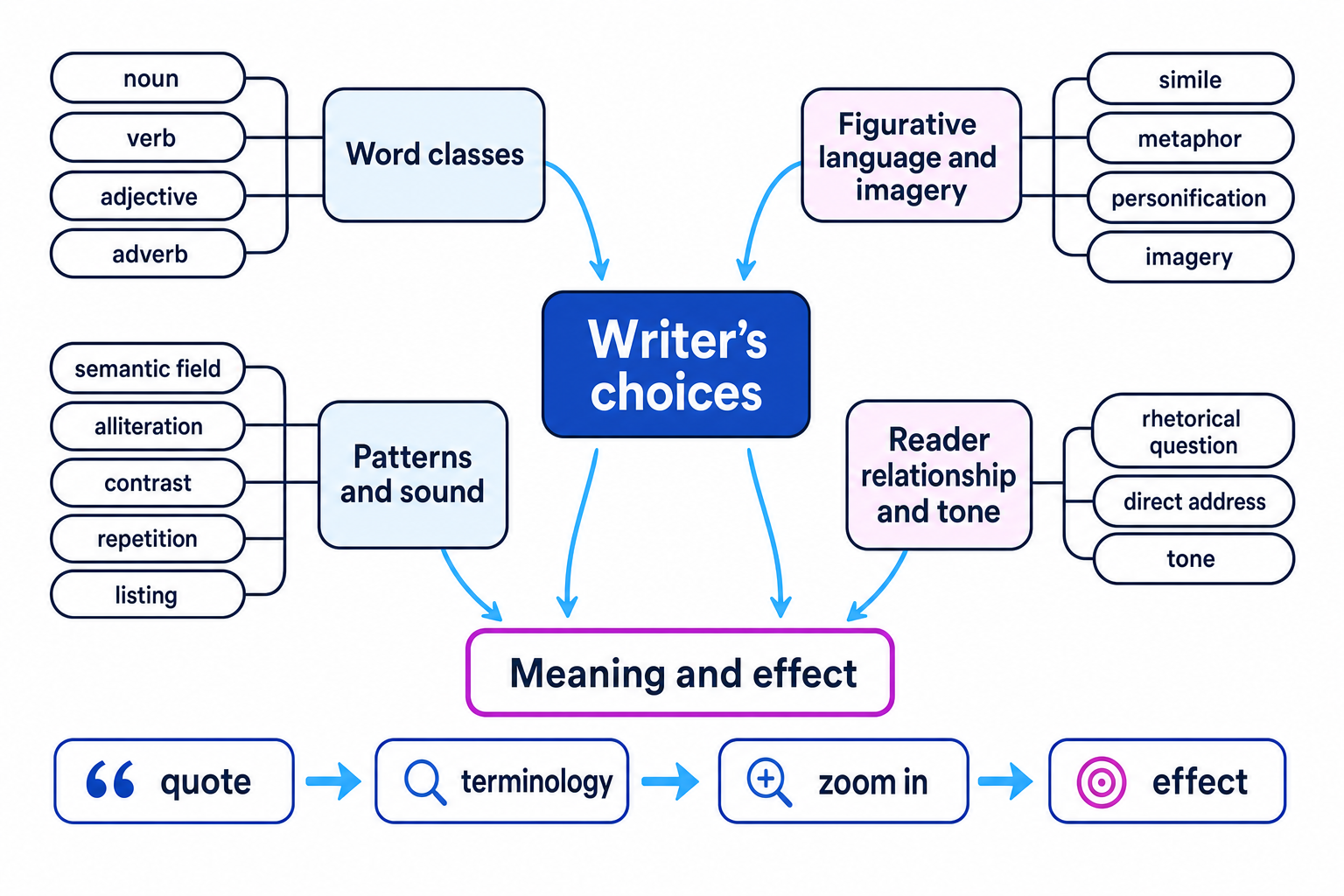
Terminology bank
Word classes
Word class
A word class is a category of word based on its job in a sentence.
- A noun names a person, place, object, feeling or idea.
- A verb shows an action, state or process.
- An adjective describes or modifies a noun.
- An adverb modifies a verb, adjective or another adverb, often showing how, when, where or to what extent something happens.
Word classes are often the safest and most precise terminology in Question 2. If you are not sure whether something is a metaphor or personification, it may be better to analyse a verb or adjective accurately.
Choosing a useful word-class comment
You have chosen a quotation from the extract and want to analyse one important word.
- Decide what the word is doing in the sentence: if it describes a noun, it is probably an adjective; if it shows an action or state, it is probably a verb.
- Ask what the word suggests beyond its basic meaning. These extra associations are called connotations.
- Link those connotations to the question focus, such as a character’s fear, a setting’s danger, or the narrator’s attitude.
- Shape the comment like this: The writer’s use of the [word class] “[word]” suggests…, because it has connotations of…
Figurative language and imagery
Figurative language
Figurative language is language that is not meant only literally. It creates meaning through comparison, suggestion or imaginative description.
- A simile compares one thing to another using “like” or “as”.
- A metaphor describes one thing as if it is another thing.
- Personification gives human qualities, actions or feelings to something non-human.
- Imagery is descriptive language that creates a sensory impression, such as something the reader can imagine seeing, hearing or feeling.
These terms are helpful when the writer is creating a vivid picture or shaping how the reader sees something.
Distinguishing comparison techniques
When you notice a comparison, work out the most accurate term before you write.
- Check whether two things are being compared. If there is no comparison, do not force the label simile or metaphor.
- If the comparison uses “like” or “as”, it may be a simile. If it says or implies that one thing is another thing, it may be a metaphor.
- If a non-human thing is given a human action, feeling or intention, the most accurate term is likely to be personification.
- If you are unsure, use a broader but accurate term such as image, comparison or description, then explain the effect clearly.
Not every “like” is a simile
The word “like” only creates a simile when it compares one thing with another. If it is used as a verb, it is not a simile.
Patterns in language
Some terminology is about patterns across several words, not just one word.
- A semantic field is a group of words connected by meaning.
- Alliteration is the repetition of the same initial consonant sound in nearby words.
- Contrast is a deliberate difference or opposition between ideas, images, characters or descriptions.
- Repetition is the repeated use of a word, phrase, sound or structure.
- Listing is a sequence of words, phrases or ideas, often used to build intensity or quantity.
These techniques can help you discuss atmosphere. For example, a semantic field might create a sense of danger, decay, beauty, violence, childhood, nature or control — depending on the actual words in the extract.
Spotting without explaining
Do not write: “The writer uses alliteration, which makes it stand out.” That is too vague. Explain what the repeated sound emphasises and how it connects to the mood or meaning.
Reader relationship and tone
Some terms describe how the writer positions the reader or creates an attitude.
- A rhetorical question is a question asked for effect, not because the writer expects a real answer.
- Direct address speaks directly to the reader or listener, often using “you”.
- Tone is the attitude or mood created by the language, such as anxious, mocking, calm, bitter, threatening, playful or mysterious.
Tone is especially useful because it pushes you beyond spotting techniques. If you can describe the tone precisely, you are already thinking about effect.
Upgrade vague tone words
Instead of saying the tone is “sad” or “scary”, try more precise words such as melancholic, uneasy, menacing, bleak, tense, mocking or admiring — but only if the extract supports them.
How to use terminology in a paragraph
A good Question 2 paragraph does not need loads of terms. It needs one or two accurate terms used well.
Effect
An effect is the impact of the writer’s language: what it makes the reader think, feel, imagine or understand.
A useful paragraph shape is:
Point → Evidence → Method → Zoom in → Effect
That means:
- Point: answer the question focus.
- Evidence: use a short quotation.
- Method: name the writer’s language choice.
- Zoom in: analyse a key word or image.
- Effect: explain what this suggests to the reader.
Turning terminology into analysis
Use this process with any short quotation you have selected from the given lines.
- Begin with the idea you want to prove: decide what the writer presents, such as danger, beauty, tension, confusion or power.
- Choose the most relevant term from the quotation. If the key impact comes from a describing word, use adjective; if it comes from a comparison, use simile, metaphor or personification.
- Zoom in on one word from the quotation and consider its connotations. Ask: what does this word make the reader associate with the subject?
- Link back to the question focus using a sentence frame like: This suggests… because… Therefore, the reader may…
Here is a flexible model sentence you can adapt:
The writer uses the [term] “[quotation]” to present [focus] as [idea]. In particular, the [word class] “[single word]” has connotations of [association], suggesting that [interpretation]. This creates a [tone] tone and makes the reader [effect].
Notice that the terminology is not sitting alone. It is connected to interpretation.
Accuracy matters more than sounding impressive
It is better to use a simple term accurately than a difficult term wrongly.
For Question 2, “the writer uses the verb…” can be excellent if you explore the effect properly. You do not need to force in rare terminology. AQA rewards relevant subject terminology, not random terminology.
The terminology dump
Avoid writing a sentence full of labels, such as: “The writer uses adjectives, metaphors, imagery, alliteration and tone.” This lists methods but does not analyse any of them. Choose fewer methods and explain them properly.
What if you cannot name the technique?
This happens to everyone sometimes. Do not panic.
If you cannot remember the exact term, use a broader accurate phrase:
- word choice
- description
- image
- comparison
- phrase
- sentence form
Sentence form
A sentence form is the type or shape of a sentence, such as a question, command, exclamation or short simple sentence. In Question 2, only mention sentence form if it clearly affects meaning or tone.
A clear explanation with simple terminology is much stronger than an inaccurate label with no effect.
Safe terminology
If in doubt, analyse word choice. You can still zoom in on a noun, verb, adjective or adverb and make a strong AO2 point.
Linking terminology to the question
Every Question 2 asks about a particular focus, such as a place, person, moment, atmosphere or feeling. Your terminology should help answer that focus.
For example, if the question asks how the writer presents a setting as threatening, do not just say “there is personification”. Explain how the personification makes the setting seem active, hostile or powerful.
A strong link sounds like:
This presents the setting as…
This makes the character seem…
This creates a sense of…
This encourages the reader to feel…
So what?
After naming a term, always ask yourself: So what does this suggest? If you cannot answer that, choose a different quotation or a different term.
In the exam
- Spend around 10 minutes on Question 2, because it is worth 8 marks and you need time for the rest of Paper 1.
- Stay inside the lines named in the question; evidence from elsewhere will not help.
- Choose two or three short quotations and analyse them closely rather than collecting lots of quotations.
- Use precise terminology only when it is accurate and relevant.
- Always move from label to meaning: term → connotations → effect → link to the question.
Check yourself
- Can you explain the difference between a simile, a metaphor and personification?
- In your last Question 2 paragraph, did each term lead to a clear “so what?” explanation?
- Could you use a simple term like noun, verb, adjective or adverb accurately to analyse a key word?
