What you'll learn
- What Paper 1 Question 2 rewards, and why evidence matters.
- How to choose short, precise quotations instead of copying whole sentences.
- How to embed quotations smoothly into your own analytical sentences.
- How to zoom in on individual words for stronger AO2 language analysis.
Where Question 2 fits
AQA GCSE English Language Paper 1 is the fiction paper. The whole paper is 1 hour 45 minutes, worth 80 marks / 50% of the GCSE.
Paper 1 Section A is reading fiction. Question 2 is usually worth 8 marks and asks you to analyse language in a given part of the extract.
You are being assessed on AO2, which means you need to explain how the writer uses language to create meanings and effects. Your quotation choices are not decoration — they are the evidence that proves your analysis.
Quotation
A quotation is the exact wording from the source, copied accurately and placed inside quotation marks. In Question 2, quotations should usually be very short: often one word, a phrase, or a short clause.
The basic job: evidence must support analysis
In Question 2, you are not just saying what happens. You are explaining how the writer’s language choices shape the reader’s understanding.
A strong answer usually does three things:
- Makes a clear point about the effect of the language.
- Uses a short quotation as evidence.
- Explains how specific words or methods create that effect.
Evidence has a job
Choose quotations because they help you analyse language. If you cannot explain a word, phrase, or method inside the quotation, it is probably not the best evidence.
The funnel below shows the move you want to make: from a long sentence in the extract to a tiny, useful piece of evidence, then into zoomed-in analysis.
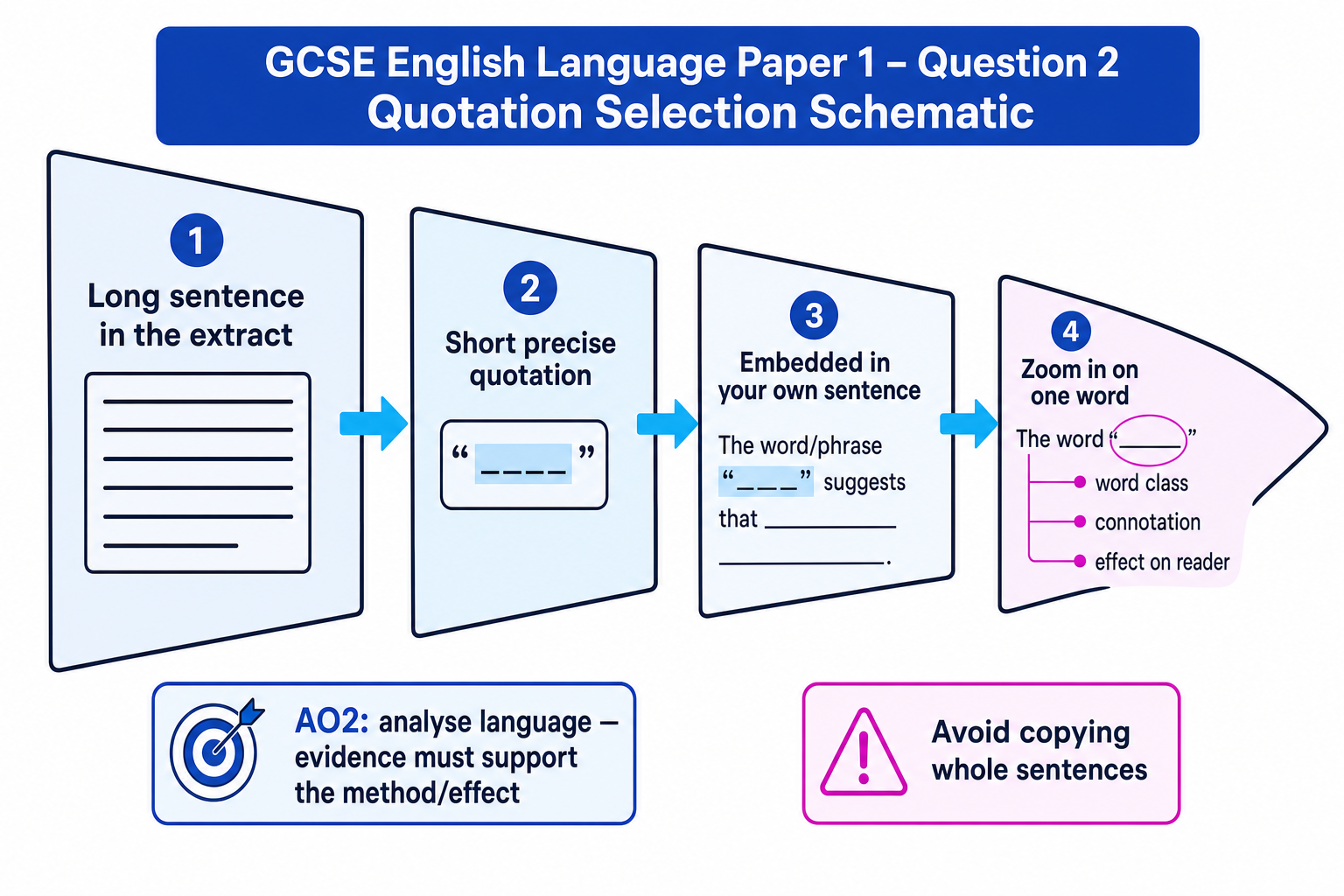
Short quotations beat long quotations
A common beginner habit is to copy a whole sentence because it feels safer. But long quotations often make your analysis weaker because the examiner has to hunt for the important word.
Instead, select the smallest part of the sentence that proves your point.
What counts as short?
A good Question 2 quotation might be:
- one word: useful for zooming in on connotations or word class
- a short phrase: useful when two or three words work together
- a short clause: useful if you need a little more context
Connotation
A connotation is an associated meaning or feeling a word suggests beyond its basic dictionary meaning. For example, a word might suggest danger, comfort, power, weakness, speed, secrecy, or beauty.
Trimming a quotation
Imagine your point is that the writer makes something seem threatening. You have underlined a long sentence in your extract, but only a small part actually creates that threatening effect.
-
First, separate information from language effect. Details that simply tell us who, where, or when are usually less useful than words that create mood, imagery, or tone.
-
Next, keep the shortest phrase that still proves the point. A phrase like “[powerful adjective] [important noun]” is usually stronger than copying the whole sentence around it, because it gives enough context while keeping attention on the writer’s choice.
-
Finally, choose one word inside that phrase to zoom in on. If “[powerful adjective]” carries the threatening feeling, your analysis can focus there instead of trying to discuss every word in the sentence.
How to spot a useful quotation
When you are choosing evidence, ask: What can I actually say about this?
The best quotations usually contain at least one of these:
1. A powerful word choice
This could be a strong verb, adjective, noun, or adverb.
Word class
A word class is the grammatical category of a word, such as noun, verb, adjective, or adverb. Use word-class terminology when it helps you explain meaning, not just to sound technical.
For example, in your real extract, you might choose:
- a verb that suggests violent movement
- an adjective that creates a gloomy atmosphere
- a noun that makes a character seem vulnerable
- an adverb that changes how an action feels
2. A language method
A language method is a deliberate technique used by the writer, such as metaphor, simile, personification, alliteration, semantic field, or imagery.
Imagery
Imagery is language that creates a picture or sensory impression in the reader’s mind. It can involve sight, sound, touch, taste, smell, or emotional atmosphere.
Do not choose a quotation just because you can name a technique. Choose it because the technique helps answer the question.
3. A sentence form
Question 2 can also reward comments on sentence forms, such as short sentences, questions, exclamations, lists, or repeated sentence patterns.
For sentence forms, you may sometimes need to quote a whole sentence — but only if it is short enough to be useful. If the sentence is long, quote the key clause and describe the sentence form around it.
Technique spotting
Do not write, “This is a metaphor, which makes it effective,” and stop there. The examiner rewards analysis of meaning and effect, not just naming a method.
Embedding quotations
To embed a quotation means to fit it smoothly into your own sentence, rather than dropping it in separately.
A dropped quotation looks like this:
quotation quotation quotationThe writer makes the place seem frightening. “
”. This is effective.
That feels clunky because the quotation is not grammatically connected to the analysis.
An embedded quotation looks more controlled:
shortquotation short quotation shortquotationThe writer makes the place seem frightening through the phrase “
”, which suggests that…
The quote becomes part of your sentence.
Embedding
Embedding is when you place a quotation inside your own sentence so that it reads grammatically and supports your point directly.
Useful embedding sentence stems
You can adapt these in the exam:
- The writer presents [focus] as [idea] through the word “[quotation]”.
- The adjective “[quotation]” suggests…
- The phrase “[quotation]” creates a sense of…
- The verb “[quotation]” implies that…
- The image of “[quotation]” makes the reader imagine…
Embedding a quotation
Suppose you have chosen a short quotation from your extract and want to use it in a paragraph.
-
Start with the effect you are arguing: The writer makes [focus] seem [idea]. This gives the quotation a clear purpose.
-
Add the quotation using a grammatical bridge: **through the phrase “
shortquotationshort quotationshortquotation” or with the adjective “
wordwordword”**. This stops the quote floating on its own.
-
Continue the same sentence with analysis: which suggests… or because it connotes…. This turns evidence into AO2 explanation, rather than leaving it as copied text.
Zooming in on individual words
Once you have embedded a short quotation, you can make your analysis stronger by zooming in.
To zoom in means choosing one important word from your quotation and exploring it closely.
You might comment on:
- its word class
- its connotations
- the mood or atmosphere it creates
- what it suggests about a character, setting, or situation
- how it affects the reader
Zoom in, do not zoom everywhere
You do not need to analyse every word in a quotation. Pick the word that does the most work and explain it in depth.
A simple zoom-in structure is:
shortquotation short quotation shortquotationThe phrase “
” creates a sense of [effect]. In particular, the [word class] “
singleword single word singleword” connotes [association], making the reader feel that [interpretation].
Zooming in on one word
You have chosen a phrase from your extract and want to analyse one word closely.
-
Identify the word doing the most meaning-work. If one adjective, verb, or noun creates the main feeling, choose that rather than discussing the whole phrase equally.
-
Connect the word to an idea. Ask what it suggests: danger, fragility, control, panic, beauty, isolation, mystery, or another relevant effect from the extract.
-
Link the word back to the question focus. Your final explanation should show how that word shapes the reader’s view of the character, setting, event, or atmosphere.
How many quotations should you use?
For an 8-mark Question 2 answer, you do not need a huge number of quotations. A sensible target is usually 2–3 well-chosen quotations, each with clear analysis.
A strong paragraph might include:
- one embedded quotation
- one zoomed-in word
- one named method if it is genuinely useful
- a clear explanation of effect
The three-word test
After underlining a possible quotation, ask: “Could I cut this down to three words or fewer and still prove my point?” If yes, cut it down.
What not to do
Avoid these habits:
- copying a full sentence when only one phrase matters
- using quotations that do not match your point
- choosing a technique but not explaining its effect
- writing a paragraph made mostly of copied words
- using a quotation without quotation marks
- changing the writer’s wording so it is no longer accurate
Quote bombing
A quote bomb is a quotation dropped into your answer without explanation. Evidence only earns marks when you analyse how the language works.
A useful paragraph shape
You do not need a rigid formula, but this shape is reliable:
- Point: Say what effect the writer creates.
- Evidence: Embed a short quotation.
- Method/word: Identify a useful language choice.
- Zoom: Analyse one important word.
- Effect: Explain what this makes the reader think, feel, or imagine.
A flexible model sentence could look like this:
The writer presents [focus] as [idea] through the phrase “[short quotation]”. The [word class] “[single word]” connotes [association], suggesting [interpretation linked to the question].
Use the frame to practise, but do not let it make your writing robotic. The best answers sound like thoughtful explanations, not memorised templates.
In the exam
-
Read the wording of Question 2 carefully and keep your evidence inside the specified lines.
-
Choose 2–3 short quotations that contain language you can actually analyse: word choice, imagery, technique, or sentence form.
-
Embed each quotation into your own sentence, then zoom in on one word and explain its effect on the reader.
Check yourself
-
Can you cut a long quotation down to the smallest phrase that still proves your point?
-
Can you embed a quotation so it fits grammatically into your own sentence?
-
Can you zoom in on one word and explain its connotations, not just name its word class?
