What you'll learn
- What Paper 2 Question 2 is really asking you to do.
- How to select relevant details from both sources.
- How to make clear inferences without drifting into language analysis.
- How to write a concise comparative summary using synthesis.
Where Question 2 fits
AQA GCSE English Language Paper 2 is called Writers’ Viewpoints and Perspectives. The whole paper lasts 1 hour 45 minutes, is worth 80 marks, and counts for 50% of the GCSE.
Question 2 sits in Section A: Reading Non-fiction. It is usually worth 8 marks and tests AO1: selecting, interpreting and synthesising information from different texts.
The main job
In Question 2, you summarise similarities or differences between the two sources. You are rewarded for choosing relevant information, making sensible inferences, and combining both sources into a clear comparison.
What “summary” means here
A summary is a short version of the most important ideas. In this question, you are not summarising everything in Source A and everything in Source B. You are summarising only the information that matches the question’s focus.
Summary
A summary is a concise account of the main relevant ideas. In Question 2, it should focus on the specific topic named in the question, such as attitudes, experiences, conditions, feelings or problems.
For example, if the question asks about differences in the writers’ attitudes to travel, details about the weather, clothing or setting only matter if they reveal something about attitude.
Retelling the whole source
Do not write a mini version of Source A followed by a mini version of Source B. Question 2 is not asking, “What happens in each source?” It is asking, “What can you understand about this specific focus across both sources?”
Explicit and implicit information
You need to work with both explicit and implicit information.
Explicit and implicit information
Explicit information is stated directly. Implicit information is suggested, so you need to infer it from details in the text.
An inference is a sensible conclusion based on evidence. It should be more than repeating the detail, but it must still be clearly supported by the source.
Moving from detail to inference
Moving from detail to inference
Suppose the question focus is about a person’s feelings during an experience.
-
Choose a relevant detail from the source, not a random one. A detail showing repeated hesitation, avoidance or reluctance is more useful than a neutral detail about the background.
-
Decide what the detail suggests. Repeated hesitation might suggest nervousness, uncertainty or lack of confidence.
-
Check which inference best fits the question focus and the rest of the source. If the source presents the person as cautious rather than terrified, “uncertain” may be more accurate than “panicked”.
-
Turn the inference into a summary point: “Source A suggests that the person feels uncertain and cautious about the experience.”
What “synthesis” means
Synthesis is one of the most important words for Question 2.
Synthesis
Synthesis means combining information from both sources to create one clear comparative idea.
Instead of treating the sources separately, you bring them together. A strong answer sounds like this:
Source A suggests…, whereas Source B presents…
That structure forces you to compare.
Use the process below as a simple way to move from reading to writing.
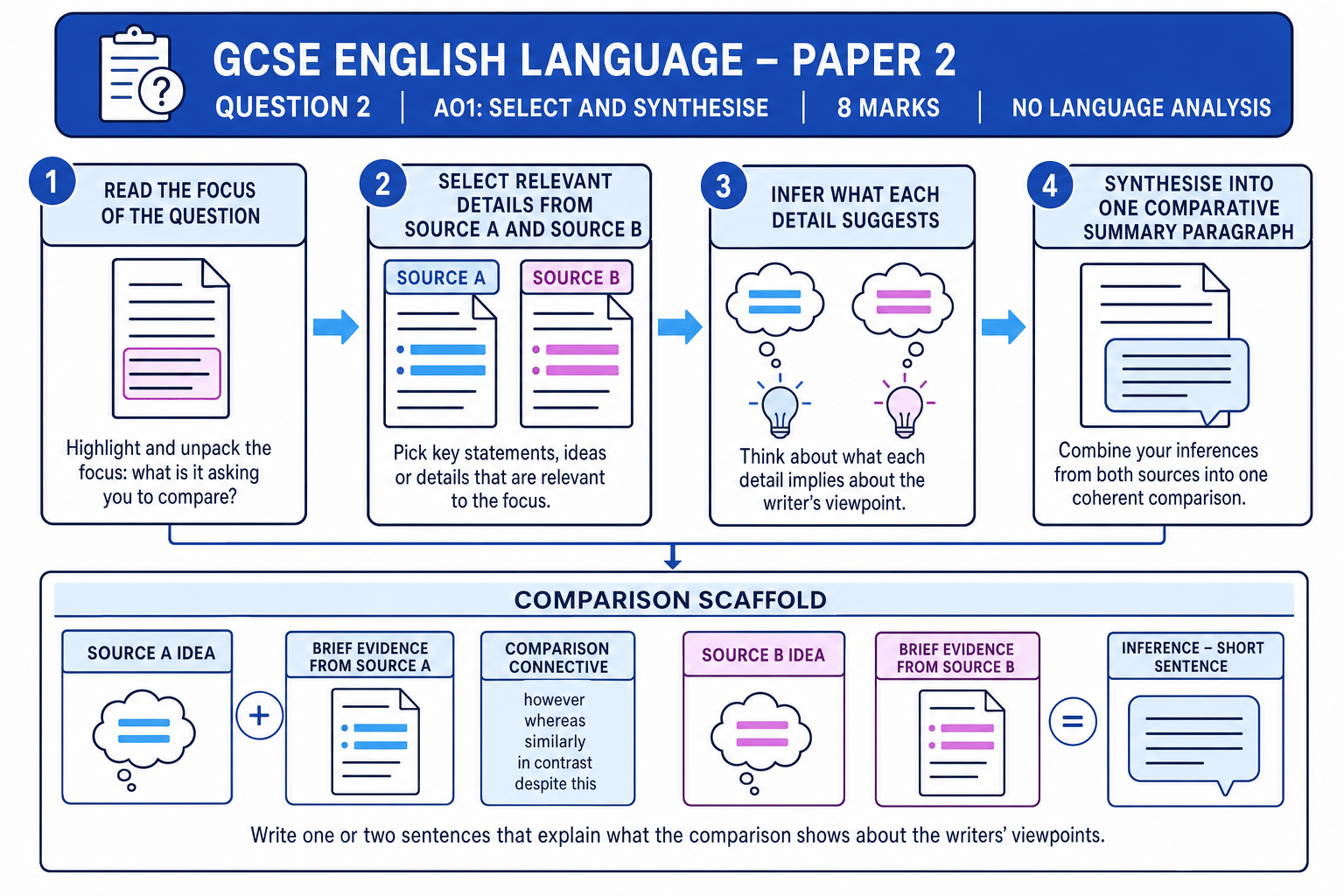
What to select
Selection means choosing details that are relevant to the question. You do not need lots of quotations. You need a few precise references from each source.
Good details might include:
- a short quotation
- a specific action
- a clear description
- a stated opinion
- a contrast in behaviour, feeling or situation
You can quote briefly, but you do not have to analyse individual words. This is not a language question.
Doing Question 2 like Question 3
Avoid writing things like “the adjective shows…” or “the metaphor creates…”. That is AO2 language analysis, which belongs mainly to Paper 2 Question 3. Question 2 rewards understanding and comparison of ideas.
How to compare clearly
A comparison explains how two things are similar or different. In Question 2, the comparison should usually be built into every paragraph.
Useful comparison connectives include:
- whereas
- while
- however
- in contrast
- unlike
- similarly
- both
- on the other hand
Best sentence starter
A reliable sentence pattern is: “Source A suggests…, whereas Source B suggests…” It keeps both sources in the same sentence and makes the comparison clear.
A simple paragraph structure
For an 8-mark answer, aim for about two developed comparative paragraphs. Each paragraph can follow this pattern:
- Make a comparative point.
- Support Source A with a relevant detail.
- Support Source B with a relevant detail.
- Explain what the comparison shows.
You do not need a long introduction or conclusion.
Turning notes into a comparative summary
Turning notes into a comparative summary
Imagine you have made notes from the actual exam sources. Your notes should contain brief details from both texts, not full copied sections.
-
Start with the focus of the question. If it asks about differences in attitudes, reject details that only describe events and keep details that reveal feelings, opinions or reactions.
-
Pair the sources by idea. For example, you might group one Source A detail showing confidence with one Source B detail showing uncertainty. This creates a direct contrast.
-
Turn each detail into an inference. Source A may suggest a positive or secure attitude, while Source B may suggest anxiety, discomfort or doubt.
-
Write the comparison in one linked sentence: “Source A presents the experience as [inference from Source A], shown by [brief detail from Source A], whereas Source B presents it as [inference from Source B], shown by [brief detail from Source B].”
-
Add a short summary comment: “Overall, the two sources differ because Source A makes the experience seem [overall idea], while Source B makes it seem [contrasting overall idea].”
What a strong answer sounds like
A strong Question 2 answer is:
- focused on the wording of the question
- comparative throughout
- supported by details from both sources
- based on inference, not just copied information
- concise and clear
A weaker answer often:
- discusses only one source
- gives lots of quotations with little explanation
- analyses language methods instead of summarising ideas
- writes about irrelevant parts of the texts
- makes vague comments like “they are different” without explaining how
Think in pairs
For each point you make, try to pair one detail from Source A with one detail from Source B. The pair should help you explain a similarity or difference.
How much should you write?
Question 2 is only worth 8 marks, so keep it controlled. Usually, two comparative paragraphs are enough if they are precise.
A useful rough plan is:
- Paragraph 1: first clear similarity or difference
- Paragraph 2: second clear similarity or difference
If the question asks for differences, keep your focus on contrast. If it asks for similarities, keep your focus on what the sources share, while still noticing small distinctions if helpful.
Mini checklist for each paragraph
Before moving on, ask:
- Have I mentioned both sources?
- Have I used a comparison word?
- Have I included relevant evidence or detail?
- Have I made an inference?
- Have I avoided language analysis?
In the exam
-
Spend a moment underlining the exact focus of the question, such as attitudes, feelings, experiences or conditions.
-
Select two or three useful details from each source, then pair them into similarities or differences before you write.
-
Write concise comparative paragraphs using phrases such as “whereas”, “similarly” and “in contrast”; do not waste time analysing language techniques.
Check yourself
- Can you explain the difference between summary and language analysis?
- Can you turn one detail from a source into a sensible inference?
- Can you write one sentence that compares Source A and Source B directly?
