What you'll learn
- What AQA Paper 1 Question 2 is really asking you to do.
- How to analyse words, phrases, imagery, tone and sentence forms.
- How to explain why a writer has chosen a word or technique.
- How to build a clear paragraph that targets AO2.
Where Question 2 fits
AQA GCSE English Language has two papers. Each paper is 1 hour 45 minutes, worth 80 marks and 50% of the GCSE. Paper 1 Section A is the fiction reading section, and every question is compulsory.
Question 2 is worth 8 marks. It focuses on AO2, which rewards you for analysing how writers use language and structure to create effects and influence readers. In Question 2, the focus is specifically language.
You will usually be asked something like:
How does the writer use language here to describe…?
The question may remind you to write about:
- words and phrases
- language features and techniques
- sentence forms
The main job
Question 2 is not a “spot the technique” question. It rewards you for explaining how the writer’s language choices create meaning and affect the reader.
What “language analysis” means
Language analysis
Language analysis means looking closely at a writer’s word choices, phrases and techniques, then explaining how they create meaning, mood, tone or reader response.
A reader response is what the language makes the reader think, feel, imagine or understand. For example, language might make a character seem threatening, a setting feel peaceful, or a moment seem tense.
Your answer should keep returning to the exact focus of the question. If the question asks how the writer describes a place as dangerous, every point should connect to danger, threat, fear, risk or uncertainty.
Start with words before techniques
The smallest useful unit in language analysis is often a single word. A word class is the grammatical category a word belongs to. You do not need to label every word, but accurate terminology can help if you use it meaningfully.
Important word classes for Question 2 include:
- A noun: a naming word for a person, place, thing or idea.
- A verb: a doing, being or action word.
- An adjective: a word that describes a noun.
- An adverb: a word that describes how, when or where an action happens.
Powerful verb
A powerful verb is a precise action word that creates a strong impression, rather than a vague verb such as “went”, “did” or “said”.
For example, a character who “stumbles” does not seem the same as a character who “marches”. One suggests weakness, panic or loss of control; the other suggests confidence, purpose or aggression.
Zooming in on a verb
- Compare the movement suggested by two possible verbs, such as “walked” and “crept”. “Walked” is neutral, while “crept” suggests slow, careful and possibly secretive movement.
- Connect that choice to meaning. If a character “crept”, the writer may be making them seem frightened, guilty, sneaky or vulnerable, depending on the context.
- Explain the reader effect. The reader may feel suspense because the verb implies the character is trying not to be noticed.
Using terminology instead of analysis
Do not write, “The writer uses a verb” and stop there. The mark comes from explaining what that verb suggests and why it matters.
Connotations: the heart of close analysis
Connotations
Connotations are the ideas, feelings or associations a word suggests beyond its literal meaning.
For example, “home” and “house” can refer to a place where someone lives, but “home” often has warmer connotations of comfort, belonging and safety.
In Question 2, connotations help you move from “what the word means” to “what the word makes the reader think or feel”.
A useful sentence frame is:
The word “_____” suggests _____ because it has connotations of _____, making the reader feel/think _____.
The because test
If your sentence does not include or imply “because”, your analysis may be too thin. Strong AO2 answers explain the reason behind the effect.
Imagery and figurative language
Imagery
Imagery is language that creates a picture or sensory impression in the reader’s mind.
Imagery often uses figurative language, which means language that is not meant completely literally. The writer uses comparison or imagination to help the reader understand something more vividly.
Simile
Simile
A simile compares one thing to another using “like” or “as”.
A simile helps the reader understand one thing by comparing it to something more familiar, striking or surprising.
Metaphor
Metaphor
A metaphor describes something as if it is something else, without using “like” or “as”.
Metaphors can make an idea feel stronger because the comparison is more direct.
Personification
Personification
Personification gives human actions, feelings or qualities to something non-human.
A writer might personify weather, a building, darkness or a landscape to make it seem alive, threatening, comforting or powerful.
Analysing imagery
- Identify what two ideas are being connected. For instance, if a description makes a place seem like a living creature, the writer is linking the setting with life, movement or intention.
- Decide what the comparison suggests. A living creature might seem watchful, dangerous, protective or unpredictable, depending on the surrounding language.
- Link the effect to the question. If the question focuses on tension, you could explain that the imagery makes the setting feel active and threatening, so the reader feels uneasy.
Sensory language
Sensory language
Sensory language appeals to the five senses: sight, sound, smell, taste and touch.
In fiction, sensory language helps the reader experience the scene rather than just understand it. It can make a setting feel realistic, intense or uncomfortable.
Common effects include:
- sight creating vivid visual detail
- sound building tension or calm
- smell suggesting decay, freshness or memory
- touch creating discomfort, warmth or danger
- taste adding physical closeness or disgust
Semantic fields
Semantic field
A semantic field is a group of words connected by meaning.
For example, several words linked to violence, nature, religion, illness or childhood can work together to build an overall impression.
Do not just say, “There is a semantic field of danger.” Name the pattern, give evidence, and explain the combined effect.
Explaining a semantic field
- Group related words from the extract by meaning, such as words connected to violence, decay or innocence.
- Ask what atmosphere that group creates. A semantic field of violence may make a setting feel hostile or unsafe.
- Explain the cumulative effect. Because several words point in the same direction, the reader receives a repeated impression rather than a one-off detail.
Contrast and repetition
Contrast
Contrast is when a writer places different ideas, images or feelings near each other to highlight their differences.
Contrast can make a change feel sharper. For example, calm language beside violent language can make the violence seem more shocking.
Repetition
Repetition is when a word, phrase, sound or idea is used more than once.
Repetition can create emphasis, rhythm, obsession, panic or inevitability. The key is to explain what is being repeated and why that matters.
Tone
Tone
Tone is the attitude or emotional colouring created by the writer’s language.
Tone might be tense, nostalgic, threatening, playful, bitter, calm, mysterious or fearful. In Question 2, you should link tone to specific language choices, not just assert it.
For example:
The negative adjectives create a threatening tone because they make the setting seem hostile rather than welcoming.
Sentence forms in Question 2
AQA may invite you to comment on sentence forms. This means the shape of individual sentences, not the whole structure of the extract.
Useful ideas include:
- A short sentence can feel blunt, dramatic or final.
- A longer sentence can build detail, flow, confusion or breathlessness.
- A simple sentence contains one main idea.
- A complex sentence contains a main idea plus extra detail, often creating layering or delay.
- A sentence fragment is an incomplete sentence used deliberately for impact.
Do not drift into Question 3
In Question 2, avoid writing mainly about shifts across the whole extract, openings, endings or narrative perspective. Those are more likely to belong in Question 3 on structure. Stay focused on local language choices.
Building a strong Question 2 paragraph
A strong paragraph usually does four things:
- Makes a clear point about the effect.
- Uses a short quotation as evidence.
- Identifies a method or word class if useful.
- Zooms in on connotations and links back to the question.
This diagram shows a simple way to build a language analysis paragraph.
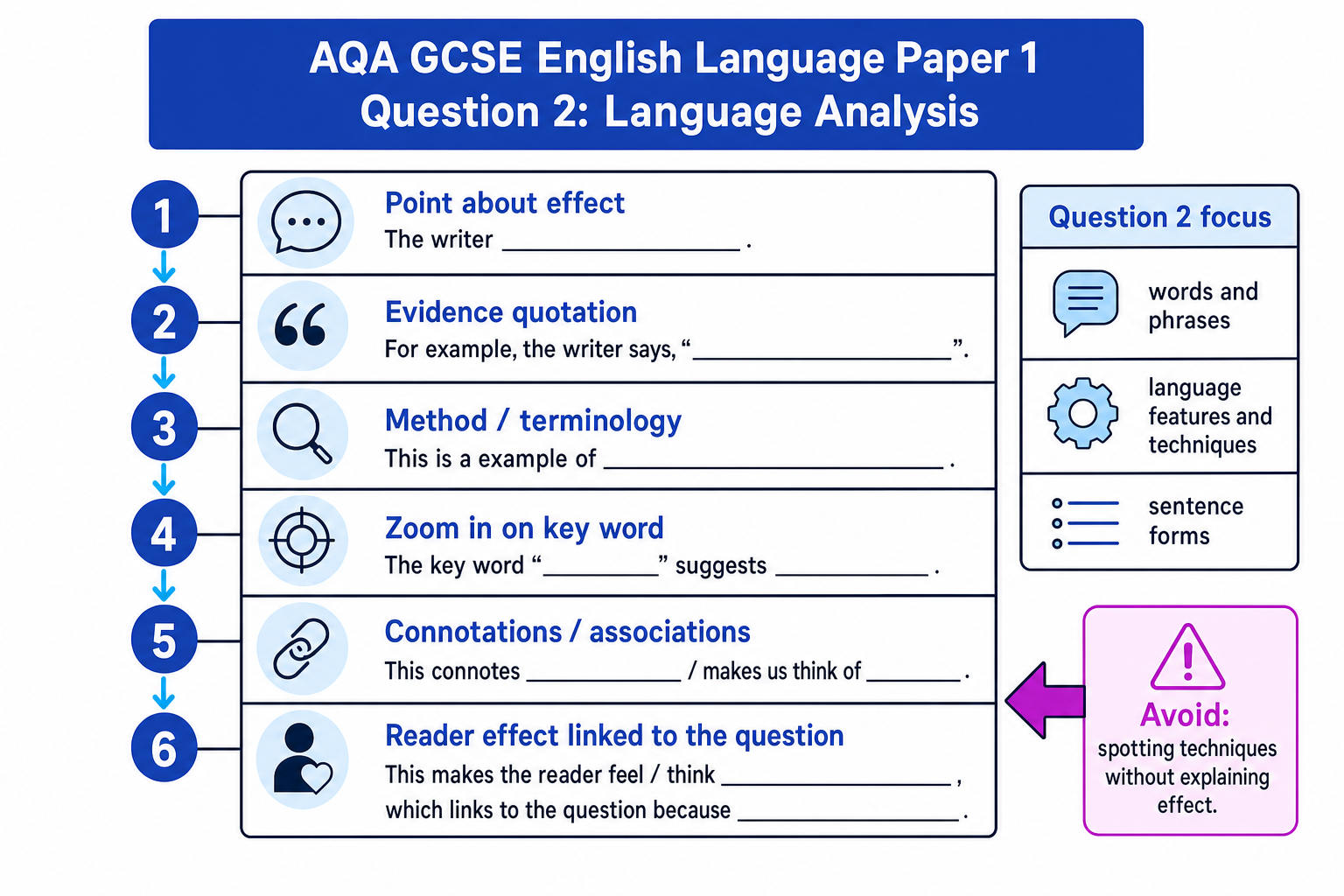
Building a language analysis paragraph
- Start with the effect you want to prove: “The writer makes the setting seem threatening.”
- Choose a short quotation that strongly supports that idea, preferably one with a powerful verb, adjective, image or repeated pattern.
- Zoom in on one key word from the quotation and explain its connotations.
- Name a technique only if it helps your explanation, such as metaphor, personification or semantic field.
- Link back to the reader: “This makes the reader feel uneasy because the description suggests danger is present before anything has actually happened.”
Useful sentence stems
You can adapt these in the exam:
- The writer presents _____ as _____ through the word/phrase “_____”.
- The adjective/verb/adverb “_____” suggests _____.
- This has connotations of _____, which makes the reader think/feel _____.
- The image of _____ implies _____.
- This creates a _____ tone because _____.
- The repeated references to _____ build a sense of _____.
- This links to the question because _____.
Writing about the quote as if it is real life
Avoid saying only, “This shows the character is scared.” Instead, write about the writer’s choice: “The verb suggests fear because…” You are analysing crafted language, not just describing events.
In the exam
- Spend about 10 minutes on Question 2, because it is worth 8 marks.
- Make 2–3 developed points rather than listing lots of techniques.
- Use short quotations and zoom in on one or two important words.
- Always explain connotations, effect and reader response.
- Keep linking back to the wording of the question.
Check yourself
- Can you explain the difference between spotting a technique and analysing its effect?
- Can you zoom in on one word and discuss its connotations?
- Can you write a paragraph that links quotation, method, meaning and reader response?
