What you'll learn
- What the Paper 1 Section A fiction source usually looks like.
- How to identify voice, viewpoint, character, setting, atmosphere, mood, tension, conflict and turning points.
- How the four reading questions fit together.
- A simple reading routine you can use on any unseen extract.
The big picture: Paper 1 Section A
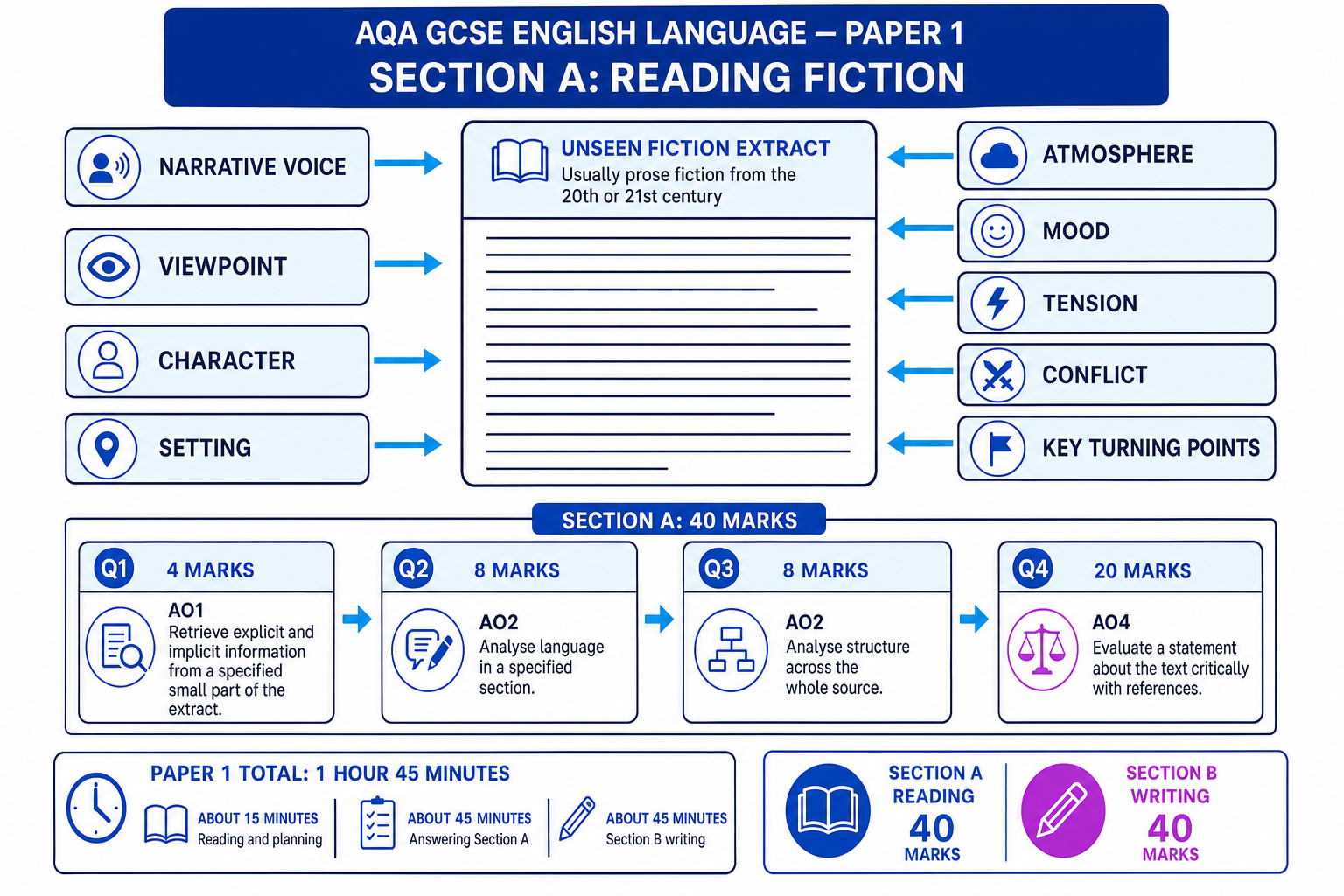
AQA GCSE English Language Paper 1 is called Explorations in Creative Reading and Writing. The whole paper is 1 hour 45 minutes, worth 80 marks and 50% of the GCSE.
Paper 1 has two sections:
- Section A: Reading — 40 marks, based on one unseen fiction extract.
- Section B: Writing — 40 marks, split into 24 marks for content and organisation and 16 marks for technical accuracy.
Every question is compulsory. There are no optional routes, so your job is to build a reliable method you can use on any extract.
Unseen fiction extract
An unseen fiction extract is a short piece of fictional prose you have not studied before. Fiction means imagined writing, usually from a novel or short story. Prose means written in ordinary sentences and paragraphs, not poetry or a play script.
The source will usually be prose fiction from the 20th or 21st century. It may include openings, endings, narrative perspectives, points of view, descriptive passages, character, setting and atmosphere.
This overview map shows what you are looking for as you read and how the four questions connect.
Your main job
You are not just reading for “what happens”. You are reading for how the writer shapes your response: whose viewpoint you follow, what information is revealed or withheld, where the focus shifts, and how the mood changes.
Start with the story basics
Before you analyse techniques, make sure you understand the situation.
Ask yourself:
- Who is involved?
- Where and when is the scene set?
- What is happening on the surface?
- What seems wrong, tense, unusual or important?
- How does the extract change from beginning to end?
This first understanding supports all four reading questions. If you misunderstand the basic situation, your analysis can become vague or inaccurate.
Narrative voice and viewpoint
Narrative voice
Narrative voice means the voice telling the story. It includes who is speaking, how close they are to the events, and what kind of personality or attitude comes through in the telling.
The narrator is the voice telling the story. The narrator might be a character inside the story, or an outside voice describing events.
Viewpoint
Viewpoint, also called perspective, means the position from which the reader sees events. It affects what we know, what we do not know, and how close we feel to a character.
Common viewpoints include:
- First-person narration — the narrator uses “I” or “we” and is usually part of the story.
- Third-person narration — the narrator uses “he”, “she”, “they” or names.
- Limited viewpoint — we mainly follow one character’s thoughts or experiences.
- Omniscient viewpoint — the narrator seems able to know more than one character’s thoughts, feelings or background.
Classifying viewpoint
-
Decide whether the narrator is inside or outside the events. If the narration is built around “I” or “we”, it is likely to be first person; if it uses names or “he/she/they”, it is likely to be third person.
-
Check how much access the reader gets to thoughts and feelings. If the narration only reveals one character’s inner experience, the viewpoint is limited; if it moves between several minds, it may be omniscient.
-
Link the viewpoint to the reader’s experience. A first-person or limited viewpoint can create closeness, bias or uncertainty because we only see what that narrator or character notices.
Narrator is not always the writer
Do not write as if the narrator and writer are automatically the same person. Say “the narrator” when you mean the voice telling the story, and “the writer” when you mean the person crafting methods and effects.
Character and characterisation
Characterisation
Characterisation is the way a writer creates and develops a character. This can happen through description, actions, dialogue, thoughts, reactions from others, and the character’s role in the plot.
When reading an unseen fiction extract, do not just label a character as “nice”, “scared” or “evil”. Instead, ask how the writer makes you infer that.
Look for:
- what the character does
- what they say
- how they move or react
- what they notice
- what other characters think of them
- whether they change during the extract
A strong answer often moves from evidence to inference. An inference is a sensible conclusion based on clues, rather than something stated directly.
Setting, atmosphere and mood
Setting
Setting means where and when the story takes place. This includes location, time period, weather, time of day, social environment and physical surroundings.
Setting is rarely just background. In fiction, it often shapes the reader’s expectations. A cramped room, an empty street, a bright kitchen or a stormy landscape can all influence how we interpret the scene.
Atmosphere and mood
Atmosphere is the overall feeling created by a place or scene. Mood is the emotional tone of the writing or the feeling encouraged in the reader.
Atmosphere and mood are closely linked. For example, a setting might create an oppressive atmosphere, which then gives the reader an anxious mood.
Linking setting to atmosphere
-
Identify the kind of setting details being emphasised, such as light, sound, weather, space, objects or movement.
-
Consider the associations of those details. Darkness may suggest secrecy or fear; silence may suggest emptiness, isolation or suspense; crowded spaces may suggest pressure or lack of control.
-
Connect those associations to the scene. If the writer repeatedly focuses on restrictive or threatening details, you can argue that the setting helps create an uneasy atmosphere.
-
Add the effect on the reader. The setting may make us expect danger, sympathise with a character, or feel that something is about to change.
Use precise mood words
Instead of always writing “tense” or “scary”, try words like uneasy, claustrophobic, melancholic, foreboding, isolated, chaotic, calm, nostalgic or threatening — but only when they genuinely fit the extract.
Tension, conflict and turning points
Tension
Tension is the feeling of pressure, suspense or uncertainty that makes the reader want to know what will happen next.
Writers can build tension by delaying information, narrowing the focus, using short sentences, introducing danger, creating unanswered questions, or showing a character under pressure.
Conflict
Conflict is a struggle or problem. It can be external, such as an argument or physical danger, or internal, such as guilt, fear, confusion or divided loyalties.
Conflict does not have to mean a dramatic fight. In fiction, a quiet disagreement, a hidden secret or a character’s private fear can be just as important.
Key turning point
A key turning point is a moment where the extract changes direction. This might be a new piece of information, a shift in mood, a change of focus, a decision, an interruption, or a sudden escalation.
Spotting a turning point
-
Divide the extract into rough phases: beginning, middle and end. Ask what each phase mainly focuses on, such as setting, character, action, memory or dialogue.
-
Find the moment where something changes. This could be where the pace speeds up, the focus moves to a new character, the mood darkens, or new information is revealed.
-
Compare the situation before and after that moment. If the reader’s understanding, the character’s emotions, or the level of danger has shifted, you have probably found a turning point.
-
Explain its significance. For example: “At this point, the focus shifts from description to conflict, so the reader begins to anticipate consequences rather than simply observe the setting.”
How the four Section A questions work
Paper 1 Section A uses different skills. The questions are designed to move from basic understanding to detailed analysis and evaluation.
| Question | Marks | Main focus | What it rewards |
|---|---|---|---|
| Q1 | 4 | AO1 | Identifying explicit and implicit information from a specified part of the source |
| Q2 | 8 | AO2 | Analysing language choices in a specified section |
| Q3 | 8 | AO2 | Analysing structure across the whole source |
| Q4 | 20 | AO4 | Evaluating a statement about the text using critical judgement and references |
AO1 is about understanding and selecting information. AO2 is about analysing how language and structure create meanings and effects. AO4 is about evaluating how far you agree with an idea about the text and supporting your judgement.
Section B uses AO5 and AO6 for writing. AO3, comparison, is assessed in Paper 2, not Paper 1 Section A.
Feature spotting
Do not just name techniques, such as “simile”, “short sentence” or “semantic field”. AQA rewards you for explaining how the writer’s choice shapes meaning, mood, character or tension.
A simple reading routine
Use your first read to understand the story, not to hunt for impressive terminology.
A good routine is:
- Read the source information and opening carefully so you know the basic context.
- Read the whole extract once to understand what happens.
- On a second pass, lightly mark changes in focus, mood, tension or character.
- For each question, stay within the correct section of the source.
- Choose evidence because it helps your idea, not because it contains a fancy technique.
Three anchor questions
When you feel stuck, return to: What changes? How does the writer create that change? Why does it affect the reader?
The full technique: meaning first, methods second
The best reading answers usually follow this order:
- Meaning — what is being shown or suggested?
- Method — what choice has the writer made?
- Effect — how does that choice influence the reader’s understanding or feelings?
A useful sentence frame is:
The writer presents [idea/character/mood] as [interpretation]. This is shaped by [method or evidence], which suggests [effect/meaning]. As a result, the reader is encouraged to [response].
You do not need to force terminology into every sentence. A precise explanation of effect is better than a list of techniques with no interpretation.
In the exam
-
Spend about 15 minutes reading and thinking before you write: understand the situation, mood and main shifts.
-
Keep each answer focused on the question’s section of the source: Q1 and Q2 usually specify a smaller area, Q3 uses the whole source, and Q4 gives a statement to evaluate.
-
For Q2, Q3 and Q4, always connect evidence to effect: explain how the writer shapes character, setting, atmosphere, tension, conflict, mood or viewpoint.
Check yourself
-
Can you explain the difference between narrative voice and viewpoint?
-
Can you identify a possible turning point in an unseen extract and explain what changes there?
-
Can you name which Paper 1 Section A question asks you to evaluate a statement about the text?
