What you'll learn
- What “technical accuracy” means in AQA GCSE English Language writing.
- How punctuation, spelling, grammar, vocabulary and sentence control affect your marks.
- How to use sentence variety for clarity, purpose and effect.
- How to proofread quickly in Paper 2 Section B.
The big picture: where technical accuracy fits
In AQA GCSE English Language, both papers are 1 hour 45 minutes long, worth 80 marks each, and each paper is worth 50% of the GCSE.
Paper 2 Section B is the viewpoint writing task. You write for a specific form such as a letter, article, speech, essay or leaflet, usually giving a clear opinion on an issue.
The writing task is worth 40 marks:
- 24 marks for content and organisation — this is AO5.
- 16 marks for technical accuracy — this is AO6.
Technical accuracy
Technical accuracy means using vocabulary, sentence structures, spelling, punctuation and grammar accurately and effectively so your writing is clear, fluent and controlled.
Technical accuracy is not just “getting commas right”. It is about control. The examiner asks: can you shape sentences deliberately, spell accurately, punctuate clearly and choose words that suit your purpose and audience?
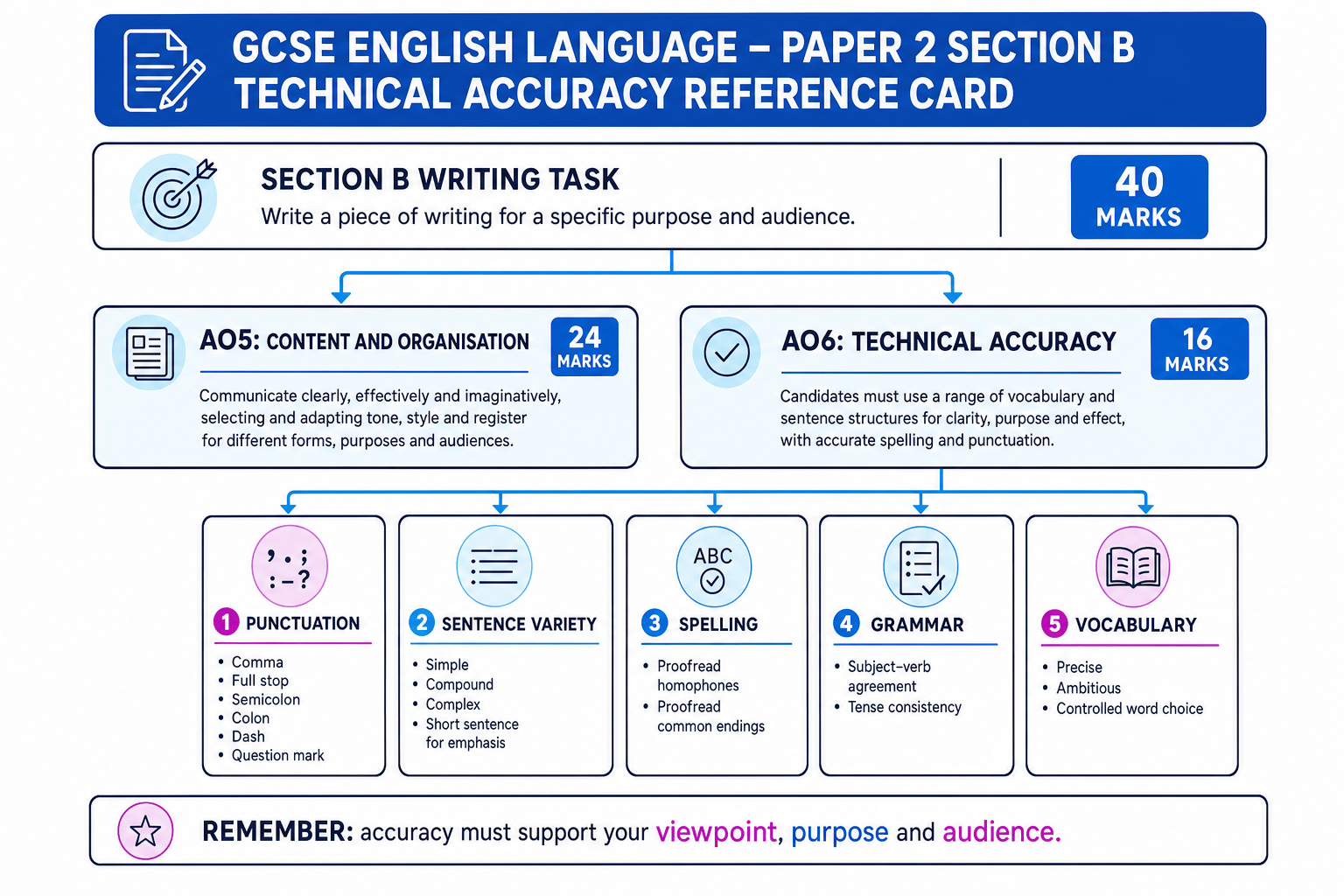
Accuracy supports meaning
The best technical accuracy is almost invisible: it helps the examiner follow your argument smoothly, trust your voice, and feel the force of your viewpoint.
Start with the basics: sentence control
A sentence is a complete unit of meaning. It usually contains a subject — the person, place or thing doing something — and a verb — the action or state.
A sentence must make sense on its own.
- Complete sentence: Young people deserve safer public spaces.
- Incomplete fragment: Because young people deserve safer public spaces.
The fragment begins with because, so the reader expects another idea to complete it.
Sentence control
Sentence control means shaping complete, clear sentences and varying their length and structure to suit your purpose.
Main clauses and subordinate clauses
A clause is a group of words containing a verb.
A main clause makes sense on its own:
- The council should invest in youth centres.
A subordinate clause adds extra information but does not usually make sense alone:
- because many teenagers have nowhere safe to go
Together, they create a complete sentence:
- The council should invest in youth centres because many teenagers have nowhere safe to go.
Fixing a sentence fragment
- Identify whether the sentence makes complete sense: “Because online abuse can affect mental health.” This feels unfinished because because introduces a reason.
- Decide what main idea the reason supports: the writer wants to argue that social media companies should act.
- Add a main clause to complete the meaning: “Social media companies must take stronger action because online abuse can affect mental health.”
The accidental fragment
Do not leave a subordinate clause standing alone in formal viewpoint writing unless you are using it deliberately for rhetorical effect. In most cases, fragments look uncontrolled rather than powerful.
Use a range of sentence structures
For AO6, AQA rewards “a range of vocabulary and sentence structures”. That does not mean every sentence must be long or complicated. It means you can use different sentence types for different effects.
Simple sentences
A simple sentence has one main clause.
- This must change.
Simple sentences are useful for clear, forceful points.
Compound sentences
A compound sentence joins two main clauses, often using a coordinating conjunction such as and, but or so.
- The problem is growing, but the response remains too slow.
Complex sentences
A complex sentence contains a main clause and at least one subordinate clause.
- Although many people ignore the issue, it affects families across the country.
Complex sentences help you explain relationships between ideas, such as contrast, cause, consequence or condition.
Choosing sentence structures for effect
- Start with the viewpoint: schools should teach financial education.
- Use a complex sentence to show contrast: “Although students learn many valuable subjects, too many leave school without understanding tax, debt or budgeting.”
- Follow with a short simple sentence for emphasis: “That is not good enough.”
- Add a compound sentence to develop the argument: “Financial education would build confidence, and it would prepare young people for real adult decisions.”
Simple does not mean basic
A short sentence can be sophisticated if it is placed deliberately after a longer sentence. Variety matters more than constant complexity.
Punctuation: guide the reader
Punctuation is the system of marks that shows how writing should be read. It separates ideas, controls pace and prevents confusion.
The most important marks for GCSE writing are:
- Full stop — ends a sentence.
- Comma — separates parts of a sentence.
- Colon — introduces an explanation, example or list.
- Semicolon — links closely related main clauses.
- Dash — adds emphasis or interruption.
- Question mark — ends a direct question.
- Exclamation mark — shows strong emotion, but should be used sparingly.
Semicolon
A semicolon links two complete sentences that are closely connected in meaning. Both sides must be able to stand alone.
Correct:
- Public transport is essential; not everyone can afford a car.
Incorrect:
- Public transport is essential; because not everyone can afford a car.
The second half is not a complete sentence.
Improving punctuation for clarity
- Begin with an unclear sentence: “We need better parks they give children somewhere safe to play they also improve health.”
- Find the separate complete ideas: “We need better parks”, “they give children somewhere safe to play”, and “they also improve health.”
- Use punctuation to show the relationship between ideas: “We need better parks: they give children somewhere safe to play, and they also improve health.”
- Check the effect: the colon introduces the explanation, and the comma before and helps manage the longer second part.
Comma splicing
A comma splice happens when two complete sentences are joined with only a comma: “The issue is urgent, we must act now.” Use a full stop, semicolon, colon or conjunction instead.
Grammar: make the writing sound secure
Grammar is the way words are arranged to create meaning. In exams, grammar accuracy helps your writing sound confident and credible.
Two key areas to control are agreement and tense.
Subject-verb agreement
Subject-verb agreement means the subject and verb match.
- Correct: The government is responsible.
- Correct: Politicians are responsible.
- Incorrect: The government are responsible — in formal exam writing, this can sound less controlled.
Tense consistency
Tense shows time: past, present or future.
If you are arguing about a current issue, you will usually write mainly in the present tense:
- Many families struggle with rising costs.
- This places pressure on children.
- The situation demands action.
Correcting grammar for control
- Read the sentence for agreement and tense: “Many teenager is feeling ignored and the problem got worse every year.”
- Match the plural subject teenagers with a plural verb: “Many teenagers are feeling ignored…”
- Keep the tense consistent by using the present tense for an ongoing issue: “…and the problem gets worse every year.”
- Final controlled version: “Many teenagers are feeling ignored, and the problem gets worse every year.”
Vocabulary: precise, ambitious, controlled
Vocabulary means your choice of words. For AO6, strong vocabulary is not about using the longest words you know. It is about choosing words that fit your viewpoint, audience and purpose.
A register is the level of formality in your writing. A letter to a local council needs a more formal register than a speech to classmates.
Weak or vague:
- This thing is really bad.
More precise:
- This policy is unfair, short-sighted and damaging.
Ambitious but controlled:
- This policy is unfair, short-sighted and damaging because it punishes families who are already under pressure.
Making vocabulary more precise
- Start with a vague sentence: “Lots of people think the new rule is bad.”
- Replace lots of people with a more precise group: “Many residents…”
- Replace bad with a word that shows the nature of the criticism: “unreasonable” or “unfair”.
- Add a reason to anchor the vocabulary in meaning: “Many residents believe the new rule is unfair because it affects those who rely on public transport.”
Do not force impressive words
If a word sounds awkward, unclear or inaccurate, it can damage AO6. Examiners reward controlled vocabulary, not random complexity.
Spelling: protect your credibility
Spelling matters because repeated errors can distract the examiner and weaken the authority of your writing.
You do not need perfect spelling to do well, but you should proofread for common errors, especially:
- Homophones: there / their / they’re, your / you’re, to / too / two.
- Common endings: -tion, -sion, -able, -ible.
- Frequently used argument words: government, environment, necessary, definitely, responsibility, opportunity.
Build a personal error list
After practice essays, keep a short list of words you personally misspell. Revising your own repeated errors is much more useful than memorising random spelling lists.
Technical accuracy in viewpoint writing
Paper 2 Section B is not just testing neat sentences in isolation. Your accuracy must help you persuade, explain, argue or advise.
A strong paragraph usually combines:
- A clear viewpoint.
- Controlled sentence structures.
- Accurate punctuation.
- Precise vocabulary.
- A tone suited to the audience and form.
Building a technically controlled viewpoint paragraph
- Begin with a clear topic sentence: “Local libraries should be protected because they offer far more than books.”
- Add a complex sentence to develop the point: “While some people see them as outdated, libraries provide internet access, study space and support for people who may feel isolated.”
- Use a colon to introduce a sharper explanation: “Their value is simple: they give communities a shared space to learn, connect and grow.”
- End with a controlled persuasive sentence: “Closing them would not be progress; it would be a failure of imagination.”
Notice that the paragraph is not overloaded with punctuation. It uses enough variety to sound fluent, but every choice supports the argument.
Proofreading: the final marks saver
You should aim to leave a few minutes at the end of the writing task to proofread. You are not rewriting the whole answer. You are checking for errors that are quick to fix.
Focus on:
- Sentence boundaries — have you used full stops properly?
- Commas — have you avoided comma splices?
- Spellings — especially repeated key words.
- Apostrophes — are they used for possession or contraction?
- Tense and agreement — do your verbs match your subjects?
In the exam
- Plan your viewpoint first, then write with control: clear ideas make accurate sentences easier.
- Use a mixture of simple, compound and complex sentences, but prioritise clarity over showing off.
- Punctuate deliberately: full stops secure meaning; colons, semicolons and dashes should only be used when you know why they fit.
- Match your vocabulary and register to the form, audience and purpose of the task.
- Save a few minutes to proofread for sentence boundaries, homophones, tense consistency and repeated spelling mistakes.
Check yourself
- Can you explain the difference between AO5 and AO6 in the 40-mark writing task?
- Can you write one simple, one compound and one complex sentence on the same viewpoint?
- Can you spot and correct a comma splice in your own writing?
