What you'll learn
- What an essay should look and sound like in GCSE English Language.
- How to write a clear introduction, strong topic sentences and a developed argument.
- How to include balanced reasoning and a counterargument without losing your own viewpoint.
- How to finish with a purposeful conclusion and gain marks for AO5 and AO6.
Where this fits in AQA GCSE English Language
This skill belongs to Paper 2 Section B: Viewpoint Writing. In AQA GCSE English Language 8700, each paper lasts 1 hour 45 minutes, each paper is worth 80 marks, and each paper counts for 50% of the GCSE.
In Section B, the writing task is worth 40 marks: 24 marks for AO5 — clear communication, content and organisation — and 16 marks for AO6 — vocabulary, sentence structures, spelling and punctuation. Every question is compulsory, so if the task asks for an essay, you need to use essay form confidently.
Essay
An essay is a sustained piece of writing that explores an issue, develops a clear line of argument and reaches a reasoned conclusion.
What makes an essay different?
A form is the type of text you are writing, such as a letter, speech, article or essay. Each form has its own conventions: expected features that make it recognisable.
An essay usually has:
- An introduction that sets up your viewpoint.
- Clear paragraphs, each focused on one main idea.
- Topic sentences to guide the reader.
- Developed explanation and reasoning.
- Some balance, including a possible opposing view.
- A conclusion that gives a final judgement.
It usually does not need the features of other forms: no “Dear Sir/Madam”, no sign-off, no speech-style greeting, and no newspaper headline unless the task specifically asks for one.
Essay form
An essay is not just “writing your opinion”. It is your opinion organised into a clear, logical argument.
Here is a simple structure you can adapt for most GCSE viewpoint essays:
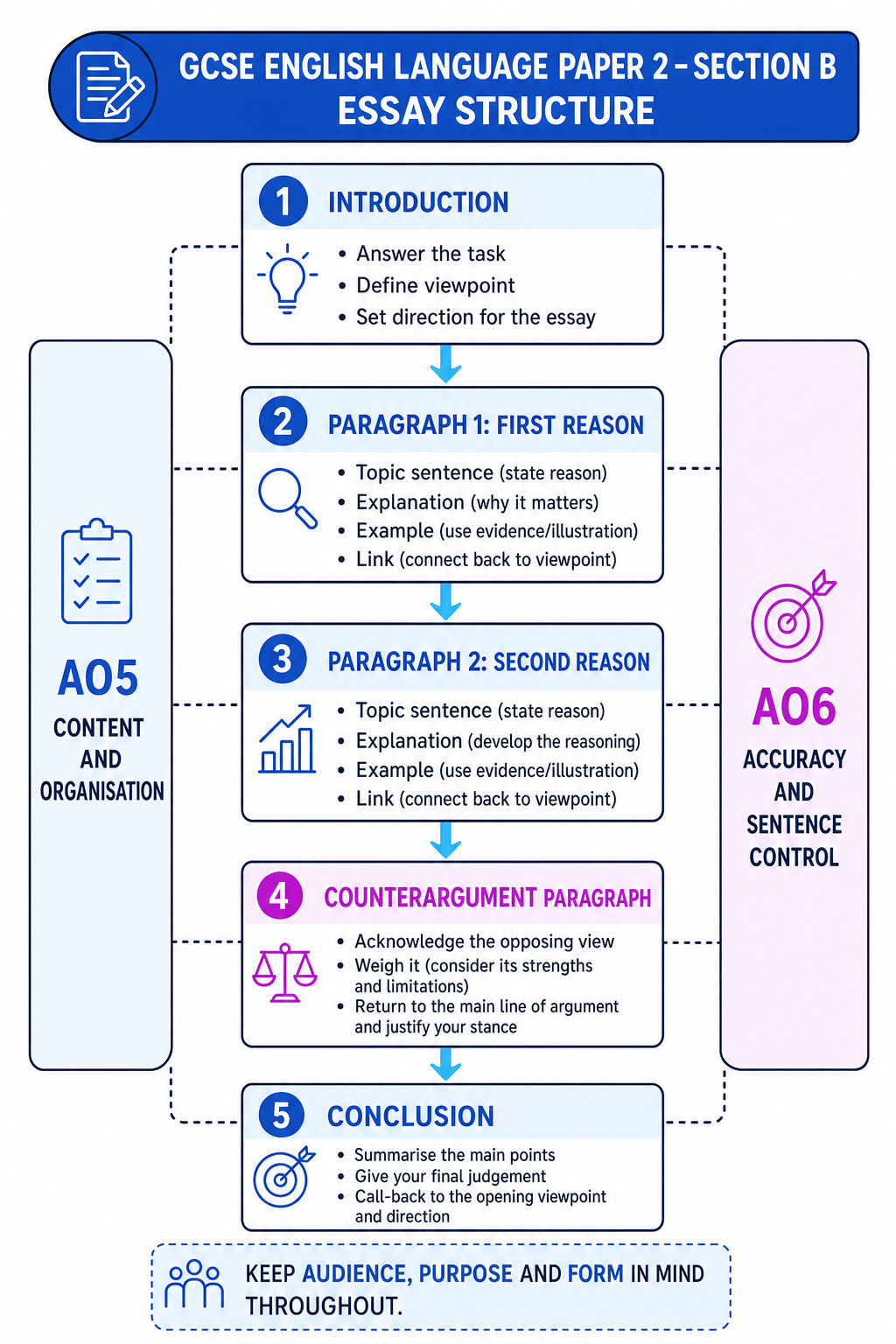
Start with the viewpoint
Viewpoint writing means writing to express a perspective, attitude or position on an issue. Your audience is who you are writing for, your purpose is what you are trying to do, and your register is the level of language you choose — for example, formal, informal or conversational.
In an essay, your register is usually fairly formal and controlled. You can still sound passionate, but you should avoid sounding like a rant.
A useful first step is to create a thesis. A thesis is your main argument in one sentence.
Building a thesis from a task
Suppose the task asks you to write about whether schools should teach practical life skills as well as academic subjects.
-
Decide your position: you might agree, disagree or take a balanced view. A strong essay often takes a clear but reasonable position, such as: schools should teach life skills alongside academic subjects.
-
Choose two or three reasons that support that position. For example: practical skills help independence, make education feel relevant, and prepare students for adult responsibilities.
-
Add a limit so the argument sounds mature rather than extreme. You are not saying academic subjects are useless; you are saying they should be balanced with practical preparation.
-
Shape this into a thesis: Schools should continue to value academic subjects, but they also have a responsibility to teach practical life skills so that young people leave education prepared for real adult choices.
Writing the introduction
An introduction is the opening paragraph that presents the issue and shows the direction of your argument. It should not waste time with vague phrases like “This essay will be about…” if you can be more purposeful.
A strong introduction usually does three things:
- Introduces the issue.
- Makes your viewpoint clear.
- Hints at the main direction of the essay.
Writing a focused introduction
Using the life-skills topic, here is how an introduction can be built.
-
Begin with the wider issue, not a random opening. For example, you could focus on the gap between school success and adult independence.
-
State your viewpoint clearly so the examiner knows your line of argument from the beginning.
-
Add a balanced direction by recognising that academic learning still matters.
-
Combine those choices into a controlled opening: Young people can leave school able to pass demanding exams yet still feel unprepared for basic adult responsibilities. Academic subjects remain essential, but education should also equip students with practical skills such as budgeting, communication and first aid. A modern curriculum should prepare students not only to achieve qualifications, but to live confidently beyond the classroom.
Topic sentences: guiding each paragraph
A topic sentence is a sentence, usually near the start of a paragraph, that tells the reader the main idea of that paragraph.
A weak topic sentence only names a topic: “Life skills are important.”
A stronger topic sentence makes a point: “Teaching life skills would make education more relevant because it connects lessons to the decisions young people will soon face.”
The second version is better because it contains a clear reason and begins the argument, not just the subject.
Improving a topic sentence
Here is how to turn a basic topic sentence into a more effective one.
-
Start with the simple idea: Life skills are important. This is true, but it is too general to drive a paragraph.
-
Add a specific area of life skills: budgeting, cooking, first aid, job interviews or communication.
-
Add a reason using a cause-and-effect relationship: these skills matter because they help students become independent.
-
Write the improved version: Teaching budgeting and communication would make school more relevant because it would help students handle real decisions about money, work and relationships.
Topic sentence test
If the rest of the paragraph could be predicted from your topic sentence, it is probably doing its job.
Developing your argument
An argument is a line of reasoning that supports your viewpoint. It does not mean being aggressive. It means making a point, explaining why it matters, and showing how it supports your overall position.
A developed paragraph often follows this pattern:
- Point: your main idea.
- Explanation: why the point is true or important.
- Illustration: a realistic example or scenario.
- Impact: what the consequence is for people or society.
- Link: how it supports your thesis.
You do not need to invent precise statistics. If you use examples, keep them believable and general unless the task gives you specific information.
Developing one essay paragraph
Here is how one paragraph can be developed from a topic sentence.
-
Begin with the point: Practical life skills would make education feel more relevant to students.
-
Explain the reasoning: if students can see how learning connects to daily choices, they are more likely to value it.
-
Add a realistic illustration: a lesson on budgeting could show students how rent, travel, food and savings compete for the same income.
-
Develop the impact: this kind of knowledge could reduce anxiety and help young people avoid poor financial decisions.
-
Link back to the overall viewpoint: For this reason, practical learning should not be treated as a distraction from education, but as part of what a good education should provide.
Balanced reasoning
Balanced reasoning means showing that you understand more than one side of an issue. It does not mean sitting on the fence. You can still have a strong view while admitting that the issue is complicated.
Useful balancing phrases include:
- Admittedly, academic subjects are vital…
- However, this does not mean practical skills should be ignored.
- Although curriculum time is limited, schools must consider what students need beyond exams.
- Nevertheless, the strongest argument remains…
Balance
Balance makes your essay sound thoughtful. It shows you can weigh ideas rather than simply repeat one opinion.
Counterargument: answering the other side
A counterargument is an opposing viewpoint that you acknowledge and respond to. Including one can make your essay more convincing because it shows you have considered objections.
A good counterargument paragraph does four things:
- Presents the opposing view fairly.
- Explains why some people might find it convincing.
- Challenges or limits it.
- Returns to your main argument.
Handling a counterargument
Here is a way to respond to the argument that schools do not have time to teach life skills.
-
Present the opposing view fairly: Some people argue that schools are already under pressure and should focus on core academic subjects.
-
Explain its strength: this is reasonable because exam results affect college places, careers and school accountability.
-
Limit the argument: however, practical skills do not need to replace academic learning; they can be integrated into existing subjects or taught through short, focused sessions.
-
Return to your stance: Therefore, the problem is not that life skills are unimportant, but that schools need to plan carefully so students receive both academic challenge and practical preparation.
Counterargument takeover
Do not let the opposing view become more convincing than your own. After acknowledging it, make sure you clearly return to your main line of argument.
Writing the conclusion
A conclusion is the final paragraph that draws your argument together and leaves the reader with your final judgement. It should not introduce a completely new major point.
A strong conclusion should:
- Summarise your central argument.
- Return to the key issue in the task.
- End with a clear final judgement.
Turning ideas into a conclusion
To conclude the life-skills essay, you would bring together the main argument rather than repeat every paragraph.
-
Select the strongest ideas: education should prepare students for qualifications and adult life.
-
Turn those ideas into a final judgement: the best curriculum is not purely academic or purely practical, but balanced.
-
Echo the introduction by returning to the idea of life beyond school.
-
Write the conclusion: Ultimately, schools should not have to choose between academic success and practical preparation. A thoughtful education can provide both: the knowledge to pass exams and the confidence to make responsible choices afterwards. If school is meant to prepare young people for the future, then life skills deserve a secure place within it.
Style: sounding like an essay writer
Because AO6 rewards vocabulary, sentence structures, spelling and punctuation, your technical control matters. Aim for clarity before complexity.
Good essay style often includes:
- Precise vocabulary: “responsibility”, “preparation”, “independence”, “relevance”.
- Controlled connectives: “therefore”, “however”, “as a result”, “nevertheless”.
- Varied sentences: some short for emphasis, some longer for explanation.
- Accurate punctuation: commas, full stops, apostrophes, and occasional colons or semicolons if you can use them correctly.
Persuasive overload
Rhetorical questions, dramatic exaggeration and exclamation marks can weaken an essay if they make it sound like a speech or rant. Use persuasive methods carefully and keep the argument controlled.
Planning a GCSE essay quickly
For a 40-mark writing task, it is worth spending a few minutes planning. A quick plan could be:
- Thesis: your overall viewpoint.
- Paragraph 1: strongest reason.
- Paragraph 2: second reason.
- Counterargument: opposing view and response.
- Conclusion: final judgement.
This helps your AO5 organisation because the essay has a clear shape from the beginning.
In the exam
-
Spend about 5 minutes planning your thesis, two main reasons, a counterargument and a conclusion before you start writing.
-
Keep checking the form: an essay needs clear paragraphs, developed reasoning and a formal register — not letter, speech or article features.
-
Leave a few minutes to proofread for AO6: full stops, commas, apostrophes, spelling, and any sentences that have become too long.
Check yourself
- Can you write a one-sentence thesis for a viewpoint task before starting the essay?
- Does each paragraph begin with a topic sentence that makes a clear point?
- Can you include a counterargument while still making your own viewpoint stronger?
