What you'll learn
- How letter form works in AQA GCSE English Language viewpoint writing.
- How to choose the right opening, tone and sign-off for your recipient.
- How to build clear, developed paragraphs that still feel like a letter.
- How to avoid wasting time on layout while still meeting AO5 and AO6.
Where this fits in AQA 8700
In AQA GCSE English Language, both papers are 1 hour 45 minutes, each worth 80 marks and 50% of the GCSE. Letter writing can appear in Paper 2 Section B: Viewpoint Writing, where you respond to a statement or situation by presenting your own view.
The writing task is worth 40 marks: 24 marks for AO5, which rewards clear communication, organisation and audience awareness, and 16 marks for AO6, which rewards vocabulary, sentence structure, spelling and punctuation.
Form
Form means the type of text you have been asked to write and the conventions readers expect from it. In a letter, this includes a greeting, awareness of the recipient, a suitable tone, organised paragraphs and an appropriate sign-off.
A letter is not just an essay with “Dear…” at the top. It is a piece of writing aimed at a specific reader.
The big idea: a letter is directed writing
A recipient is the person or group receiving the letter. Your recipient affects your tone, which means the attitude or level of formality your writing creates. A letter to a headteacher, newspaper editor or local council should usually sound formal and controlled. A letter to a friend can sound warmer and more personal.
Use this layout as a mental checklist for the main parts of a GCSE viewpoint letter.
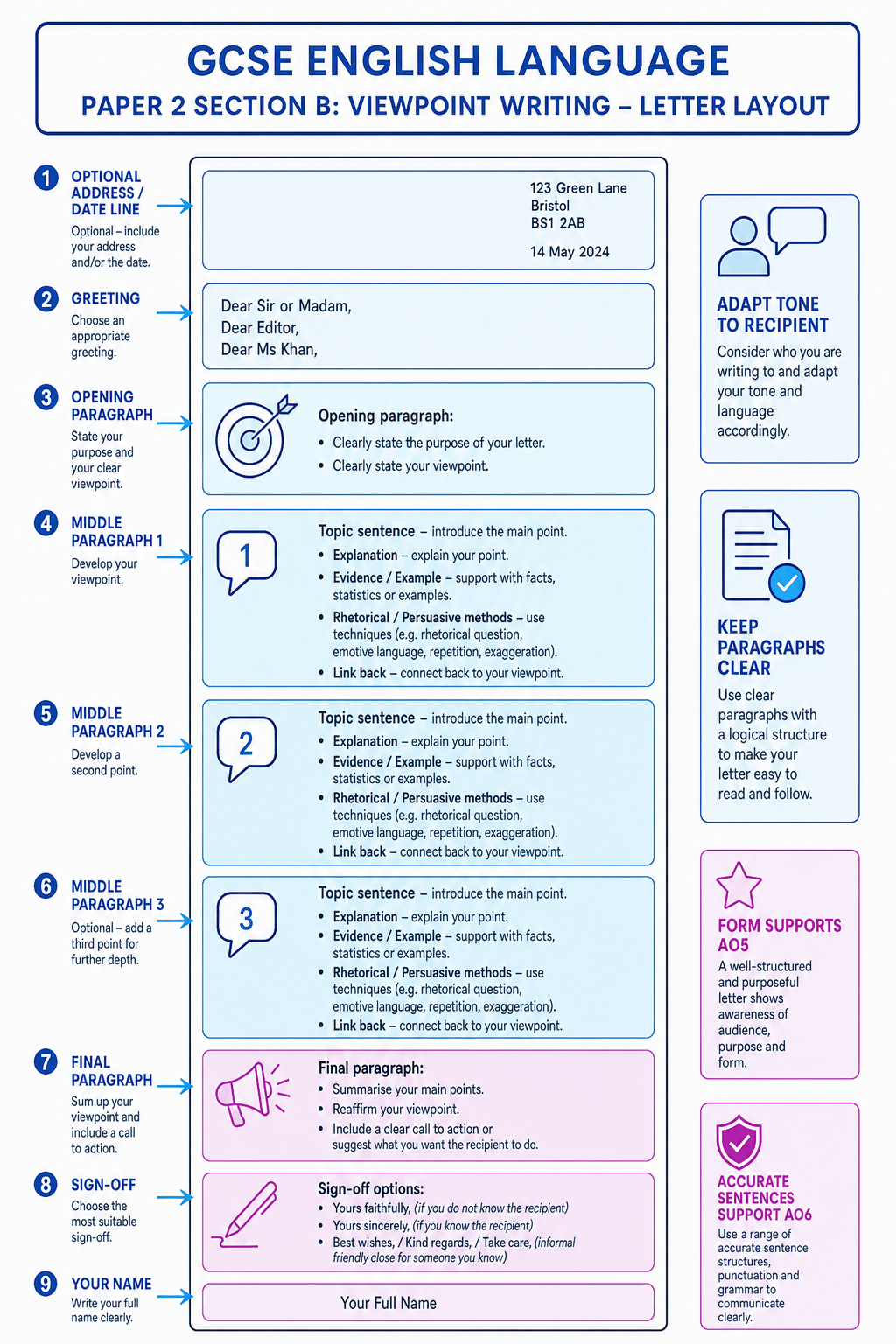
The letter mindset
A successful letter sounds as if it has been written to someone, for a reason, with a clear view that develops from the opening to the final sign-off.
Choosing the right tone
Most Paper 2 letters are formal or semi-formal because you may be writing to a public figure, organisation or newspaper. However, always obey the wording of the task.
| Recipient in the task | Likely tone | Suitable greeting | Suitable sign-off |
|---|---|---|---|
| Newspaper editor | Formal | Dear Editor, | Yours faithfully, |
| Headteacher named as Ms Khan | Formal | Dear Ms Khan, | Yours sincerely, |
| Local council / MP | Formal | Dear Sir or Madam, | Yours faithfully, |
| Friend or relative | Informal or semi-formal | Dear Sam, / Hi Sam, | Best wishes, / Take care, |
Formal tone does not mean boring. It means controlled, precise and respectful. You can still be passionate, but your passion should sound thoughtful rather than aggressive.
Choosing tone and sign-off
You are asked to write a letter to your local newspaper arguing that teenagers should have more free sports facilities.
- The recipient is a public audience through a newspaper editor, so the tone should be formal rather than chatty.
- Because “the editor” is a role rather than a personal name, a suitable greeting is Dear Editor, or Dear Sir or Madam,.
- The purpose is to persuade readers and the editor that the issue matters, so the language should be confident: “I am writing to urge our community to take teenage health more seriously.”
- Since the recipient is not personally named, the most suitable sign-off is Yours faithfully, followed by your name.
Over-formal layout, weak argument
Do not spend five minutes inventing full postal addresses and dates if your ideas are thin. A brief address/date line is optional in the exam; your viewpoint, organisation and control matter much more.
Writing a strong opening
Your opening paragraph should establish three things quickly:
- Purpose: what you are writing to do, such as persuade, argue, complain, advise or explain.
- Viewpoint: your clear opinion or position.
- Recipient awareness: a sense that you know who you are addressing.
A simple opening can still be effective:
Dear Ms Khan,
I am writing to urge the school to extend library opening hours, because many students need a calm, safe place to study after lessons.
This works because it is direct, polite and specific.
Writing a purposeful opening
Imagine the task asks you to write to your headteacher about keeping the school library open later.
- The headteacher has authority, so your opening should be respectful and practical rather than dramatic or rude.
- Your purpose is to persuade, so you need a clear stance: the library should stay open later.
- Your first paragraph should link the issue to students’ needs: “I am writing to ask you to reconsider the library’s closing time, as many pupils rely on it for quiet study, homework support and access to books they may not have at home.”
Developing the middle paragraphs
A good letter usually has two or three developed middle paragraphs. Each paragraph should focus on one main idea.
Topic sentence
A topic sentence is a sentence, usually near the start of a paragraph, that introduces the main idea of that paragraph.
Development means you do not just state an opinion and move on. You explain it, give a relevant example, consider consequences and link it back to the recipient.
A useful paragraph shape is:
- Topic sentence: make one clear point.
- Explanation: say why it matters.
- Example or scenario: make the point feel real.
- Link back: connect it to your purpose or requested action.
Developing one paragraph
You are writing to a local council arguing for cheaper bus fares for teenagers.
- Start with a clear claim: cheaper transport would help teenagers access education, work and community activities.
- Link the claim to the recipient’s responsibilities: the council should care because transport affects opportunity across the local area.
- Add a believable example rather than an invented precise statistic: “A student who cannot afford two bus journeys may miss revision sessions, part-time work or sports clubs.”
- Finish by pushing for action: “For this reason, a discounted youth travel pass would not be a luxury; it would be an investment in young people’s independence.”
Using persuasive methods naturally
A rhetorical method is a language choice used to influence the reader’s thoughts or feelings. In letters, persuasive methods should support your argument, not replace it.
Useful methods include:
- Direct address: using “you” or “your” to involve the recipient.
- Modal verbs: words such as “must”, “should” and “could” that show certainty, obligation or possibility.
- Rhetorical question: a question asked for effect rather than because you expect an answer.
- Anaphora: repeating the same word or phrase at the start of nearby clauses or sentences.
- Counterargument: acknowledging an opposing view before explaining why your view is stronger.
Adding persuasive pressure
Suppose your basic point is: “The park should be cleaned more often.”
- Make the point more precise by naming the issue: “The park should be cleaned more often because overflowing bins are making it unpleasant and unsafe.”
- Add direct address to connect the issue to the recipient: “As councillors, you have the power to restore a space that families should be proud to use.”
- Use a counterargument to sound balanced: “Some may argue that cleaning costs are already too high, but prevention is cheaper than repairing vandalised, neglected spaces later.”
- Finish with a modal verb to push action: “The council must introduce a reliable weekly cleaning schedule before more residents stop using the park altogether.”
Technique dumping
Do not fire off five rhetorical questions in a row. One well-placed question after a developed point is usually stronger than a whole paragraph of questions.
Ending the letter
Your final paragraph should not introduce a completely new argument. It should bring your view together and make the reader feel that action is needed.
A strong ending often does three things:
- briefly summarises your main view;
- reminds the recipient why the issue matters;
- includes a clear call to action.
For example:
For these reasons, I hope you will reconsider the proposal and listen carefully to the students who will be most affected. A small change now could make a lasting difference to our school community.
Then choose the correct sign-off:
- Yours faithfully, if you used “Dear Sir or Madam,” or do not know the recipient’s name.
- Yours sincerely, if you used a named recipient, such as “Dear Ms Khan,”.
- Best wishes, or Take care, only if the task clearly asks you to write to someone you know.
Easy ending formula
Use: summary + significance + action. In other words: remind them of your view, explain why it matters, then say what you want them to do.
AO6: accuracy and control
AO6 rewards the technical quality of your writing. In a letter, this means your sentences should be accurate, varied and suitable for the chosen tone.
For formal letters, use Standard English, which means grammatically correct English suitable for public or professional communication. Avoid slang, texting abbreviations and overly casual phrases unless the task clearly asks for an informal letter.
You can show control by varying sentence length:
This cannot continue. Although the proposal may seem convenient in the short term, it risks creating a community where young people feel ignored, blamed and excluded.
The first sentence is short and emphatic. The second is longer and more developed. Together, they create a controlled but persuasive voice.
Proofread for the easy marks
Before you finish, check capital letters, full stops, apostrophes, commas after the greeting/sign-off, and any sentence that has become too long to follow.
A flexible letter skeleton
You can adapt this structure to most GCSE letter tasks:
Dear [recipient],
I am writing to… [state purpose and viewpoint clearly].
Firstly, [main point one]. This matters because…
Furthermore, [main point two]. For example…
Some people may argue that… However…
For these reasons, I urge you to…
Yours faithfully / Yours sincerely,
[Your name]
Do not memorise this word for word. Use it as a planning frame, then shape it to the exact task.
In the exam
- Read the task carefully and identify the recipient, purpose and required form before you start writing.
- Choose your greeting and sign-off quickly, then focus most of your time on developing a clear viewpoint.
- Plan two or three main points, each in its own paragraph, with examples or consequences to develop them.
- Keep the tone appropriate: formal for public figures and organisations, warmer only for someone you know.
- Leave a few minutes to proofread for AO6 accuracy, especially sentence boundaries and punctuation.
Check yourself
- Can you explain the difference between a formal and an informal letter opening?
- Can you write one developed paragraph that includes a topic sentence, explanation and link back to purpose?
- Can you choose the correct sign-off for a named recipient and an unknown recipient?
