What you'll learn
- How to spot the purpose of a Paper 2 Section B writing task.
- How purpose affects your tone, vocabulary, methods and structure.
- How to handle common purposes: persuade, argue, explain, advise, inform, complain, campaign, criticise, support and entertain.
- How to plan a response that feels focused rather than generic.
Why purpose matters in viewpoint writing
AQA GCSE English Language Paper 2 is 1 hour 45 minutes. Section B is the writing task: one compulsory question worth 40 marks. Those marks are split into 24 for AO5 — clear, effective communication and organisation — and 16 for AO6 — vocabulary, sentence structures, spelling and punctuation.
Purpose is central to AO5 because it shapes what you are trying to achieve. A brilliant sentence in the wrong tone can still feel unsuitable.
Purpose
Purpose means the main reason a text is written: what the writer wants the reader to think, feel or do by the end.
In Paper 2 Section B, you are usually asked to write from a viewpoint. That means you are not just “writing about a topic”; you are trying to make the reader respond in a particular way.
For example, if the task asks you to complain, your writing should sound controlled, firm and specific. If it asks you to entertain, your writing can be more playful, surprising or humorous.
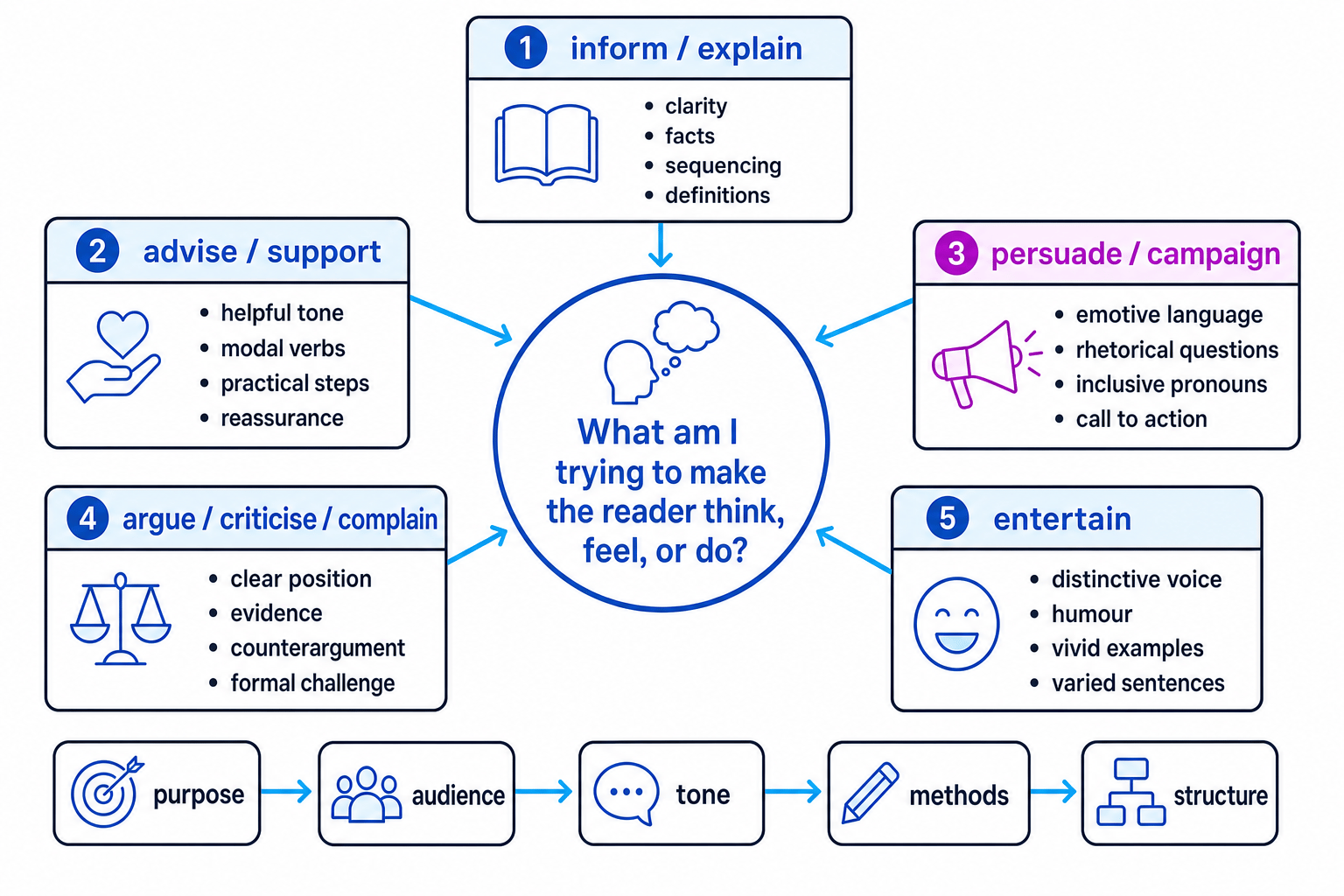
The key chain: purpose → audience → tone → methods → structure
Before you write, connect five things.
Purpose
This is your goal. Are you trying to persuade, explain, advise, criticise or entertain?
Audience
The audience is the person or group your writing is aimed at. A letter to the headteacher will sound different from a speech to classmates.
Audience
Audience means the intended reader or listener of a text.
Tone
Tone means the attitude or “voice” of your writing. It might be passionate, serious, friendly, outraged, humorous, reflective or reassuring.
Tone
Tone is the feeling or attitude created by your choice of words, sentence structures and level of formality.
Methods
Methods are the language and structural choices you use deliberately, such as rhetorical questions, direct address, repetition, emotive language, statistics, anecdotes or contrast.
Structure
Structure is how you organise the whole response: the order of your points, paragraphing, shifts in tone and ending.
The purpose chain
A strong viewpoint response does not begin with random techniques. It begins with purpose, then chooses the audience, tone, methods and structure that fit that purpose.
Turning a task into a purpose plan
Task: “Write a speech for your classmates in which you argue that young people should have more opportunities to volunteer in their local area.”
- The command word is argue, so your main purpose is to present a clear viewpoint and defend it with reasons.
- The audience is classmates, so the tone can be confident and direct, but not overly formal or distant.
- Because the topic is volunteering, your methods should help readers see personal and community benefits: direct address, examples, contrast and a call to action would fit.
- The structure could move from a shared problem, to the benefits of volunteering, to a challenge at the end: “So why wait for change when we can start it ourselves?”
The main purposes you need to recognise
Many exam tasks blend purposes, but one will usually dominate. Here are the key ones.
To persuade
To persuade means to convince the reader to agree with you or take action.
Persuasive writing often uses:
- Direct address: “you”, “we”, “our”
- Emotive language: words chosen to create feeling
- Rhetorical questions: questions asked for effect, not because you expect an answer
- Repetition for emphasis
- A clear call to action at the end
Emotive language
Emotive language is vocabulary chosen to create an emotional response, such as sympathy, anger, hope or guilt.
Persuasion is not just shouting. The best persuasive writing sounds controlled, purposeful and aware of the reader.
To argue
To argue means to present a viewpoint logically and support it with reasons. It is slightly different from persuading: argument often feels more balanced, developed and reasoned.
Argumentative writing often uses:
- A clear line of opinion
- Evidence or examples
- Logical connectives: “therefore”, “however”, “as a result”
- Counterargument, where you acknowledge the other side before challenging it
Counterargument
A counterargument is an opposing viewpoint that you mention and respond to, usually to make your own argument seem more thoughtful and convincing.
Using counterargument in an argument
Claim: “Schools should start later in the morning.”
- Start with your own viewpoint: “A later school start would improve concentration and wellbeing.”
- Acknowledge the other side: “Some people argue that this would make life harder for working parents.”
- Respond to it: “However, schools already manage clubs, breakfast sessions and after-school care, so a carefully planned change is possible.”
- Return to your main line: “If we care about learning, we should design the day around how teenagers actually function.”
To explain
To explain means to make an idea clear. You are not mainly trying to win an argument; you are helping the reader understand.
Explanatory writing often uses:
- Clear sequencing: “first”, “next”, “as a result”
- Definitions or clarification
- Examples
- Cause and effect
A task might ask you to explain your views on a topic. In that case, you still have a viewpoint, but your tone may be calmer and more informative than a heated argument.
To advise
To advise means to recommend what someone should do. The tone should usually be helpful, practical and respectful.
Advisory writing often uses:
- Modal verbs such as “should”, “could”, “might”
- Step-by-step suggestions
- Reassuring language
- Direct address
Modal verbs
Modal verbs are helping verbs that show possibility, advice or obligation, such as “should”, “could”, “might”, “must” and “would”.
For example, “You should revise every day” can sound bossy. “You could begin with ten focused minutes a day” sounds more supportive and realistic.
To inform
To inform means to give the reader useful information. The aim is clarity.
Informative writing often uses:
- Precise facts or details
- Clear headings if the form allows them
- Neutral or balanced tone
- Organised paragraphs
In AQA Paper 2 Section B, you are rarely asked to produce a purely factual information sheet, because the task usually involves a viewpoint. However, informative sections can strengthen a speech, article or letter.
To complain
To complain means to express dissatisfaction and usually request change. Good complaint writing is firm, specific and controlled.
Complaint writing often uses:
- Formal tone
- Specific details of the problem
- Clear explanation of impact
- Polite but direct requests
Sounding rude instead of effective
A complaint is not more powerful because it is aggressive. Examiners reward control. A sentence like “This situation is unacceptable and needs urgent attention” is usually stronger than insults or exaggerated rage.
To campaign
To campaign means to push for a cause or change, often by motivating a group of people.
Campaign writing often uses:
- Collective pronouns: “we”, “us”, “our”
- Repetition of a memorable slogan or key phrase
- Urgent tone
- Clear action: sign, join, donate, change, speak out
Campaigning is usually persuasive, but it has a stronger sense of public action.
To criticise
To criticise means to point out faults or weaknesses. It does not simply mean “be negative”. Effective criticism is specific, justified and purposeful.
Critical writing often uses:
- Precise judgement words: “unfair”, “short-sighted”, “wasteful”
- Evidence or examples
- Contrast between what is happening and what should happen
- A controlled, assertive tone
To support
To support means to back an idea, cause, person or group. This purpose often overlaps with argue, persuade or campaign.
Supportive writing often uses:
- Positive language
- Examples of benefits
- Inclusive pronouns
- Reassurance and encouragement
For example, if you support a new school recycling scheme, you might combine practical explanation with persuasive enthusiasm.
To entertain
To entertain means to interest, amuse or engage the reader. It does not always mean making jokes. It can mean creating a lively, memorable voice.
Entertaining writing often uses:
- Anecdotes, which are short personal stories
- Humour or irony, if appropriate
- Vivid description
- Sentence variety
- Surprising comparisons
Anecdote
An anecdote is a brief personal story used to illustrate a point or make writing more engaging.
In viewpoint writing, entertainment often supports another purpose. For example, you might entertain readers at the start of an article so they keep reading, then move into a serious argument.
Matching language to purpose
The same topic can be written in completely different ways depending on purpose. This is where top-level writing often stands out: the choices feel deliberate.
Adapting one topic for different purposes
Topic: public transport for teenagers.
- To inform, you might write: “Several bus routes now offer discounted fares for students after 4 p.m.” The language is clear and factual.
- To persuade, you might write: “Why should young people be priced out of opportunities simply because the bus fare is too high?” The rhetorical question pushes the reader towards agreement.
- To complain, you might write: “The current service is unreliable, overpriced and unsuitable for students who depend on it daily.” The tone is firm and critical.
- To campaign, you might write: “Together, we can demand a transport system that gets young people where they need to be.” The inclusive pronoun “we” builds shared action.
- To entertain, you might write: “Waiting for the number 27 has become a local sport: part patience, part weather survival, part blind optimism.” The humour makes the viewpoint more memorable.
A quick planning question
Before you choose any technique, ask: What do I want the reader to think, feel or do after this paragraph? That question keeps your writing purposeful.
Mixed purposes: what if the task has more than one?
Many Paper 2 tasks combine purposes. For example:
- “Argue your views…” may also require persuasion.
- “Write an article explaining…” may also include advice.
- “Write a letter complaining…” may also criticise and request action.
- “Write a speech campaigning…” will almost certainly persuade and support.
When purposes are mixed, decide which one is the main driver.
Dominant purpose
The dominant purpose is the main job your writing must do. Other purposes can support it, but they should not take over.
For example, in a campaign speech, you may inform the audience about a problem, but only so that you can persuade them to act. The information is useful because it serves the campaign.
Purpose and form
Form means the type of text you are writing, such as a speech, article, letter, leaflet or blog.
Form
Form is the kind of text you have been asked to produce, and it affects layout, voice and conventions.
A speech may include direct address and spoken-style rhythms: “Look around you. This is our community.”
A letter may need a clear opening reason and a polite sign-off.
An article may use a headline, engaging opening and developed paragraphs.
Purpose and form work together. A complaint letter should not sound like a stand-up comedy routine. A campaign speech should not read like a dry information leaflet.
Do not let form replace purpose
Adding “Dear Sir/Madam” or a headline is not enough. Those features show form, but the marks come from how effectively your ideas, tone and structure achieve the purpose.
Building a purposeful paragraph
A strong paragraph in viewpoint writing usually does three things:
- Makes a clear point.
- Develops that point with explanation, example or reasoning.
- Uses language choices that fit the purpose.
For instance, if your purpose is to persuade people to protect local parks, you might write:
“Without our parks, where will children run, families meet, or older residents find a quiet place to breathe? These spaces are not luxuries; they are the lungs of our community. If we allow them to disappear, we lose more than grass and trees — we lose connection.”
This paragraph persuades through rhetorical questioning, emotive metaphor and inclusive community language. The methods are useful because they match the purpose.
Technique dumping
Do not force in every device you know. A random statistic, rhetorical question and triple phrase will not help if they do not fit your purpose. Choose fewer methods and make them work harder.
A simple purpose planning grid
Before writing, quickly decide:
| Question | What to decide |
|---|---|
| What is my main purpose? | Persuade, argue, explain, advise, inform, complain, campaign, criticise, support or entertain |
| Who is my audience? | Students, parents, adults, local residents, readers of a newspaper, a headteacher |
| What tone fits? | Formal, passionate, calm, humorous, urgent, supportive, critical |
| What methods fit? | Direct address, evidence, anecdote, repetition, rhetorical question, contrast |
| How should it end? | Call to action, final judgement, memorable image, solution, warning |
You do not need to write this grid in the exam, but thinking through it can save you from drifting.
In the exam
- Read the task twice and underline the command word, such as argue, persuade, explain or advise.
- Decide the dominant purpose, then choose a tone that fits the audience and form.
- Plan three or four main points, making sure each one helps the reader think, feel or do what the task requires.
- Use methods because they serve your purpose, not because you are trying to tick off a list.
- Leave a few minutes to check AO6: spelling, punctuation, sentence control and paragraphing.
Check yourself
- Can you explain the difference between persuading and arguing?
- If a task asks you to complain, what tone would be most effective?
- How could the same topic be written differently to inform, campaign and entertain?
