Globalisation makes separate economies act together
Definition
Globalisation: the growing connection and interdependence of the world's economies, as goods, services, money, technology and people move more freely between countries.
- Over the past twenty years or so goods have moved far more freely across borders and countries have come to rely on one another far more, and that pairing is what the word describes.
- The connection runs through several channels at once: trade in goods and services, money moving between countries, technology spreading from one economy to another, and people moving for work.
- Because the channels work together, a decision taken by a firm or a government in one country now reaches households and firms in many others.
Globalisation is more than international trade
- Plain international trade means one country selling finished goods and services to another, and on its own that is not globalisation.
- Under globalisation production itself is split up, so a single product can be designed in one country, use materials bought in a second and be put together in a third before it is sold in a fourth.
- The result is interdependence, because countries now depend on one another for parts, finance and jobs, so a shock in one economy spreads quickly to the rest.
Example
- A pair of trainers on sale in a UK shop may be designed in one country, made from materials bought in a second and stitched together in a third.
- The firm that sells them, the bank that finances the order and the ship that carries them can each be based somewhere else again.
- No single country makes the trainers, which is what separates globalisation from one country simply selling finished goods to another.
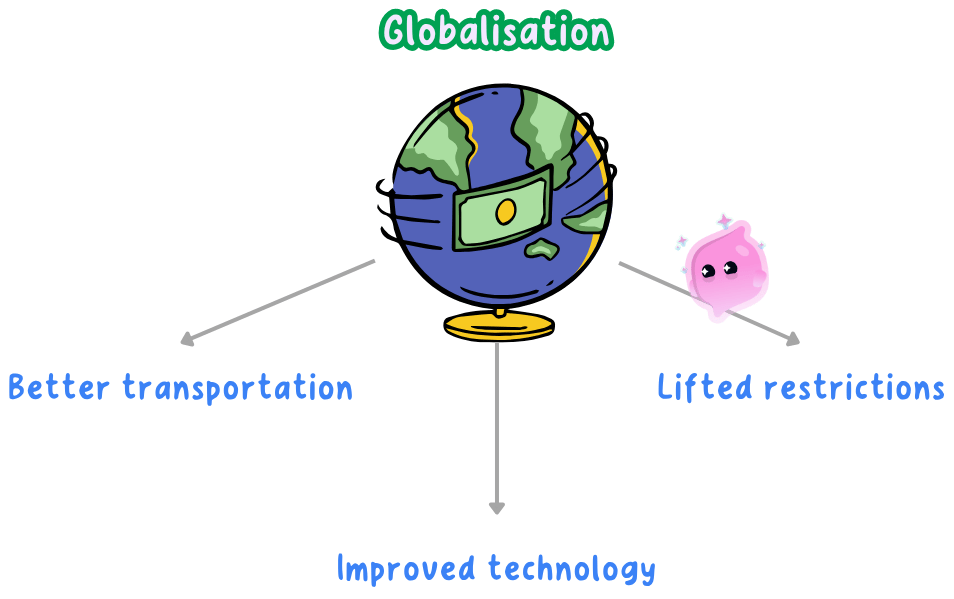
Cheaper transport made distance matter less
Definition
Containerisation: loading cargo into standard steel boxes that lift straight from ship to lorry to train, cutting the time, labour and damage involved in handling it.
- Moving goods around the world once cost so much that producing a long way from the customer made no sense.
- A single ship now carries thousands of those containers at once, so the transport cost carried by any one item inside them is a tiny share of its price.
- Once transport is cheap, a firm can put each stage of production wherever that stage is done best or most cheaply, and that is what builds a supply chain spanning several countries.
Technology lets firms run production anywhere
- Production can only be spread across countries if it can be controlled from a distance, and communication technology is what made that possible.
- Orders, designs and instructions now travel between countries in seconds rather than weeks, so a drawing changed in an office one morning reaches a factory abroad the same day.
- Digital technology also created trade that did not exist before, because software, streaming, advertising, design and customer service can all be delivered from anywhere with a connection.
Restrictions on trade and money were removed
- Governments have removed many of the charges and restrictions that once made selling into another country slow and expensive.
- Controls on moving money between countries were relaxed as well, so savings and investment can flow to wherever they earn most instead of staying at home.
The driving factors work together, not alone
- No single factor produced globalisation, because each one is worth far less without the others.
- Cheap shipping would not build a supply chain spanning several countries without the technology to manage a factory abroad, and neither would matter if the money could not cross the border.
- The drivers also feed one another, since more goods shipped pays for bigger ships and better ports, which lowers the cost of shipping again.
Whether all this leaves a developed country better off is weighed in 4.4.3.
Exam technique
- Where a question asks what globalisation means, answer with the freer movement of goods and the greater dependence of countries on one another, since that is the pairing OCR is looking for.
- International trade, specialisation and sustainability are all offered as near-miss answers to that question, and each is a separate idea rather than a definition of globalisation.
Self review
- In one sentence, what does globalisation mean?
- Give one way globalisation goes beyond international trade.
- How did containerisation make it worth producing far from the customer?
- Name two things other than goods that now cross borders freely.
- Why is no single driving factor enough to explain globalisation on its own?
