Development means more than a bigger economy
Definition
Economic development: the improvement over time in living standards, health, education and the opportunities open to the people of a country.
Developed country: a country with high incomes, long lives, widespread education and services that reach almost the whole population.
Less developed country: a country with low incomes, shorter lives and services such as health care, schooling and electricity that many people cannot reach.
- Economic growth is a rise in the output an economy produces, while economic development is the broader question of whether people's lives are getting better.
- The two usually move together, because a country producing more has more to spend on hospitals, schools and clean water.
- They can also come apart, since output can rise while the gain reaches only a few people, or while the extra output comes from selling off resources that leave nothing behind.
- That is why development is measured with several indicators rather than by output alone, and OCR names five of them.
Note
A country can grow richer without developing, when the extra output never reaches people as longer lives, better schooling or usable services.
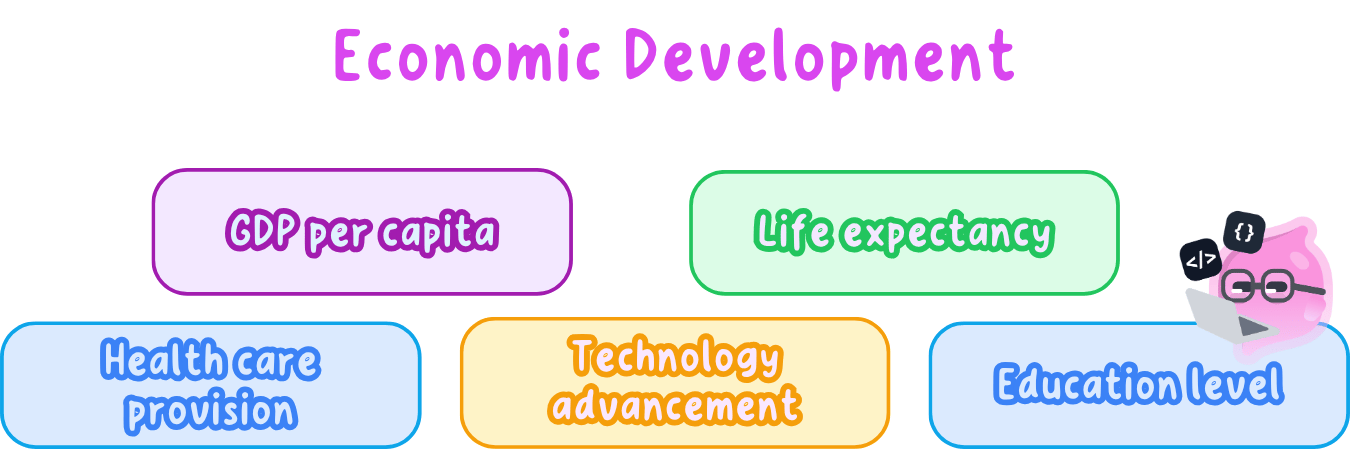
GDP per capita is the first indicator
- A higher GDP per capita means more output for each person in the country, and output is what pays for food, housing, medicine and schooling.
- It measures development because income is what turns a want into a purchase, and because a government can only fund services out of what its economy produces.
- What it cannot show is how that income is shared, so a respectable average can sit alongside widespread poverty.
How GDP per capita is worked out, and what output figures do and do not include, is set out in 3.1.3.
Life expectancy reveals the conditions of life
- Life expectancy at birth is the average number of years someone born today could expect to live.
- It measures development because staying alive depends on almost everything else being in place: clean water, enough food, treatment when ill, safe work and safe housing.
- It is also a direct signal of how safe a country is, because a country at peace loses far fewer people to conflict and violence, and that shows up in the average immediately.
Access to health care shows who benefits
- This indicator asks not whether hospitals exist but how many people can reach one, afford it and be treated in time.
- It measures development because a service only the richest can use leaves most of the population no better off, so access separates a country that has built services for everyone from one that has not.
- Care that reaches everyone also keeps adults in work and children alive to be educated, so it lifts the other indicators as well as measuring this one.
Technology shows what daily life allows
- Technology here means the everyday things people can actually use: mains electricity, clean cooking, a mobile connection, the internet and machinery at work.
- It measures development because each of those removes hours of unproductive work from a day, so a household with electricity and running water gains time that can go into schooling and paid work.
- It also raises what a worker produces in an hour, and a farmer who can check prices and be paid by phone is no longer at the mercy of the nearest buyer.
Education decides what people can become
- Education is usually measured by literacy rates and by the number of years people spend in school.
- It measures development because schooling widens the range of work a person can do and the choices they can make, and a wider range of choices is development in its own right rather than only a route to income.
- A country with weak schooling stays stuck in low-value work, so education measures future development as well as present.
The UK and Nigeria compared in 2023
- Life expectancy: 81.3 years in the UK against 54.5 years in Nigeria, a gap of more than twenty-six years in the length of an average life.
- Mean years of schooling: 13.5 years in the UK against 7.6 years in Nigeria, so the average UK adult has had nearly twice as much education.
- Gross national income per head: 54,372 US dollars in the UK against 5,569 in Nigeria, both measured in 2021 dollars adjusted so that the same amount buys a comparable basket in each country.
- All three point the same way, which is what makes the comparison convincing: one indicator could be a quirk, three together is a pattern.
No single indicator is enough alone
- Every one of these indicators is an average, and an average hides the spread, so GDP per capita can rise while the income of most households does not move at all.
- A single indicator can mislead in the other direction too, since a country can have long lives and weak schooling, or good schooling and very low income.
- A falling GDP per capita does not by itself mean a country is in recession, because the figure also falls when the population grows faster than output while output is still rising.
- The safe approach is to read the indicators as a set and say what each one adds that the others miss.
Exam technique
- Where a question asks why life expectancy measures development, the answer wanted is what a long average life reveals about conditions, including that the country is safer and has less conflict, not anything about demand for health services.
- Reject any statement treating a fall in GDP per capita as proof of recession, since a country whose population grows faster than its output can produce more than last year and still record a fall.
Self review
- What is the difference between economic growth and economic development?
- Name the five indicators of development you must know.
- Why does life expectancy tell you about safety as well as health?
- Why is GDP per capita on its own a weak measure of development?
- Give one reason a fall in GDP per capita need not mean a recession.
