Demand is buying that can actually happen
Definition
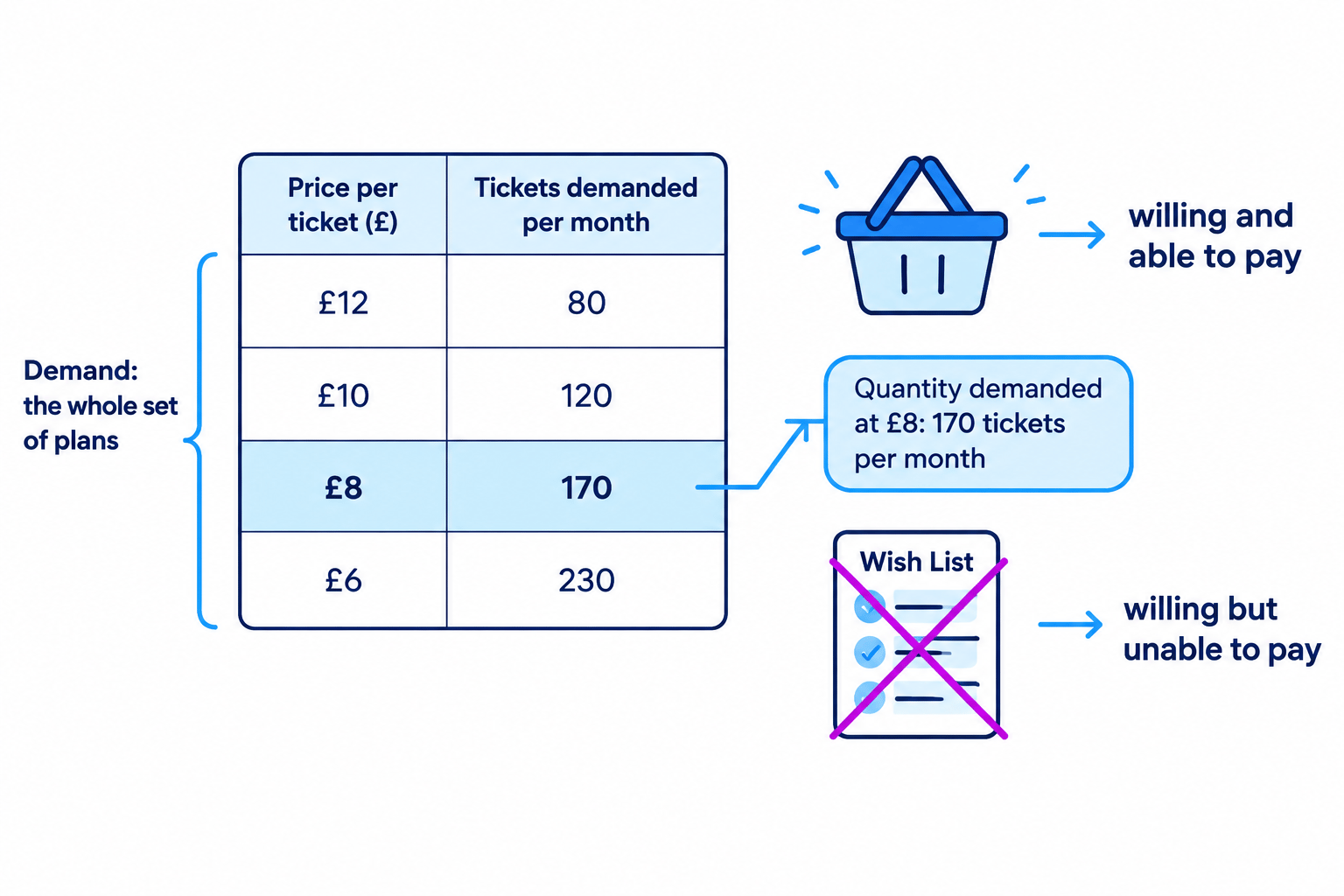
Demand: the quantity of a good or service that consumers are willing and able to buy at a given price over a period of time.
Effective demand: buying backed by the money to pay for it, which is the only kind that reaches a shop's till.
- Two separate tests have to be passed, because a consumer must both want the good and be able to pay for it.
- Wanting something you cannot afford is not demand, which is why a wish list and a shopping basket are different things.
- Demand is about consumers, so it is the buying side of the market set out in 2.1.1.
Demand and quantity demanded are different things
Definition
Quantity demanded: the single amount consumers would buy at one particular price, taken out of that whole set of buying plans.
- Demand is the whole set of plans, covering what would be bought at every possible price, not one number.
- Quantity demanded is one of those plans picked out, so it only means something once a price is named.
- Using the words the wrong way round is the commonest error in this topic, because a price change alters the quantity demanded and leaves demand itself alone.
Common Mistake
- Do not write that a price rise reduces demand, since a price rise reduces the quantity demanded.
- Do not give a quantity demanded without the price it belongs to, because the figure is meaningless on its own.
Demand is a flow measured over a period
- Every demand figure carries a time period, such as tickets a month, litres a week or cars a year.
- Without the period the number cannot be compared with anything, since 500 units a day and 500 units a year describe very different markets.
- Demand is therefore a flow rather than a stock, in the sense set out in 3.3.1.
Example
- The average UK cinema ticket cost £8.01 in 2025 (Source: UK Cinema Association).
- That is a price, not demand: demand is how many tickets people would buy at £8.01, and at every other price, over a stated period such as a month.
- Pairing the two is what makes a demand figure usable, which is why the next article starts from a table of prices and quantities.
Demand and supply together make a market
- Demand describes what consumers plan to do, and supply, covered in 2.3.1, describes what producers plan to do.
- A market needs both, because a price only forms where buying plans meet selling plans.
- Consumers, producers and the government are the three groups in 1.1.1, and demand is what the first of them brings to the market.
Exam technique
- Include willing and able in a definition of demand, because a definition that says only what people want is incomplete.
- Attach a time period to any demand figure you quote, since the period is part of the measurement rather than an extra detail.
Self review
- Define demand in one sentence.
- What are the two tests a purchase must pass to count as demand?
- What is the difference between demand and quantity demanded?
- Why must a demand figure state a time period?
- Why is wanting a sports car you cannot afford not demand?