Four types with four different causes
Definition
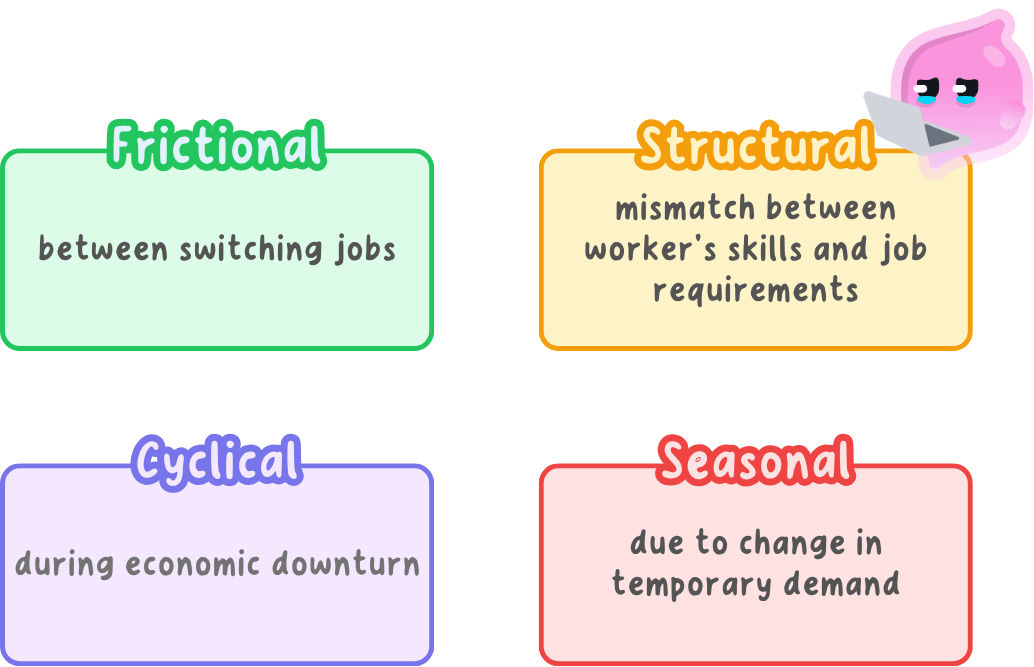
Cyclical unemployment: unemployment caused by a fall in the total demand for goods and services during a downturn, so firms need fewer workers.
Frictional unemployment: short-term unemployment while a person moves between jobs and searches for a suitable vacancy.
Seasonal unemployment: unemployment that rises and falls with the time of year as demand for certain work changes.
Structural unemployment: unemployment caused by a long-term mismatch between workers' skills or location and the jobs available.
- Sorting unemployment this way matters because each type has a different cause, so each one needs a different response.
- The types also differ in how long they last, which is usually the quickest way to tell them apart in a scenario.
- More than one type can be at work at once, since a downturn can push someone out of an industry that was already shrinking.
Frictional and seasonal unemployment are short
- Frictional unemployment exists even in a healthy economy, because matching a worker to a suitable job takes time on both sides.
- Imperfect information makes it worse, since workers and employers do not instantly know that the other exists.
- Seasonal unemployment is predictable, which is what separates it from the rest: the same weeks come round every year.
- It concentrates in industries whose demand swings with the calendar, such as tourism, farming and construction.
Example
- A graduate from Leeds spends six weeks applying before accepting a marketing role in Manchester, which is frictional because vacancies existed and the search simply took time.
- Staff at Blackpool's seaside attractions are laid off each autumn as visitor numbers fall and rehired the following spring, which is seasonal because the cause is the calendar.
Structural and cyclical unemployment last longer
- Structural unemployment lasts because the remedy is slow: a worker has to retrain, or move, or both, before the mismatch closes.
- It is driven by long-run change, including new technology replacing workers, production moving abroad and whole industries declining.
- Cyclical unemployment appears in a downturn and fades in a recovery, so it lasts as long as weak demand does.
- It also spreads, because workers who lose income spend less, which cuts other firms' sales and costs further jobs.
Case study
- Tata Steel closed the blast furnaces at its Port Talbot steelworks on 30 September 2024, and thousands of jobs went at the plant and in its supply chain (Source: Senedd Research).
- Those steelmaking skills had no other local buyer, which is what makes this structural rather than cyclical unemployment.
- Construction of a replacement electric arc furnace began in July 2025 and is due to finish by the end of 2027.
- The slowness is the point, because retraining workers and rebuilding an industry take years while a downturn passes in quarters.
Matching a case to its type
- The question to ask is what changed: the calendar, the state of the whole economy, one industry, or simply the time a job search takes.
- A fall in spending across the whole economy points to cyclical, while one industry shrinking as others keep hiring points to structural.
- During the lockdowns of 2020 spending fell across pubs, shops and hotels at once, which makes that cyclical rather than structural.
- If the person has stopped looking altogether they are economically inactive rather than unemployed, whichever type would otherwise have applied.
Self review
- Name the four types of unemployment and give one cause of each.
- Which type tends to last longest, and why?
- A fruit picker has no work in winter. Which type is this, and why?
- Why is the closure of the Port Talbot blast furnaces structural unemployment?
- Why is being briefly between jobs not the same as cyclical unemployment?
