Unemployment rises for several reasons
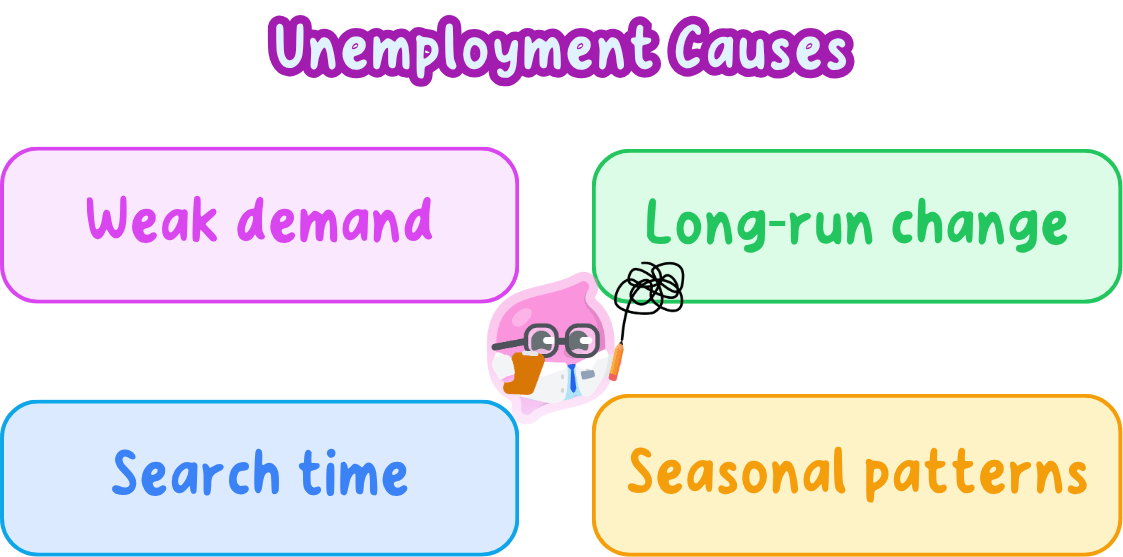
- Weak demand is the usual cause of a sudden rise, because when spending falls firms produce less and cut jobs.
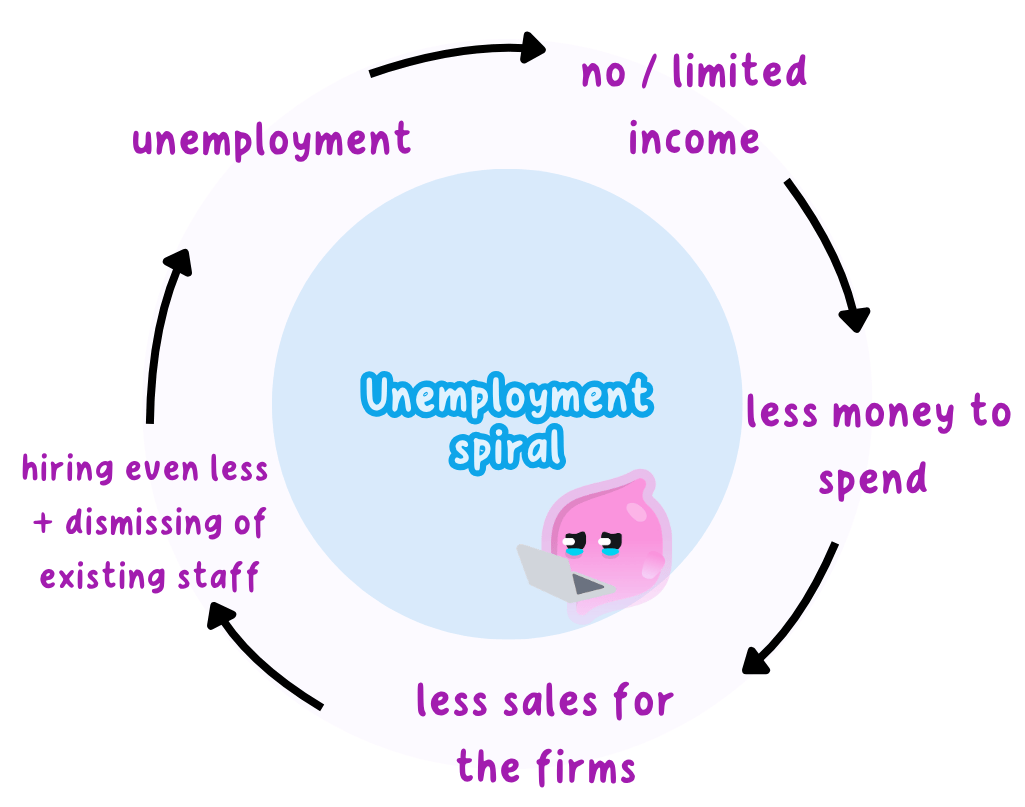
- The effect compounds, since workers who lose income spend less and cost other firms their sales as well.
- Long-run change causes a slower and more stubborn rise, as technology, trade and the decline of industries leave skills in the wrong place.
- Search time puts a floor under the figure, because at any moment some people are between jobs however healthy the economy is.
- Seasonal patterns move the figure within the year without saying anything about the state of the economy.
Common Mistake
- Do not put every rise in unemployment down to a recession, because a rise concentrated in one industry usually has a structural cause.
- Do not read a seasonal rise as a weakening economy, since the same rise happens every year.
Individuals lose income, skills and health
Definition
Long-term unemployment: unemployment that has lasted more than twelve months, after which the damage to a person's skills and chances of being hired grows sharply.
- The immediate loss is income, so living standards fall at once and longer spells bring debt and poverty.
- Skills fade while someone is out of work, and employers read a long gap as a reason to hire somebody else, so the longer it lasts the harder it becomes.
- Unemployment also damages physical and mental health and confidence, which feeds back into the chance of being hired.
- The loss is not only the individual's, because the output that person would have produced is never produced at all.
Example
- A worker made redundant can fall behind on rent and bills within weeks, because outgoings do not pause when income stops.
- After a year out of work the same person faces employers who see the gap before they see the experience.
Regions can lose their main employer
- Unemployment is rarely spread evenly, so a national rate of 4.9% can sit alongside a far higher rate in one town.
- When an area's main employer closes, local shops and suppliers lose their customers too, so the job losses multiply through the local economy.
- The skills that made the region prosperous are often the hardest to use anywhere else, which is why unemployment there lasts.
- The people who can move away tend to be the younger and better qualified, which leaves the area weaker still.
Case study
- One estimate put the cost of the Port Talbot steel closure to the town at around £200 million of earnings a year, close to 15% of its gross earnings.
- A year on, by September 2025, support schemes had placed 332 people into new jobs and helped create 22 new firms.
- Set against thousands of lost jobs, that shows how little of a regional shock is repaired quickly.
- The national unemployment rate barely moved, which is exactly why regional figures have to be asked for separately.
The government pays twice over
- Spending rises, because more people claim out-of-work support, and the Claimant Count is the direct measure of that bill.
- Revenue falls at the same time, since fewer people pay income tax and national insurance and they spend less, so receipts from taxes on spending drop too.
- Both moving together pushes the government's budget towards deficit, which narrows what it can afford to do elsewhere.
- The wider loss is the output those workers would have produced, which no later policy can recover.
Common Mistake
Do not treat unemployment as a cost only to the person without work, because taxpayers, firms, regions and the whole economy carry part of it.
How serious the unemployment is depends
- It depends on how long it lasts, because a few weeks between jobs costs almost nothing while a year out of work damages skills, health and future earnings.
- It depends on which type it is, because cyclical unemployment fades with the recovery while structural unemployment can outlast a generation of workers.
- It depends on how concentrated it is, because the same number of job losses spread thinly across a country does far less damage than the same number in one town.
- It depends on who is affected, because young people entering the labour market and older workers with narrow skills both carry lasting costs from one spell out of work.
- It depends on what support exists, because benefits, retraining and help with job search all change how much of the cost the individual ends up bearing.
- Overall: short spells of frictional unemployment are close to harmless and are the price of a labour market where people can change jobs, but long-term structural unemployment concentrated in one region is the most damaging case, because it hits individuals hardest, drains the region and costs the government most, all at the same time.
Exam technique
- A cause and a consequence are different questions, so check which one is being asked for: weak demand is a cause, while lost tax revenue is a consequence.
- Duration is the strongest line of argument on this topic, because almost every cost of unemployment grows with the length of the spell rather than the size of the figure.
Self review
- Give one cause of cyclical unemployment and one cause of structural unemployment.
- Explain how unemployment affects the government's budget.
- Why is long-term unemployment more damaging than a short spell?
- Why does unemployment in one town spread beyond the workers who lost their jobs?
- Which factor most affects how serious a given rise in unemployment is?
