Scarcity forces every economy to choose
Definition
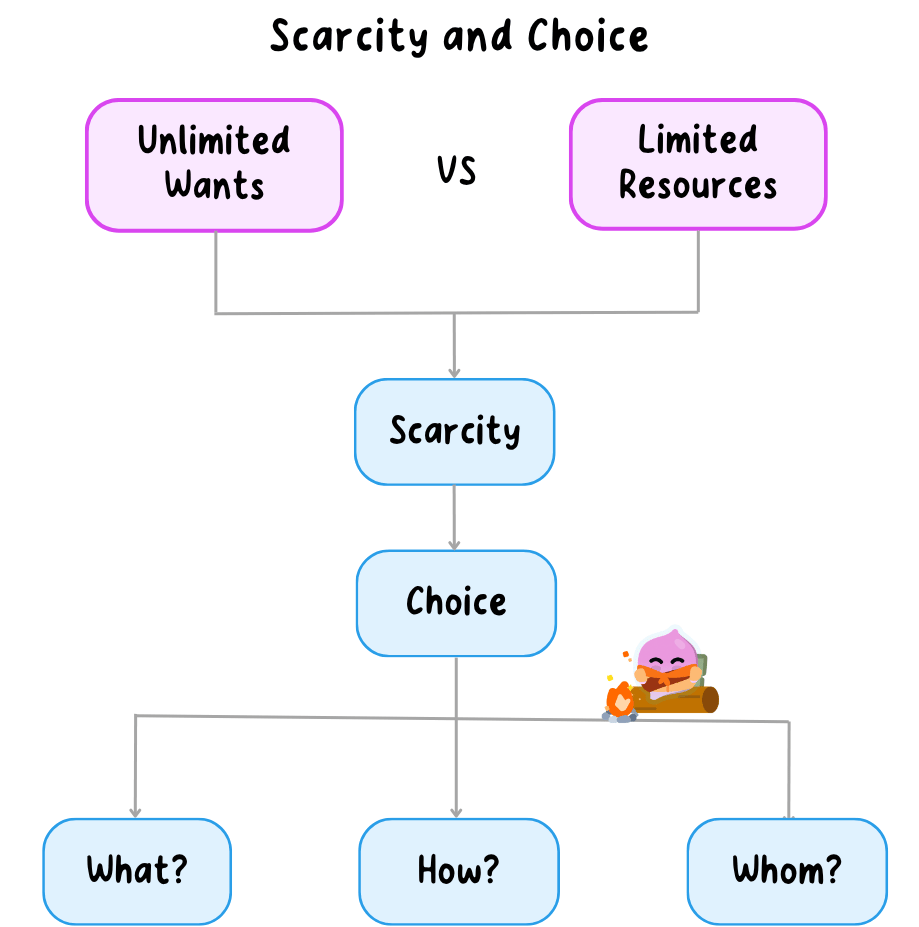
The economic problem: because resources are scarce and wants are unlimited, every economy has to decide which wants are met and which are left unmet.
- Scarce resources and unlimited wants, set out in 1.2.1, are the two halves of the problem.
- Since the two never match, somebody has to choose, and that need to choose is what the economic problem actually is.
- It applies at every level, from a shopper with £10 in a canteen to the whole of a government Budget.
- The problem never goes away, because even the richest economy cannot produce everything its people want at once.
Common Mistake
- Scarcity is the condition that resources are finite.
- The economic problem is the need to choose that scarcity creates.
Allocating resources answers three questions
Definition
Allocation of resources: deciding which uses the scarce factors of production are put to, and so which goods and services get made and who receives them.
- What to produce: which goods and services to make and in what quantities, since making more of one thing means making less of another.
- For whom to produce: how the output is shared out among different people and groups, which usually follows who can afford to pay for it.
- How to produce: which method to use, such as more labour or more machinery.
- No economy can dodge any of the three, because choosing not to decide still leaves resources allocated some way.
- Answering them badly is costly, since resources put into goods people do not want are resources unavailable for the goods they do want.
Common Mistake
- How to produce is the method, labour against machines, not which goods to make.
- For whom to produce is who receives the output, not who pays for the raw materials.
A UK housebuilder answers all three
- What to produce: whether to build one-bedroom flats or four-bedroom family houses on the plot it owns.
- For whom to produce: whether the homes go to private buyers at full price or to the council as affordable housing.
- How to produce: whether to use bricklayers building on site or timber frames made in a factory and craned into place.
- Each answer commits scarce factors of production, because the plot, the bricklayers and the crane cannot be used twice.
- Every producer answers the same three questions, and an economy is simply the sum of all those answers.
Example
- A school canteen with a fixed budget faces the identical three decisions.
- It picks which dishes to cook, who gets served first at lunch, and whether to use ready meals or cook from scratch.
- The scale changes but the questions do not, and the canteen has no more choice about answering them than the government does.
Consumers, producers and government all answer them
- In the UK most of the answers come from consumers and producers, since what people choose to buy and what firms choose to make settles what gets produced.
- The government answers some of them directly, deciding what the NHS and state schools provide and who receives it.
- Neither route escapes the three questions, because the resources are scarce whichever way the answers are reached.
How prices actually answer these three questions in a market is taken further in 2.4.5.
Self review
- What is the economic problem?
- What is the difference between scarcity and the economic problem?
- What are the three questions of resource allocation?
- What does the how to produce question actually decide?
- Who answers the three questions in the UK?
