Wants are unlimited but resources are not
Definition
Scarce resources: the factors of production available to an economy are limited in supply at any one time, so only a limited amount can be produced with them.
Unlimited wants: the desires people have for goods and services have no end point, because satisfying one want tends to create the next.
- The resources an economy has are the land, labour, capital and enterprise set out in 1.1.2.
- Each of them is finite, because there is only so much farmland, only so many trained nurses and only so many hours in a working day.
- Wants keep growing, because buying a phone soon creates wants for a case, apps and the next model.
- Higher incomes expand wants rather than use them up, so even the richest households still want things they cannot all have.
Example
- The NHS has a fixed budget each year but an almost endless list of treatments it could fund.
- It cannot pay for every drug, nurse and hospital that patients might want.
- Its resources are scarce even though the sums involved are enormous.
Scarcity is permanent, a shortage is temporary
- Putting limited resources against unlimited wants gives scarcity, the gap between what people want and what can actually be produced.
- Scarcity exists in rich and poor countries alike, because no economy anywhere has enough resources to satisfy every want.
- Scarcity is the starting point of the whole subject, because it is what forces every decision maker to choose.
Common Mistake
- A shortage is temporary and happens when buyers want more of a good than sellers are offering at the current price.
- Scarcity is permanent, because resources are always limited against wants that never stop growing.
- Petrol can be scarce and still be sitting on every forecourt, since scarce means limited rather than unavailable.
A need is essential, a want is not
Definition
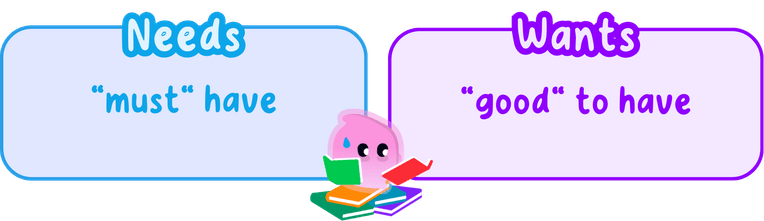
Need: a good or service that is essential for survival, such as food, clean water, shelter, warmth and basic clothing.
Want: a desire for a good or service that is not essential for survival, such as a holiday, a games console or a Greggs sausage roll.
- Everyone shares the same short list of needs, but wants vary widely with taste, income and advertising.
- One need can be met in many ways, and the choice between them is usually a want, since you need to eat but you want a takeaway rather than plain rice.
- When money is tight, households cut wants before needs, which is why UK households kept paying to heat their homes through the energy price rises of 2022 and the high bills that followed in 2023, while cutting takeaways and streaming subscriptions.
Common Mistake
- Calling something a need does not make it one, so test whether survival really depends on it.
- Saying you need the newest phone describes a strong want, not a need.
Scarcity affects every decision maker
- Consumers face scarcity because their income is limited while the things they would like to buy are not.
- Workers face scarcity because they have a limited number of hours and must choose how to use them.
- Producers face scarcity because they have limited money, materials and staff to make their products with.
- The government faces scarcity because tax revenue is limited while the demands for spending on health, education and defence are enormous.
Because scarcity forces a choice, every choice has a cost, which is the subject of 1.2.3.
Self review
- What is meant by scarce resources?
- Why are human wants described as unlimited?
- What is the difference between scarcity and a shortage?
- What is the difference between a need and a want?
- Give one example of how the government faces scarcity.
