Only the next best alternative counts
Definition
Opportunity cost: the next best alternative given up when a choice is made.
- Opportunity cost comes straight from scarcity, because using money, time or materials one way rules out every other use of them at that moment.
- To find it, list the options that were realistically available, rank them, then name the one at the top of the rejected list.
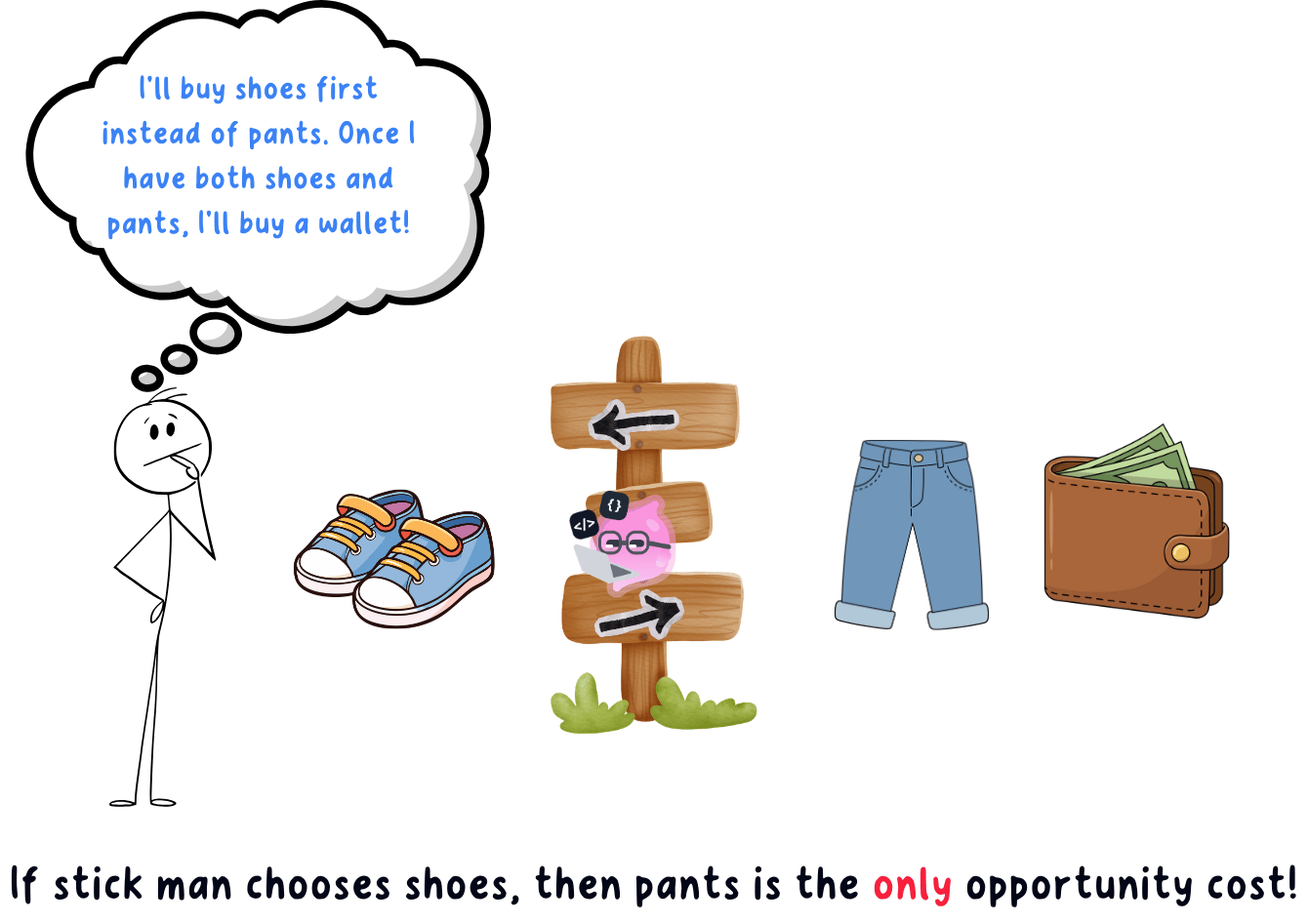
- Only that single option counts, however many others were turned down, because the chooser could have taken just one of them instead.
- Judging a choice by what it displaces is why economists call every choice a trade-off.
Example
- You have £8 and a single lunch break, and three things you could do with it.
- Ranked, they are the meal deal you want most, then a paperback, then topping up your bus card.
- You buy the meal deal, so the opportunity cost is the paperback and nothing else.
- The bus card never counts, because you would not have chosen it even without the meal deal.
All three economic groups face it
- A consumer who spends £45 on trainers gives up the concert ticket that was the next best use of that £45.
- A producer whose ovens run sourdough all morning gives up the sausage rolls those same ovens could have baked.
- The government that puts an extra £1 billion into the NHS gives up the next best public use of that money, such as new school buildings.
- Government choices show the idea most sharply, because a Budget fixes the total before any of it is allocated.
Common Mistake
- The price on the receipt is not the opportunity cost.
- The £45 spent on trainers is the money cost, and the concert ticket it would have bought is the opportunity cost.
Opportunity cost is not always a money cost
- Time is scarce too, so an hour spent one way carries an opportunity cost even when nothing is bought or sold.
- A worker who takes a Saturday shift gives up whatever they would otherwise have done with the day, which may be revision rather than money.
- Land and equipment can each do only one job at a time, so a farmer who sows a field with wheat gives up the barley it could have grown that season.
- Where the sacrifice carries no price tag, say what the resource would otherwise have produced.
A free good is the one exception
Definition
Free good: a good that is not scarce, so using it leaves nobody else with less and carries no opportunity cost.
Economic good: a good that is scarce, so producing or consuming it uses resources that could have been used for something else.
- Air is the standard example of a free good, because breathing it takes nothing away from anybody else.
- Almost everything else in this course is an economic good, which is why almost every choice carries an opportunity cost.
- This gives a quick test of understanding, since a choice that really costs nothing means the resource was not scarce in the first place.
Exam technique
- Write the next best alternative given up, because next best is the part most often missing from an answer.
- Never list two or three sacrificed options, since only the single highest ranked one counts.
- Where time or land is given up rather than cash, name the alternative use rather than the spending.
Self review
- Define opportunity cost in one sentence.
- If four options are rejected, how many count as the opportunity cost?
- State the opportunity cost of spending £1 billion more on the NHS.
- Give one opportunity cost that does not involve money.
- Why does a free good have no opportunity cost?
